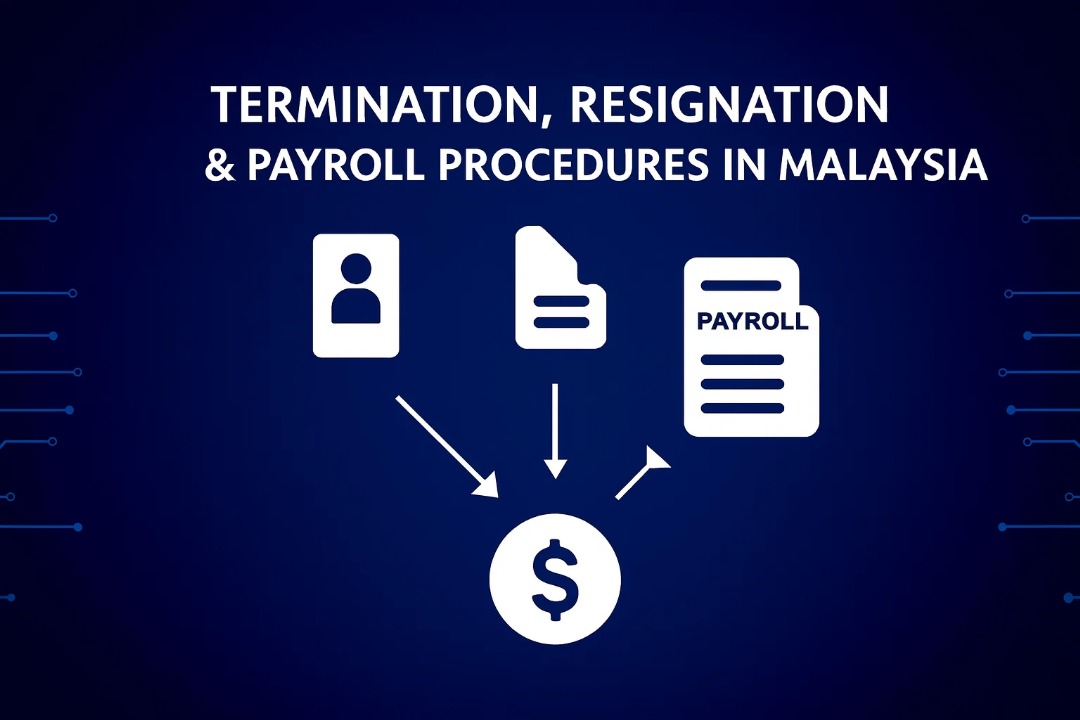
Termination, Resignation & Payroll Procedures in Malaysia (2025 Update)
Employee exits can be complex, especially with Malaysia’s updated Employment Act and stricter compliance requirements. This guide helps employers and HR professionals navigate termination, resignation, and final payroll processes with confidence—ensuring legal accuracy, fair treatment, and proper documentation every step of the way.
Introduction
Navigating employee exits—whether through termination or resignation—can be tricky for employers and HR professionals. In Malaysia, staying compliant means understanding the Employment Act 1955, its latest amendments, and additional regulations from the Industrial Relations Act 1967 and Income Tax Act 1967. This guide will help you manage terminations, resignations, and payroll with confidence and legal accuracy.

Overview of Malaysia’s Employment Framework
The Employment Act 1955 governs most aspects of labor relations in Malaysia. As of the 2025 update, it applies to all employees regardless of wages, expanding its coverage to previously excluded management-level roles.
Key Legal Updates in 2025:
- Broader coverage of employee protections
- Increased emphasis on fair dismissal procedures
- Digital submission of tax clearance and termination forms
- Enhanced penalty clauses for employer non-compliance
These updates ensure employees are treated fairly during their tenure and upon exit, while employers are expected to maintain accurate documentation and timely payroll processing.
Termination of Employment Contracts
Termination of Employment Contracts
| SERVICE DURATION | NOTICE PERIOD |
|---|---|
| Less than 2 years | 4 weeks |
| 2–5 years | 6 weeks |
| More than 5 years | 8 weeks |
Employers may provide salary in lieu of notice, allowing for immediate termination while compensating the employee.
Termination Without Notice (Dismissal)
If an employee commits serious misconduct, an employer may dismiss them without notice. However, this must be executed fairly and lawfully.
Key Steps:
- Conduct a Domestic Inquiry (DI)
- Present allegations to the employee
- Allow them to respond
- Document all actions and findings
Non-compliance may lead to wrongful dismissal claims under Section 20 of the Industrial Relations Act 1967. The Industrial Court often sides with employees when procedural fairness is not upheld.
Retrenchment and Layoff
Retrenchment is permitted under circumstances like restructuring, automation, or financial strain.
Employer Duties:
- Submit PK Form to the Labour Department 30 days before retrenchment
- Follow the Code of Conduct for Industrial Harmony
- Provide retrenchment benefits under the Employment (Termination and Lay-Off Benefits) Regulations 1980:
| SERVICE LENGTH | BENEFIT PER YEAR |
|---|---|
| Less than 2 years | 10 days' wages |
| 2–5 years | 15 days' wages |
| More than 5 years | 20 days' wages |
Employee Resignation Procedures
Serving Resignation Notice
Employees are required to give notice as per their employment contract. If no period is stated, the statutory periods mentioned earlier apply. They may also pay in lieu of notice.
Writing a Resignation Letter
A resignation letter is an important part of documentation. It should include:
- The date the notice is given
- Final working day
- (Optional) Reason for resignation and words of appreciation
Exit Process & Clearance
Smooth offboarding ensures continuity and reduces legal risks.
Recommended Steps:
- Complete all handover tasks
- Return company equipment (e.g., laptops, access cards)
- Conduct an exit interview (optional)
- Complete HR clearance forms
Payroll Procedures for Exiting Employees
Final Salary Computation
As per Sections 20 and 22 of the Employment Act:
| EXIT TYPE | FINAL SALARY DUE DATE |
|---|---|
| With notice | On the last working date |
| Without notice | Within 3 calendar days |
Final Salary Must Include:
- Unpaid basic salary
- Encashment of unused annual leave
- Outstanding overtime, bonuses, or allowances
- Payment in lieu of notice (if applicable)
Mode of Salary Payment
Section 25 mandates all wages must be deposited into:
- Employee's personal bank account
- A joint account (with written consent)
Payment by cash or cheque is only allowed with written approval from the Director General of Labour.
Payslip and Contribution Obligations
Employers must issue a detailed payslip for the final wage period. Statutory contributions that must be deducted and submitted:
Recommended Steps:
- EPF (Employees Provident Fund)
- SOCSO (Social Security Organisation)
- EIS (Employment Insurance System)
- PCB (Monthly Tax Deduction)
Tax Clearance (Form CP22A)
- If the employee is:
- Retiring
- Leaving Malaysia
- Terminated from a taxable position
- The employer must:
- Submit Form CP22A to LHDN at least 30 days before cessation
- Withhold final salary until tax clearance is obtained
Payroll Procedures for Exiting Employees
| REQUIREMENT | ACTION / DEADLINE |
|---|---|
| Termination/Resignation Notice | As per contract or Employment Act |
| Final Salary Payment | Last day or within 3 days (no notice) |
| Payslip Issuance | With final pay |
| Statutory Contributions | Submit per monthly schedule |
| Tax Clearance (Form CP22A) | 30 days prior to final day (if applicable) |
| Retrenchment Notification | Submit PK Form 30 days in advance |
Tools for Automation and Compliance
Manual HR and payroll processes are vulnerable to human error and compliance risk. Systems like AutoCount Payroll automate:
- Final salary calculation
- EPF/SOCSO/PCB deductions
- Leave encashment
- Form CP22A generation
- Payslip generation
Common Mistakes to Avoid
These mistakes can lead to legal disputes, financial penalties, or reputational damage.
- Skipping Domestic Inquiry before dismissal
- Miscalculating retrenchment benefits
- Failing to submit CP22A on time
- Withholding salary without legal basis
Legal Ramifications of Non-Compliance
Employers may face:
- Fines and imprisonment under Employment Act
- Unfair dismissal lawsuits
- Claims in the Industrial Court
Case Example: A company was ordered to reinstate a dismissed employee due to failure to conduct a fair inquiry.
Tools for Automation and Compliance
Manual HR and payroll processes are vulnerable to human error and compliance risk. Systems like AutoCount Payroll automate:
- Plan knowledge transfer sessions
- Encourage candid exit interviews
- Send a formal farewell note to preserve goodwill
- Maintain exit documents for at least 7 years
Conclusion
Managing employee terminations and resignations in Malaysia involves understanding legal obligations, honoring timelines, and calculating payments accurately. With 2025’s updates, compliance has become even more important.
- Use automation tools
- Document all processes
- Respect employee rights
- Seek legal advice when in doubt

By following this guide, your organization can maintain a fair, compliant, and efficient offboarding process.
Want to simplify your business finances?
AutoCount Payroll automates wage classification, statutory deductions, and compliance with ease, saving you time and reducing errors.