Top 10 Powerful Employee Protections Under Malaysia’s Employment Act 1955: Ultimate 2025 Guide
Discover the key protections of Malaysia’s Employment Act 1955. Learn how the law safeguards employees’ rights, from working hours to maternity leave, and ensures fair treatment for all workers, regardless of wage.
Introduction to the Employment Act 1955
Malaysia’s Employment Act 1955 (EA 1955) stands as the central pillar of labor protection in Peninsular Malaysia and the Federal Territory of Labuan. Enacted to ensure fairness and minimum standards at the workplace, this legislation has evolved over the years—most notably with major amendments that took effect on January 1, 2023. These changes have widened its scope, offering stronger security for both employees and employers by clearly defining rights and obligations.
Understanding the Employment Act 1955 is crucial, whether you are an HR manager, small business owner, or an employee wanting to safeguard your rights. This guide provides a detailed yet accessible breakdown of who is covered, the special categories protected, and the powerful safeguards enshrined in law.

Who Is Covered Under Malaysia’s Employment Act 1955?
The EA 1955 now covers all employees in Peninsular Malaysia and Labuan who are working under a contract of service—regardless of how much they earn. This shift, brought by the 2023 amendments, eliminates confusion about wage thresholds and extends protection to a wider workforce.
-
Definition of Contract of Service:
A contract of service means an agreement, whether oral or written, where one person agrees to employ another as a worker and the other agrees to serve as an employee. This includes full-time, part-time, and even probationary employees. -
Applicability by Wage:
Prior to 2023, protections under the Act were limited by salary. Now, nearly all employees (except certain categories) enjoy baseline rights—setting a clear standard for fair treatment. -
Coverage Expansion:
This means executives, junior staff, and even those with higher salaries benefit from the Act’s minimum requirements unless otherwise specified.
Key Exclusions and Exceptions
While the Employment Act 1955 casts a wide net, there are notable exceptions:
- Employees earning above RM4,000 per month are exempt from certain provisions, unless they fall within specified categories (covered later).
- Exempted Provisions for High Earners:
Overtime pay (Section 60A(3))
Rest day pay (Section 60(3))
Shift allowances (Section 60C(2A))
Public holiday pay (Section 60D(3)&(4))
Termination, lay-off, and retirement benefits (Section 60J)
- Not Covered:
Employees in Sabah & Sarawak (governed by state ordinances)
Independent contractors & freelancers
Government (public sector) employees
Special Categories Fully Covered (Regardless of Wages)
One of the most powerful features of the EA 1955 is its full coverage for certain job categories, even if they earn more than RM4,000 per month. These roles are explicitly listed to ensure core sectors and vulnerable workers always receive baseline protections.
Why this matters:
These categories are listed in Paragraph 2 of the First Schedule of the EA 1955, ensuring that even highly paid staff in these roles must receive overtime pay, leave entitlements, termination benefits, and other protections—closing common loopholes.
- Manual Labor Workers
Manual laborers are protected regardless of wage.
Examples include:
- Construction workers (site laborers, builders)
- Factory/production line staff
- Warehouse packers & loaders
- Cleaners & Janitors
- Landscapers & Gardeners
- General maintenance crews
- Supervisors of Manual Labor
Supervisors who manage or direct manual labor are also fully covered, such as:
- Construction site supervisors
- Production team leaders
- Factory shift supervisors
- Workshop foremen
- Operators/Maintainers of Mechanically Propelled Vehicles
Employees whose main duties involve operating or maintaining vehicles and machinery benefit from full protections:
- Truck, bus or lorry drivers
- Delivery drivers using company vehicles
- Train & tram operators
- Forklift, crane & heavy machinery operators
- Vehicle & fleet mechanics
- Domestic Servants & Household Employees
Domestic servants are often at risk of abuse or exploitation, making this full protection vital. Examples:
- Housemaid (live-in or live-out)
- Private household cooks
- Gardeners (serving only a single household)
- Nannies & Childminders
- Older people caregivers
Employees Not Covered by the Employment Act 1955
Not all workers in Malaysia fall under the EA 1955:
- Sabah and Sarawak Employees: Governed by state-specific labor ordinances.
- Public Sector Employees: Protected by the Public Service Commission and separate laws.
- Independent Contractors/Freelancers: Only those with a formal contract of service are included.
Understanding these distinctions helps avoid confusion and ensures workers know which rights and protections they can legally claim.
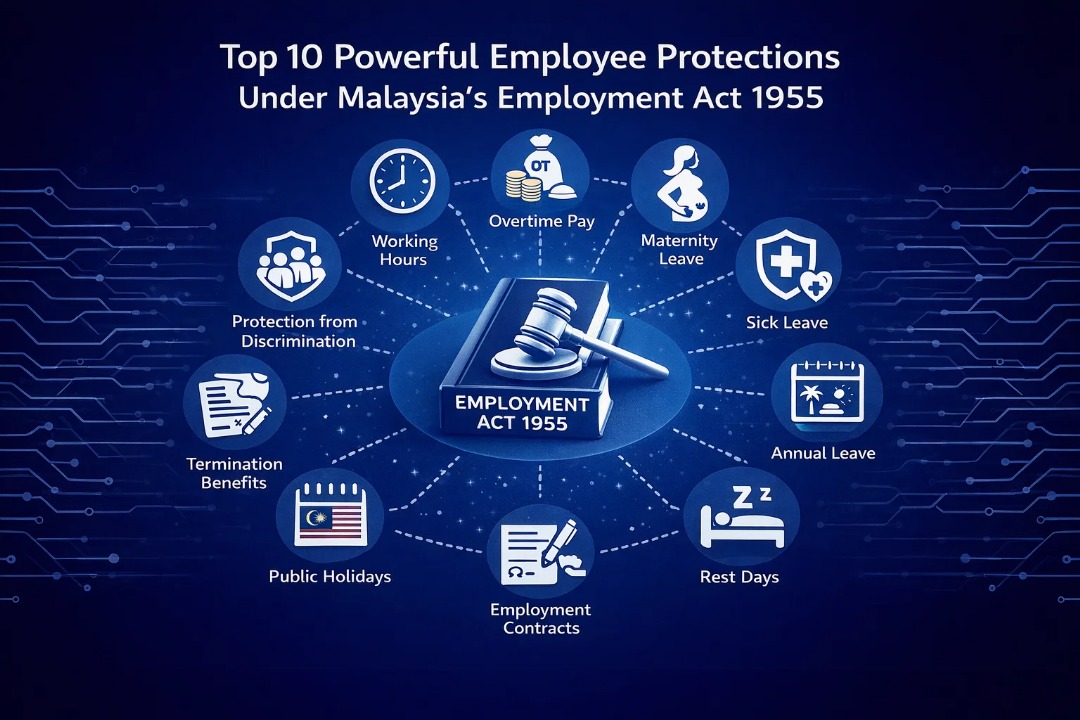
10 Key Protections Under Malaysia’s Employment Act 1955
The EA 1955 grants powerful rights to employees—forming the backbone of fair labor practices in Malaysia.
- Maximum Working Hours & Overtime Pay
Employees are protected from overwork with a maximum of 45 hours per week. Overtime pay is mandatory for hours worked beyond this limit—usually at 1.5 times the hourly rate.
Tip: Even supervisors or vehicle operators get overtime, no matter their salary!
- Rest Days & Public Holiday Entitlements
All employees must receive at least one rest day per week. Work on public holidays entitles them to extra compensation, ensuring they’re not exploited during national celebrations.
- Paid Annual Leave & Sick Leave
Depending on their length of service, employees are entitled to annual leave (from 8 to 16 days) and sick leave (14 to 22 days). Hospitalization grants up to 60 days’ sick leave per year.
- Maternity & Paternity Leave
Malaysia’s EA 1955 is forward-thinking on family support, granting:
- Maternity Leave: 98 days fully paid
- Paternity Leave: 7 days for married male employees
This applies regardless of the employee’s wage or job title.
- Protection Against Unfair Dismissal
The Act enshrines the right to fair dismissal. Employees cannot be terminated without just cause and are entitled to due process, with recourse to the Industrial Court if necessary.
- Right to Flexible Working Arrangements
Recent amendments give employees the right to request flexible work arrangements—including remote work, changes in hours, or compressed workweeks. Employers must respond in writing with reasons for refusal if they deny the request.
Employer Obligations & Compliance
Employers must:
- Review and align contracts with the EA 1955
- Maintain accurate payroll and attendance records
- Display the Act in a prominent place
- Face fines or prosecution for non-compliance
Pro tip: Routine HR training on the Act reduces risks and improves employee satisfaction.
Employee Rights and How to Enforce Them
Employees who feel their rights are violated can:
File a complaint at the nearest Labor Department office.
Seek advice from trade unions or legal aid services.
Pursue claims through the Industrial Court.
Keeping personal copies of employment contracts, payslips, and medical certificates is crucial for building a strong case.
Real-Life Case Studies: Employment Act in Action
Overtime Dispute
A factory worker was denied overtime despite working 60 hours a week. After filing a complaint, the Labor Department investigated and ordered the employer to pay back wages plus interest.
Dismissal Without Cause
A delivery driver was fired without notice. The Industrial Court ruled the dismissal unjust, awarding compensation and ordering reinstatement.
Maternity Leave Violation
A domestic servant was dismissed after requesting maternity leave. The court ruled in her favor, highlighting the Act’s protection for all wage levels.
Common Myths and Misconceptions About the Employment Act
| Myth | Fact |
|---|---|
| Only low-wage earners are protected. | Many high earners are also covered. |
| Freelancers can claim annual leave. | Only formal employees are entitled. |
| Employers can deny rest days to supervisors. | All covered employees must have a rest day. |
Practical Tips
- Regularly review employment contracts for compliance.
- Train HR and payroll on changes in the law.
- Address grievances promptly to avoid disputes.
- Learn your specific category and entitlements.
- Document working hours, leave, and communications.
- Don’t hesitate to seek external help if rights are breached.
Conclusion
Malaysia’s Employment Act 1955 delivers robust protection for a wide range of employees—regardless of wage or sector (with few exceptions). Both employers and employees should stay informed, ensure compliance, and seek help if needed. As the workforce evolves, so does the law, making continuous learning essential.
Want to simplify your business finances?
AutoCount Payroll automates wage classification, statutory deductions, and compliance with ease, saving you time and reducing errors.