Understanding Payroll Deductions in Malaysia: Types, Rules, and Compliance [2025 Guide]
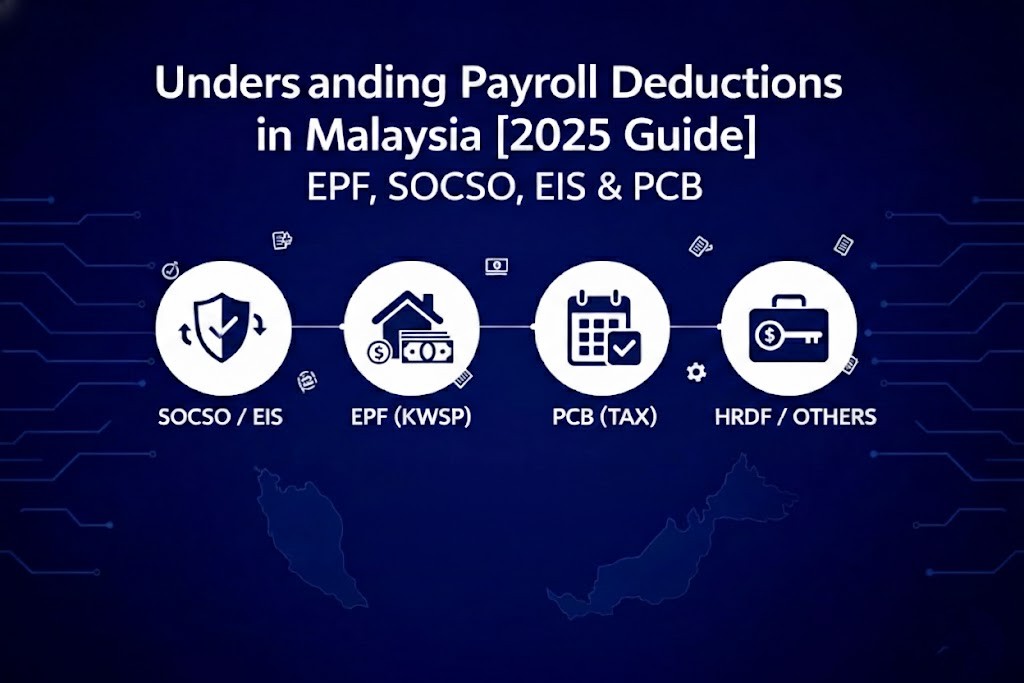
In 2025, mandatory payroll deductions for Malaysian employees include contributions to the Employees Provident Fund (EPF), Social Security Organization (SOCSO), the Employment Insurance System (EIS), and Monthly Tax Deductions (PCB).
Introduction: Understanding Payroll Deductions in Malaysia
Payroll deductions are a fundamental part of workforce management, ensuring legal obligations are met while maintaining employee satisfaction and trust. In Malaysia, payroll deductions are governed by the Employment Act 1955, which outlines the specific types of permissible deductions and the conditions that must be met to enforce them.
Understanding payroll deductions in Malaysia not only helps employers stay compliant with local labor laws but also protects employees from unauthorized wage reductions. This article provides a detailed overview of deduction types, salary advance rules, statutory contributions, and best practices for compliance.

Types of Payroll Deductions in Malaysia
Payroll deductions refer to amounts that are deducted from an employee’s salary to fulfill statutory obligations or other agreements. There are two main categories: mandatory deductions and voluntary deductions. Below are the key types:
Employees Provident Fund (EPF)
A mandatory retirement savings plan where both employers and employees contribute a portion of the salary.
SOCSO (Social Security Organization)
Provides benefits for employees in case of injury, disability, or death while in employment.
Employment Insurance Scheme (EIS)
Covers unemployment benefits for workers who lose their jobs.
Potongan Cukai Berjadual (PCB)
A system for regular income tax deductions, designed to avoid a large tax bill at the end of the year.
Loan Repayments
Any salary deductions for loans or financial advances provided by the employer.
Union Fees
Deductions made for union memberships or other voluntary employee deductions.
Rules for Payroll Deductions
The Employment Act 1955 and other related laws govern payroll deductions in Malaysia. Employers must adhere to the regulations to avoid penalties. The key rules are:
Mandatory Deductions: EPF, SOCSO, and EIS deductions are compulsory for employees with qualifying salaries.
- Employee Consent: For voluntary deductions (e.g., loans, union fees), written consent from the employee must be obtained.
- Clear Payslips: Employers must issue payslips that clearly show all deductions, ensuring transparency.
- Tax Deductions: PCB tax deductions must be made as per the employee’s income tax rate and tax reliefs.
- Contribution Adjustments: Ensure that EPF and SOCSO contribution rates are adjusted according to the employee’s salary and government updates.

Payroll Compliance for 2025
Updated Contribution Rates
New EPF and SOCSO rates may be announced. Employers need to stay updated and adjust contributions accordingly.
Tax Rate Adjustments
Ensure that PCB (income tax) is correctly deducted as per the new tax brackets set by the government.
Automation Tools
Using payroll software like **AutoCount Payroll** can help automate deductions and ensure compliance with the latest laws.
EPF and SOCSO Compliance
Accurate calculations for EPF and SOCSO must be reported to the relevant authorities.
Common Payroll Deduction Mistakes
Even the most well-meaning employers can make errors in payroll deductions. Avoid these common mistakes to stay compliant:
- Incorrect Deduction Amounts: Failing to calculate EPF, SOCSO, and tax deductions accurately.
- Missing Updates on Contribution Rates: Not updating deduction rates according to new government announcements.
- Lack of Transparency: Not providing employees with clear payslips showing deductions, leading to confusion or disputes.
- Failure to Comply with Tax Deductions: Improper or incomplete tax deductions for employees under the PCB system.
- Delays in Statutory Submissions: Late submissions of EPF or SOCSO contributions can result in fines and penalties.
Frequently Asked Questions
What are the types of payroll deductions in Malaysia?
The main types of payroll deductions in Malaysia are EPF, SOCSO, EIS, PCB, and voluntary deductions like loan repayments and union fees.
How are EPF and SOCSO contributions calculated?
EPF and SOCSO contributions are calculated based on an employee’s monthly salary, with specific rates determined by the Malaysian government. For example, EPF contributions are typically a percentage of the salary, and SOCSO has different rates based on the salary bracket.
Do I need to update payroll deductions for 2025?
Yes, payroll deductions such as EPF, SOCSO, and PCB must be updated for any changes in the contribution rates or tax brackets that may occur in 2025.
How can AutoCount Payroll help with compliance?
AutoCount Payroll automates statutory deductions, generates detailed payslips, and ensures that all payroll calculations are in line with the latest legal requirements, including updates for 2025.
Can customers insist on an e-Invoice for a refundable deposit on collection?
They can request documentation, but an e-Invoice is typically not issued until application/forfeiture. Provide a receipt or pro-forma.
Mastering Payroll Deductions in Malaysia: The Complete 2025 Guide
Stay compliant with the latest 2025 statutory updates. Learn everything you need to know about EPF, SOCSO, EIS. Let learn more about AutoCount Cloud Payroll.