Bookkeeping vs Accounting: Key Differences and Why It Matters for Your Business
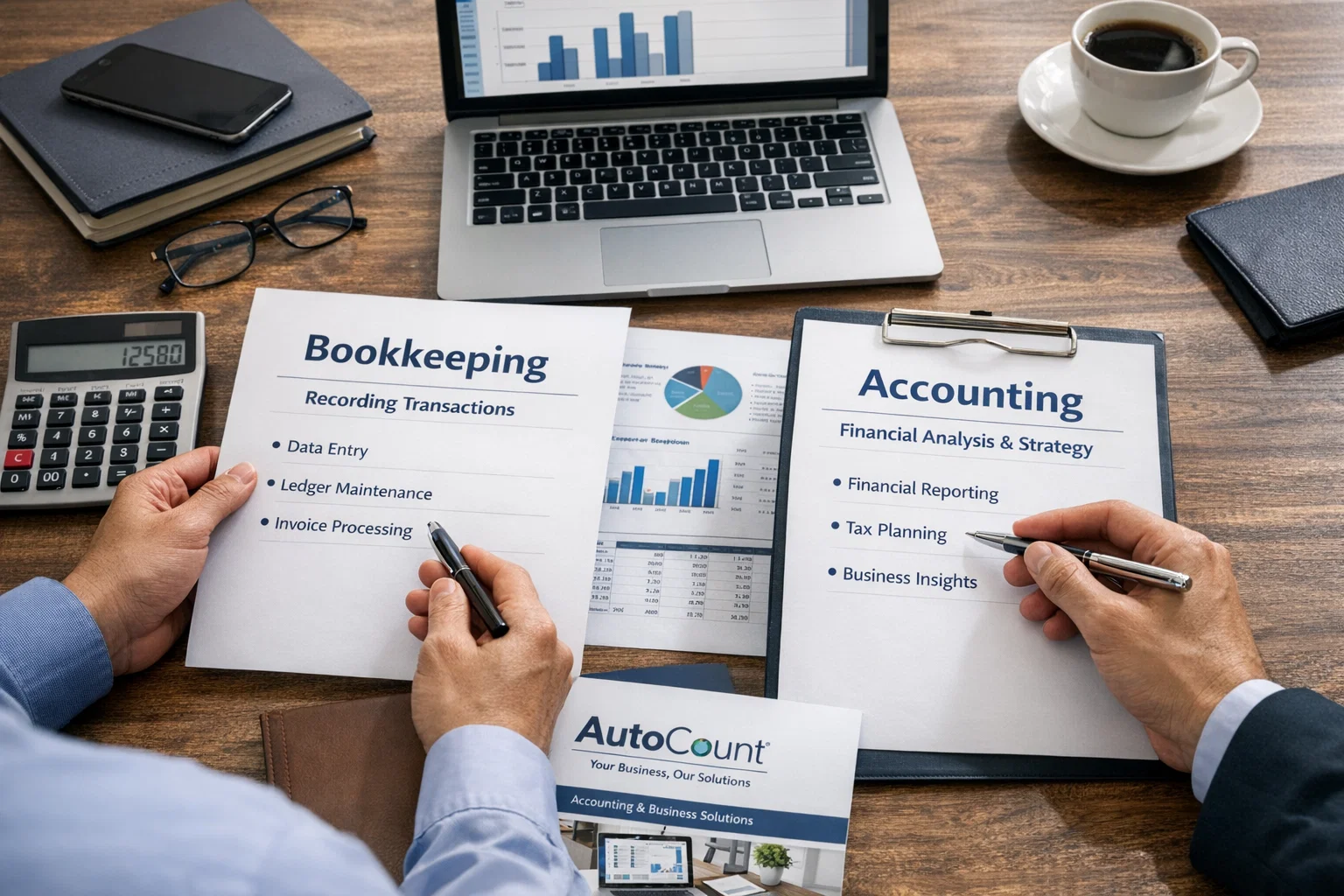
Bookkeeping vs Accounting focuses on the key differences between recording daily financial transactions and analyzing financial data for decision-making. While bookkeeping ensures accurate records, accounting interprets this information to support planning, compliance, and business growth. Understanding both helps businesses maintain financial accuracy and make informed strategic decisions.
Many owners use “bookkeeping” and “accounting” interchangeably. They’re related—but not the same. Bookkeeping records the numbers; accounting explains what those numbers mean and what to do next. Together, they power clean books, tax compliance, and better business decisions.
Whether you’re a startup owner, SME manager, or finance executive in Malaysia, grasping the distinction between bookkeeping vs. accounting can help you choose the right tools, like AutoCount, to support your operations and improve your financial management.
Quick takeaway: Bookkeeping is the foundation. Accounting is the insight.
What Is Bookkeeping?
Bookkeeping is the accurate, day-to-day recording of financial transactions. It keeps your ledgers current so monthly closing and tax filings are smooth.
Tax computations, provisioning, and liaison with tax agents
Internal controls and policy recommendations
Management insights: pricing, break-even, and KPI dashboards
Good to know: In smaller businesses, one person may wear both hats—but the skillsets and outputs are different.
Bookkeeping vs Accounting: Side-by-Side
They’re complementary. Without reliable bookkeeping, accounting insights are delayed or inaccurate.
Aspect
Bookkeeping
Accounting
Primary focus
Record transactions accurately
Analyse, interpret, and advise
Time horizon
Daily/weekly
Monthly/quarterly/annually
Typical outputs
Ledgers, reconciliations, AR/AP aging
Financial statements, budgets, KPIs
Skills
Detail-oriented, consistent, software proficiency
Analytical, standards knowledge, communication
Who does it?
Bookkeeper or junior accounts exec
Accountant, finance manager, CFO
Business value
Accurate records & audit trail
Decision-making & compliance strategy
Why This Difference Matters for Your Business
Compliance: Clean books reduce tax filing stress and penalties.
Faster decisions: Current numbers enable pricing, hiring, and purchase decisions with confidence.
Cash flow control: Know who owes you and what you owe—on time.
Funding-ready: Accurate statements improve your chances with banks and investors.
Real Malaysian SME Examples
Retail (POS + e-Commerce)
Bookkeeping records daily POS and online sales, fees, refunds, and bank payouts. Accounting analyses margins by product line and guides stock purchasing to hit target GP%.
F&B (Multiple e-wallets)
Bookkeeping reconciles e-wallet settlements and tips. Accounting tracks food cost %, wastage, and recommends menu price adjustments to maintain profitability.
Services (Project-based)
Bookkeeping tracks billable hours and invoices; accounting measures project profitability and cash collection cycle to plan hiring and marketing.
When to DIY, Hire, or Outsource ?
AutoCount is one of Malaysia’s leading accounting software solutions, trusted by over 250,000 businesses. Here’s how it helps:
DIY (very small or early-stage)
Low transaction volume
Founder comfortable with software and basic compliance
Hire a Bookkeeper
Growing volume, recurring AR/AP, multiple payment channels
Need weekly reconciliations and document control
With AutoCount, you don’t have to choose between the two. You get a comprehensive solution that supports both bookkeeping and accounting—made for Malaysian businesses.
Optimize Your Financial Strategy with AutoCount
Learn how understanding the difference can streamline your operations. Get started with AutoCount Accounting