Contract of Service vs Contract for Service in Malaysia: Complete Guide
Make the right call for your workforce: know when a hire counts as an employee or a contractor. Discover how classification affects EPF/SOCSO contributions, leave entitlements, liability and compliance — and protect your business from audits, fines or back‑dated charges.
Introduction
Understanding the fundamental distinction between a Contract of Service and a Contract for Service is critical for compliant human resource and payroll management in Malaysia. This difference, often reduced to a single word, carries profound legal, financial, and operational implications for every type of engagement, from long-term employment to project-based consultancy.
This comprehensive guide, updated with the latest amendments to the Employment Act 1955, provides a complete breakdown of employee types, statutory obligations, benefits, and the critical legal tests used to determine worker status. We’ll also explore how proper classification impacts your payroll processing and how solutions like AutoCount Payroll can help ensure compliance.
Key Statutory Updates (2022-2024)
Employment Act 1955 now covers all employees regardless of wages
Increased maternity leave from 60 to 98 consecutive days
Enhanced paternity leave provisions
Stricter enforcement of EPF, SOCSO, and EIS compliance


1. Contract of Service vs Contract for Service: Key Differences
The core of Malaysian labour law divides working relationships into two legally distinct categories, which dictates statutory compliance and worker rights. Understanding the difference between a Contract of Service and a Contract for Service is essential for every employer in Malaysia.
| Term | Contract of Service (Employee) | Contract for Service (Contractor) |
|---|---|---|
| Definition | An agreement between an employer and an employee | Agreement for specific task/service |
| Relationship | Master-servant/employer-employee | Business-to-business |
| Governing Law | Employment Act 1955 | Civil Contract Law |
| Integration | Integrated into organization | External to organization |
| Control | Employer controls manner and time | Contractor controls manner |
| Statutory Deductions | Required (EPF, SOCSO, EIS) | Not required |
| Tax | PCB deducted by employer | Contractor handles own taxes |
| Dispute Resolution | Industrial Court | Civil Courts |
The distinction between Contract of Service and Contract for Service is not merely about what the contract is called, but about the actual working relationship. Courts will look beyond the contract title to determine the true nature of the relationship using the “Multiple Test” approach.
2. Types of Employees Under Contract of Service in Malaysia
Individuals in this category are legally considered employees and are fully protected by the Employment Act 1955 (as amended in 2022 to cover all employees regardless of wages) and the IRA 1967.
A. Contract of Service (Employees) Categories
| Your Category | Legal Status | Key Compliance Obligations for Employer |
|---|---|---|
| Permanent (Full-Time) Employees | Employee (Contract of Service) | FULL statutory obligations. Mandatory EPF, SOCSO, EIS contributions, and minimum statutory leave/working hours must be provided. |
| Part-Time Employees | Employee (Contract of Service) | Statutory obligations apply. EPF, SOCSO, EIS contributions are mandatory. Leave is calculated on a pro-rata basis according to the Employment (Part-Time Employees) Regulations 2010. |
| Contract Employees (Fixed-Term) | Employee (Contract of Service) | Statutory obligations apply for the duration of the contract. They receive full EA 1955 protection. Their fixed term is the specified end date, but they still have protection against unfair dismissal before that date. Repeated renewal may convert status to permanent employment. |
| Casual Employees | Employee (Contract of Service) (if master-servant is proven) | Statutory obligations still apply if an employment relationship (master-servant) is established. The company must deduct EPF/SOCSO/EIS on a daily/hourly wage basis. The ambiguous nature risks an unfair dismissal claim if the relationship is continuous. |
| Apprentices | Employee (Contract of Service) | Apprentices are defined as employees under the EA 1955 (for 6 to 24 months). MANDATORY EPF, SOCSO, EIS. Entitled to the national Minimum Wage. |
| Interns | Not an Employee (Generally) | Interns are often treated as employees depending on the degree of control and remuneration. EPF/EIS Not Mandatory. SOCSO is Mandatory if they receive wages/allowance of RM1,000 or more. |
3. Types of Independent Contractors Under Contract for Service
Individuals in this category are not legally considered employees. They are independent service providers, and their arrangement is governed by Civil Contract Law.
B. Contract for Service (Independent Contractors)
| Your Category | Legal Status | Key Compliance Obligations for Engaging Company |
|---|---|---|
| Freelancers / Independent Contractors | Independent Contractor (Contract for Service) | NO statutory obligations. The engaging company does not pay EPF, SOCSO, or EIS. No minimum leave or working hours rules apply. The contractor handles all their own taxes and benefits. (Tax Note: WHT may apply for non-residents.) |
4. Comparison of Worker Types in Malaysia
This table summarizes the key differences in employment rights and benefits for Full-Time, Part-Time, and Casual Workers, based on the Employment Act 1955 and the Employment (Part-Time Employees) Regulations 2010.
| Feature | Full-Time Worker | Part-Time Worker | Casual Worker |
|---|---|---|---|
| Definition & Status | Employee under a "Contract of Service" with no fixed end date. | Employee under a "Contract of Service" as defined by the Part-Time Regulations | Engaged irregularly or on a task-by-task basis. Status is often ambiguous; may function as an employee but is excluded from Part-Time Regulations |
| Coverage under EA 1955 | Fully covered | Covered, with benefits pro-rated as per the Part-Time Regulations | Limited or no coverage under the Part-Time Regulations. Rights depend on proving a "Contract of Service" exists |
| Normal Weekly Hours | 31.5 hours or more (≥70% of 45 hours) | 13.5 to 31.5 hours (>30% to ≤70% of 45 hours) | Up to 13.5 hours (Works up to 30% of 45 hours) |
| Overtime Pay (Normal Day) | 1.5 × Hourly Rate of Pay (HRP) if exceeded normal working hours | • 1.0 × HRP if normal hours. • 1.5 × HRP if exceeded normal working hours |
Not entitled under the Part-Time Regulations |
| Public Holidays | Entitled to 11 paid public holidays, must include: • Workers' Day • National Day • Malaysia Day • Birthday of Yang di-Pertuan Agong • Birthday of State Ruler / FT Day |
Entitled to 7 paid public holidays, must include: • Workers' Day • National Day • Birthday of Yang di-Pertuan Agong • Birthday of the State Ruler / FT Day |
Not entitled under the Part-Time Regulations |
| Pay for Work on Public Holiday | • 2.0 × HRP (within normal working hours) • 3.0 × HRP (exceeding normal working hours) |
• 2.0 × HRP (within normal working hours) • 3.0 × HRP (exceeding normal working hours) |
Not entitled under the Part-Time Regulations |
| Sick Leave | • 14 days • 18 days • 22 days |
• 10 days • 13 days • 15 days |
Not entitled under the Part-Time Regulations |
| Hospitalization Leave | 60 days | Not entitled | Not entitled |
| Annual Leave | • 8 days • 12 days • 16 days |
• 6 days • 8 days • 11 days |
Not entitled under the Part-Time Regulations. |
| Maternity Leave | 98 consecutive days | Not entitled | Not entitled under the Part-Time Regulations |
| Rest Day | 1 day | 1 day (if employee works 5 days or more with a total working hours of not less than 20 hours a week) | Not entitled under the Part-Time Regulations |
| Pay for Work on Rest Day (For Monthly Rate) | • 0.5 x HRP if does not more than half the normal working hours • 1.0 x HRP if more than half day but not exceeded normal working hours • 2.0 x HRP if exceeded normal working hours |
• 1.5 × HRP for within normal working hours • 2.0 × HRP if exceeded normal working hours |
Not entitled under the Part-Time Regulations |
| Termination & Lay-Off Benefits | Yes, entitled if covered under the Act | Yes, entitled if covered under the Act | Not entitled under the Part-Time Regulations |
| Statutory Deductions (EPF, SOCSO, EIS) | Yes, mandatory | Yes, mandatory | Generally not required if on a true "Contract for Service." Mandatory if legally determined to be an employee |
To understand payslips, leave rules and salary compliance for Malaysian employers—take a look at Salary, payslip & leave rules for Malaysian employers for a complete breakdown.
5. Internship vs. Apprenticeship in Malaysia
Understanding this difference is vital for employers to ensure compliance, particularly concerning minimum wage and mandatory contributions. The key differentiator is that an Apprentice is legally classified as an employee under a Contract of Service.
| Feature | Internship | Apprenticeship |
|---|---|---|
| Legal Status | Not an Employee. Governed by educational/training contract. | Is an Employee (Contract of Service). Governed by EA 1955. |
| Governing Law | Law of Contract; sometimes subject to SOCSO (if paid > RM1,000). | Employment Act 1955 & relevant regulations. |
| Purpose | Broad exposure, job sampling, and fulfilling academic requirements. | Structured, formal training toward skill mastery in a specific trade/occupation. |
| Target Group | Undergraduates, college students, or recent graduates. | Trainees committed to long-term skill acquisition for a specific trade. |
| Remuneration | Allowance (often below minimum wage). May be unpaid. | Always paid (entitled to national Minimum Wage). |
| Duration (Updated) | Short-term (few months to one year). | Minimum 6 months to maximum 24 months (EA 1955). |
| Statutory Leave/ Benefits | Generally Not Entitled (no mandatory annual, sick, or maternity leave). | Fully Entitled to all EA 1955 benefits, pro-rata based on the duration of the contract. |
| Statutory Deductions | EPF/EIS Not Mandatory. SOCSO mandatory if paid ≥ RM1,000. | EPF, SOCSO, EIS are Mandatory. |
If you want to get detailed insight into deduction types, statutory requirements and compliance best‑practices for Malaysian payrolls—check out our Payroll Deductions in Malaysia.
6. Legal Risks of Misclassification in Malaysia
Misclassifying an employee as an independent contractor is a significant legal hazard. The Malaysian courts apply a holistic “Multiple Test” to determine the true nature of the relationship, looking beyond the title of the signed document.
The Courts’ “Multiple Test”
Control Test: Who controls the way the work is done?
Integration Test (Part and Parcel): Is the worker’s function integrated into the company’s core business?
Economic Reality Test: Does the worker stand on their own as a business person (bearing profit/loss risk, providing their own tools), or are they economically dependent on the employer?
Consequences of Misclassification:
If a contractor is successfully re-classified as an employee by the Industrial Court, the company faces immediate liability for:
- Unfair Dismissal Claims: Exposure to claims under the IRA 1967.
- Back Payments: Liability for years of unpaid mandatory EPF, SOCSO, and EIS contributions (both employer and employee shares), plus financial penalties and interest.
- Statutory Damages: Payment for all unprovided statutory benefits, including annual leave, sick leave, and termination benefits.
- Tax Non-Compliance: Audits by the Inland Revenue Board (LHDN) for failure to deduct PCB.

7. Payroll Solutions for Malaysian Compliance
Managing statutory deductions and compliance for different employee types can be complex. Using dedicated payroll software like AutoCount Payroll can streamline this process and reduce compliance risks.
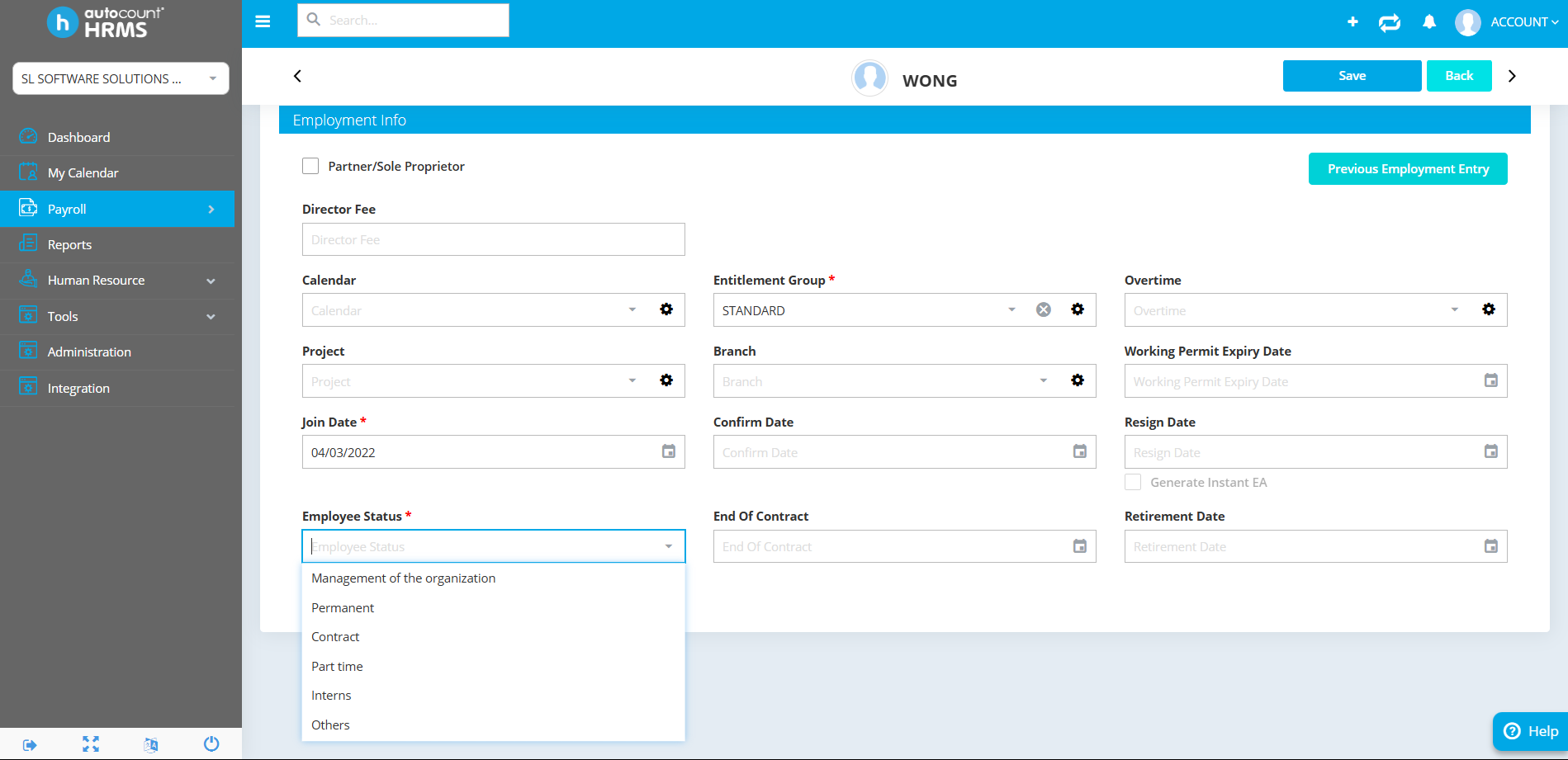
Benefits of Using AutoCount Payroll for Employee Classification
Automatic EPF, SOCSO, and EIS Calculations
Accurately calculates statutory contributions based on employee classification and salary.
PCB (Monthly Tax Deduction) Management
Automatically calculates and deducts PCB for employees while excluding contractors.
Leave and Attendance Tracking
Manages statutory leave entitlements based on employee type and service duration.
Compliance Reporting
Generates statutory forms and reports required by EPF, SOCSO, LHDN, and HRDF.
Simplify Your Payroll Compliance
Ensure accurate employee classification and statutory compliance with AutoCount Payroll.
Disclaimer
This article provides a general overview of Malaysian labour law and should not be construed as legal advice. Employers and individuals are strongly advised to seek professional legal consultation for specific contract drafting and compliance issues.
Frequently Asked Questions
What is the main difference between Contract of Service and Contract for Service in Malaysia?
The main difference is that a Contract of Service creates an employer-employee relationship with statutory obligations (EPF, SOCSO, EIS), while a Contract for Service creates a business-to-business relationship with no statutory obligations. Employees under Contract of Service are protected by the Employment Act 1955, while independent contractors under Contract for Service are governed by civil contract law.
What happens if my contractor is reclassified as an employee?
If a contractor is reclassified as an employee, the company becomes liable for all statutory contributions (EPF, SOCSO, EIS) that should have been paid, potentially going back several years. This includes both the employer and employee portions, plus penalties and interest. The company may also face claims for unpaid statutory benefits like annual leave, sick leave, and potentially unfair dismissal if the engagement is terminated.
How can I ensure my independent contractor classification will hold up in court?
To strengthen your contractor classification: 1) Have a clear written contract specifying it’s a Contract for Service, 2) Ensure the contractor has control over how the work is performed, 3) The contractor should use their own tools/equipment, 4) The contractor should be free to work for other clients, 5) Payment should be based on deliverables rather than time worked, and 6) The contractor should bear some financial risk (e.g., fixed project fee regardless of hours worked).
Are part-time employees considered under Contract of Service or Contract for Service?
Part-time employees are considered under a Contract of Service and are protected by the Employment Act 1955 and the Employment (Part-Time Employees) Regulations 2010. Employers must provide statutory benefits on a pro-rata basis and make mandatory EPF, SOCSO, and EIS contributions for part-time employees.
What's the difference between a fixed-term contract employee and an independent contractor?
A fixed-term contract employee is still an employee under a Contract of Service, entitled to all statutory benefits and protections. An independent contractor operates under a Contract for Service with no employment rights. The key distinction lies in the degree of control, integration into the business, and whether the individual is in business on their own account.