
SL SOFTWARE INSIGHTS / CONNECTED RETAIL
AutoCount OneSales connects POS, marketplace sales, mobile selling and inventory with AutoCount Cloud Accounting and e-Invoice workflows. Explore seven core areas, compare starting prices and see whether the connected approach fits your retail business.

QUICK ANSWER
Bring Cloud POS, e-commerce, inventory, Palm POS, e-Invoice, accounting integration and mobile access into a coordinated workflow. Choose the modules and subscriptions your business needs, then verify the complete flow in a demonstration.
01 / RETAIL INSIGHTS
Many Malaysian retailers started with separate systems for different jobs: a POS for the cashier, accounting software for financial records, and another platform for online sales. As the business grows, these disconnected systems can create more work instead of making operations easier.
Sales may need to be transferred into accounting, inventory may not update consistently between physical and online channels, and management reports may come from several different places.
Malaysia’s e-Invoice requirements have added another consideration. Businesses now need to think about how sales, customer information, accounting records and e-Invoice workflows connect.
This is where AutoCount OneSales becomes interesting.
Rather than treating POS, e-commerce, inventory and mobile sales as completely separate operations, OneSales is designed around a connected cloud-based sales ecosystem that can also integrate with AutoCount Cloud Accounting and support e-Invoice workflows.
The question is whether that connected approach provides enough practical advantages for Malaysian retailers to move away from a fragmented software setup.
02 / RETAIL INSIGHTS
AutoCount OneSales is a cloud-powered sales platform designed to connect different parts of a business’s selling operations.
Instead of looking only at what happens at the cashier, OneSales brings physical POS, e-commerce, mobile sales and inventory into a connected environment. AutoCount also positions Cloud Accounting as part of the wider ecosystem, allowing transaction information to flow into financial records.
Core Areas of the OneSales Ecosystem:
AutoCount’s current OneSales product information describes the idea as three connected sales channels — Cloud POS, e-commerce and Palm POS — supported by centralised inventory, accounting integration and e-Invoice capabilities.
See the official AutoCount OneSales product overview, or explore AutoCount POS for related retail options.
03 / RETAIL INSIGHTS
There is nothing inherently wrong with using different software for different tasks.
The problem appears when those systems do not communicate properly.
A retailer may have one system recording counter sales, another holding the accounting records, and another managing online orders. The business then depends on imports, exports, plugins or manual data entry to keep everything aligned.
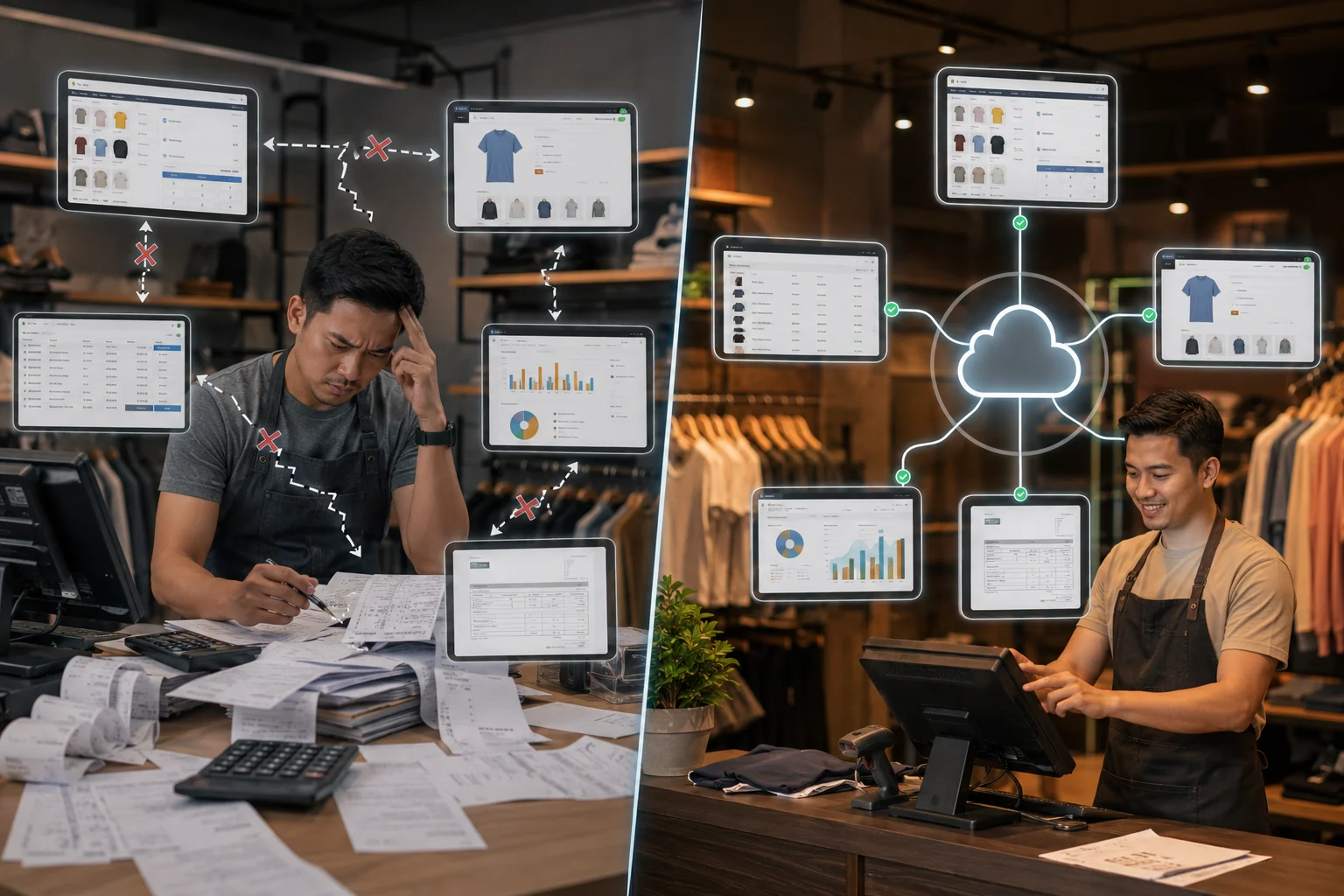
Core Common problems include:
The bigger the business becomes, the more noticeable these gaps can become.
A connected platform such as AutoCount OneSales attempts to reduce those gaps by allowing sales channels and inventory information to work from a more centralised environment.
04 / RETAIL INSIGHTS
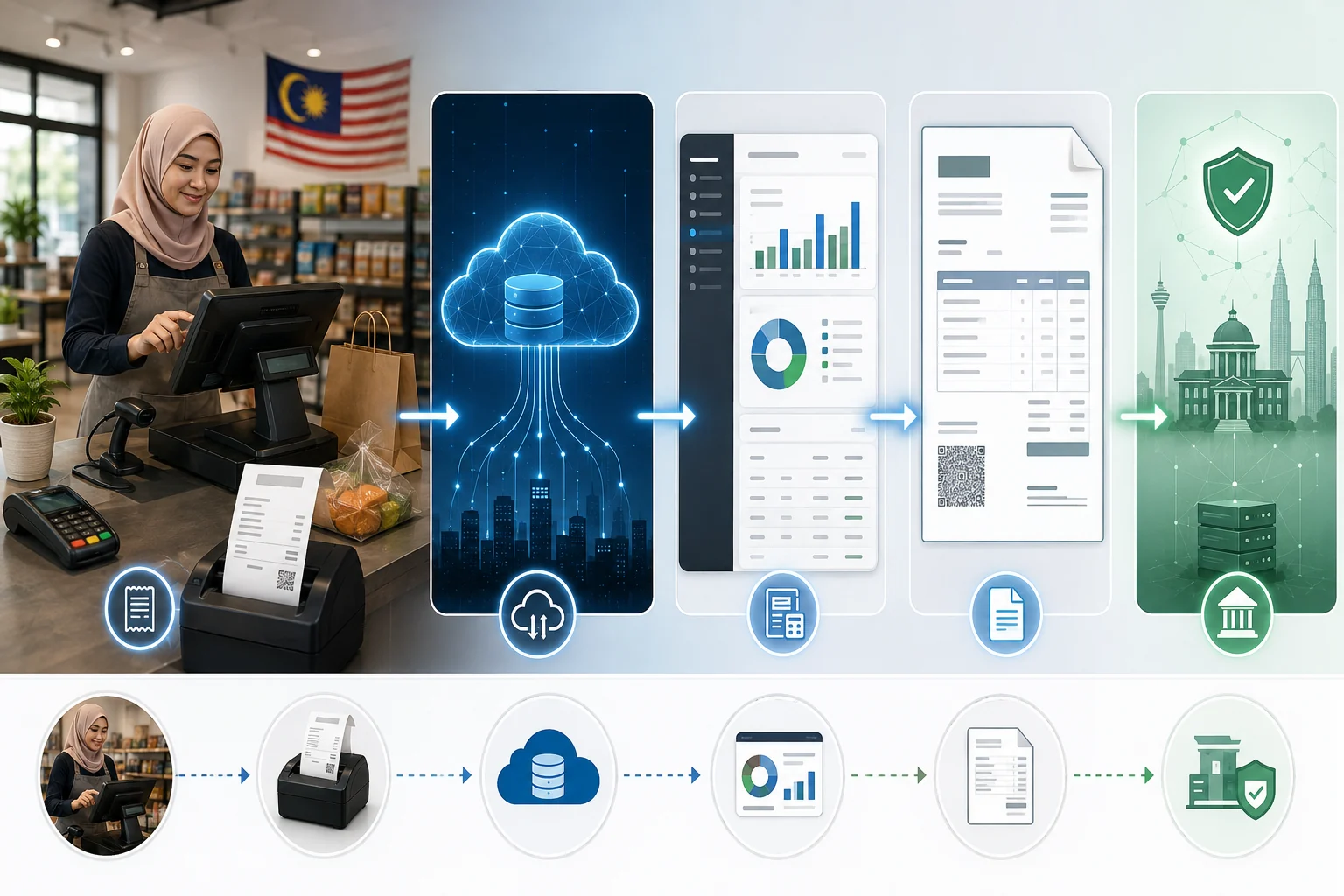
OneSales is positioned as an e-Invoice-ready sales solution. AutoCount’s wider e-Invoice ecosystem uses the AutoCount E-Invoice Platform to facilitate e-Invoicing across solutions including AutoCount POS, AutoCount Accounting, AutoCount Cloud Accounting and OneSales.
The important point is that retailers should not assume that every POS receipt must automatically become an individual e-Invoice.
Malaysia supports different e-Invoice scenarios, including standard and consolidated e-Invoice workflows depending on the transaction and applicable HASiL rules.
The table below follows HASiL’s implementation timeline, updated 30 August 2026. Check the current guidelines and exemption conditions for your business.
| Annual Turnover / Revenue | Implementation Date |
|---|---|
| More than RM100 million | 1 August 2024 |
| More than RM25 million up to RM100 million | 1 January 2025 |
| More than RM5 million up to RM25 million | 1 July 2025 |
| Up to RM5 million | 1 January 2026 |
| Less than RM3 million | Currently exempt |
For retailers that are required to implement e-Invoice, having the sales and e-Invoice processes within a connected software environment can reduce the need to move transaction information manually between different platforms.
Do not choose a POS system based only on whether it says “e-Invoice ready.” Look at how sales, customer information, inventory, accounting and e-Invoice submission work together in your actual daily workflow.
05 / RETAIL INSIGHTS
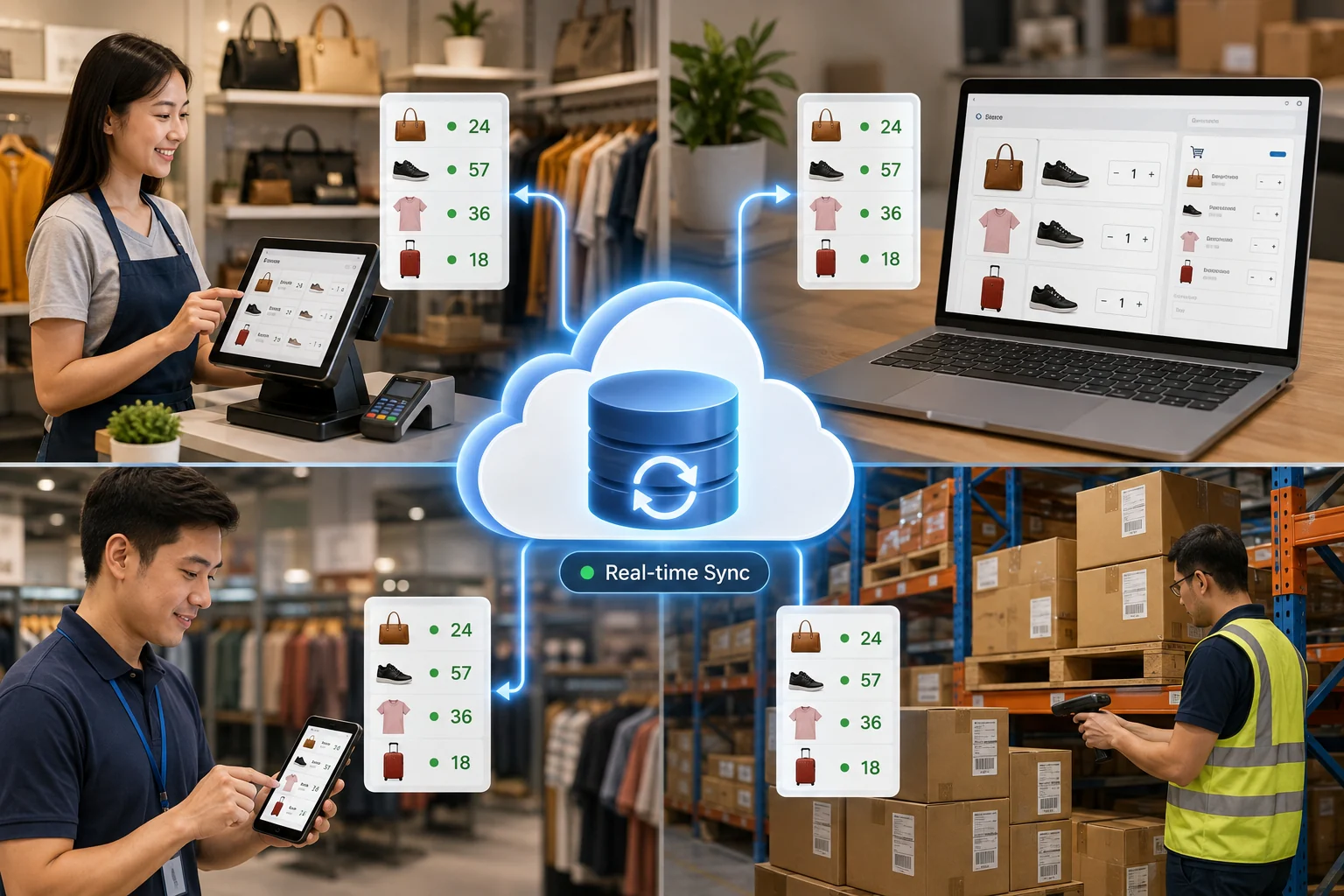
For retailers, the real value of omnichannel software is not simply being able to sell through several channels.
Those channels also need to share reliable product, order and inventory information.
AutoCount OneSales is designed around this connected approach. Its Cloud POS and e-commerce components synchronise sales and inventory information, while the marketplace solution specifically highlights Shopee and Lazada integration.
This can be especially useful when the same stock is being sold both in a physical outlet and online.
If an item sells in-store, the objective is for the connected inventory environment to reflect that stock movement without employees manually updating every sales channel.
| Sales Channel | How It Fits into AutoCount |
|---|---|
| Physical Retail | OneSales Cloud POS |
| Shopee | OneSales Marketplace integration |
| Lazada | OneSales Marketplace integration |
| Mobile / Field Sales | Palm POS |
| Shopify | Available through the wider AutoCount integration/plugin ecosystem |
| WooCommerce | Available through the wider AutoCount integration/plugin ecosystem |
| EasyStore | Available through the wider AutoCount integration/plugin ecosystem |
The distinction is important.
AutoCount’s wider e-commerce ecosystem supports platforms including Shopify, WooCommerce and EasyStore, but the current OneSales Marketplace product information specifically highlights Shopee and Lazada. Businesses requiring other platforms should therefore confirm which module or integration is required before purchasing.
OneSales should be evaluated as an ecosystem, not simply as a cashier system. The more sales channels your business operates, the more valuable centralised inventory and transaction data can become.
06 / RETAIL INSIGHTS
The main comparison is not simply how many features each option has.
The bigger difference is how information moves between the different parts of the business.
| Capability | Separate Software Stack | AutoCount OneSales Ecosystem |
|---|---|---|
| Physical POS | Separate POS application | Cloud POS |
| Online orders | Separate marketplace/e-commerce tools | Connected marketplace workflow |
| Inventory | May require synchronisation between systems | Centralised connected inventory |
| Accounting | Data may require export, import or integration | Integration with AutoCount Cloud Accounting |
| e-Invoice | May require another integration or workflow | e-Invoice support within AutoCount ecosystem |
| Mobile sales | Additional application may be required | Palm POS available |
| Reporting | Information may come from several systems | More centralised sales data |
| Maintenance | Multiple vendors/integrations may be involved | More components within one ecosystem |
A fragmented setup can still work well when the integrations are properly designed.
The advantage of OneSales is therefore not that separate systems are automatically bad. It is that businesses can reduce the number of disconnected workflows they need to manage.
That becomes increasingly important as the number of outlets, products and sales channels grows.
07 / RETAIL INSIGHTS
Published starting prices help you compare the different parts of the ecosystem. Review the OneSales product and pricing overview and request a quotation for your users, outlets, hardware and services.
| Solution | Published Starting Price |
|---|---|
| Palm POS Compliance | RM49/month/user |
| Full Cloud POS | RM130/month/user |
| E-Commerce Marketplace Solution | From RM159/month |
The final cost will depend on the number of users and the combination of POS, marketplace, accounting and other requirements your business needs.
The current product information also notes that certain sales-document functions require Cloud Accounting, so businesses should confirm the complete package required for their workflow rather than assuming every component is included automatically in a single subscription.
Before comparing prices, compare the complete workflow. A cheaper POS may become more expensive once accounting integration, marketplace synchronisation, e-Invoice and additional middleware are added.
08 / RETAIL INSIGHTS
AutoCount OneSales makes the strongest case for businesses that need several sales channels to work together.
Businesses That May Benefit Most:
09 / RETAIL INSIGHTS
OneSales may be more than you need if your business operates entirely online with no physical POS requirement.
Businesses that need specialised e-commerce platforms, highly customised processes or industry-specific functions should also confirm which AutoCount modules, plugins or integrations are required.
F&B businesses should not assume that every specialised restaurant function is automatically part of OneSales. If you require advanced table management, kitchen workflows or other restaurant-specific features, compare OneSales with AutoCount POS F&B before deciding.
10 / RETAIL INSIGHTS
FREQUENTLY ASKED QUESTIONS
AutoCount OneSales is a cloud-powered sales platform that connects POS, e-commerce, inventory and mobile sales within one ecosystem. It also integrates with AutoCount Cloud Accounting and supports Malaysian e-Invoice workflows.
Do not automatically assume so. AutoCount presents Cloud Accounting as an integrated part of the wider OneSales ecosystem, and its current product page notes that certain sales documents require Cloud Accounting. Businesses should confirm the exact package and subscription combination required before purchasing.
The current OneSales Marketplace solution specifically highlights Shopee and Lazada integration. AutoCount’s wider integration ecosystem also supports platforms such as Shopify, WooCommerce and EasyStore through separate integrations or plugins.
No. According to the current HASiL implementation timeline, taxpayers with annual turnover or revenue below RM3 million are exempt from e-Invoice implementation. Businesses above the applicable threshold should check their implementation date and current requirements directly with HASiL.
At the time of this update, AutoCountSystem lists Palm POS Compliance at RM49 per month per user, Full Cloud POS at RM130 per month per user, and its e-commerce marketplace solution from RM159 per month. Prices are before SST, and the final cost depends on the combination of products and users required.
SL Software Solutions Sdn Bhd can help assess OneSales POS, marketplace connections, Cloud Accounting and e-Invoice workflows. Share your outlet count, sales channels and current software so we can recommend a suitable setup.