
Difference Between Invoice and e-Invoice in Malaysia
The difference between invoice and e-Invoice matters: a PDF invoice and a validated e-Invoice are not the same. Learn how Malaysia’s MyInvois process works, what changes for businesses and which records still matter.
Compare invoice types
What are an invoice and an e-Invoice?
A business billing document
Businesses issue invoices to document goods or services provided and amounts due. An invoice may be printed, emailed as a PDF or generated in accounting software.
A structured validated record
Malaysia’s e-Invoice is a structured digital record submitted through the MyInvois Portal or API for validation. XML or JSON is used for API exchange; the customer may receive a visual representation.
Difference Between Invoice and e-Invoice: Side by Side
The main difference between invoice and e-Invoice is not simply paper versus digital. It is the structured data and LHDN validation process applied to the e-Invoice.
| Comparison | Normal invoice | Malaysia e-Invoice |
|---|---|---|
| Meaning | A commercial document requesting payment or recording a sale | A structured transaction document accepted and validated under Malaysia’s MyInvois system |
| Format | Paper, PDF or business-software document | Structured XML/JSON information submitted using MyInvois Portal or API |
| LHDN validation | Not automatically validated merely by issuing it | Receives a validation outcome and unique identifier where successfully validated |
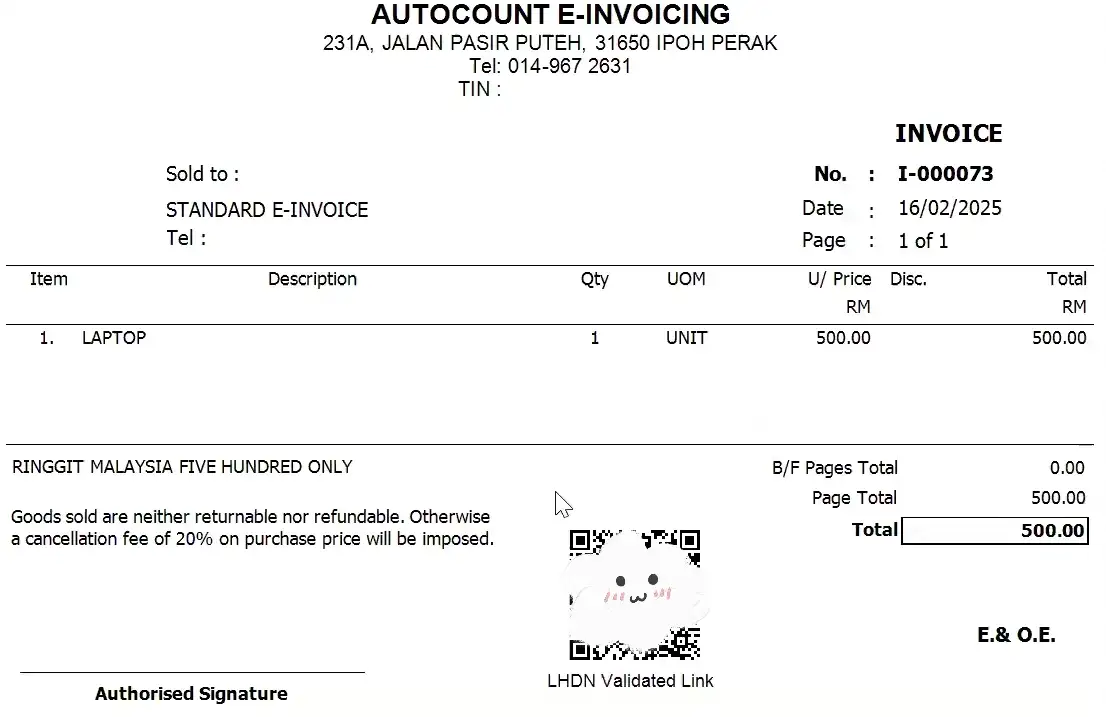
| Customer copy | Printed or electronically shared document | A visual representation may be shared, commonly including a validation QR or relevant reference |
| Recordkeeping | Maintain invoice and supporting accounting records | Keep validated e-Invoice and underlying commercial/accounting records |
| SST | Tax treatment depends on applicable SST rules | e-Invoice validation is separate from determining correct SST treatment |
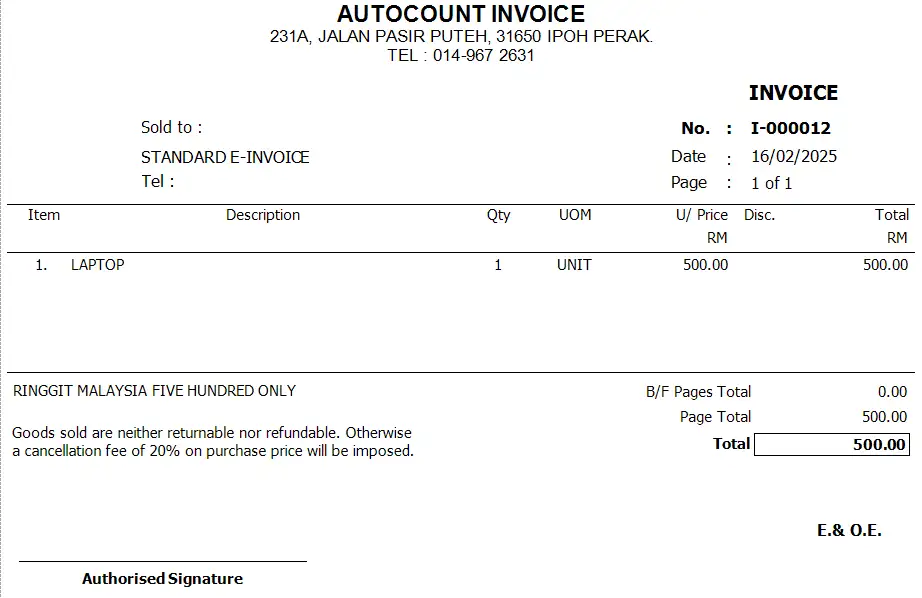
See the Difference Between Invoice and e-Invoice Formats
These sample images are retained from the original article for illustration. Their precise layout may differ from the actual document you issue, and a sample image is not evidence of validation.
How Malaysia’s e-Invoice process works
Create document data
Prepare supplier, buyer, transaction and classification information in an applicable system.
Send to MyInvois
Submit using the official portal or an API-integrated accounting solution.
Check LHDN response
Review validation status and correct any rejected or incorrect information using the applicable procedure.
Record the result
Provide the relevant document representation to the buyer and retain accounting records.
Example: a wholesaler issues a sales invoice
This example shows the difference between invoice and e-Invoice in practice. Staff create the invoice in their accounting system. Where the transaction requires an individual e-Invoice, the relevant data is submitted to MyInvois through the available workflow.
The validation result and reference can be recorded, while staff still need to reconcile the original sales transaction, inventory movement and tax treatment.
Read more about the AutoCount e-Invoice solution.

Malaysia MyInvois vs Singapore InvoiceNow
Malaysia’s MyInvois uses tax-authority validation of submitted e-Invoice documents. Singapore’s InvoiceNow uses the Peppol network for exchange of invoice data, with the GST InvoiceNow requirement also introducing phased transmission of relevant invoice data to IRAS.
MyInvois
Structured documents submitted to LHDN for validation through the portal or API, subject to applicable rules.
InvoiceNow
Peppol-based invoice exchange and a phased GST InvoiceNow reporting requirement for GST-registered businesses.
The previous article’s description of Singapore as having no tax-authority data integration is outdated; refer to current IRAS implementation phases.
What Malaysian businesses should prepare
Review master records
Confirm customer and supplier identifiers, registration information and relevant transaction fields.
Train your accounts team
Agree who reviews invoice details, submits and checks validation results.
Test the workflow
Confirm version compatibility, supported e-Invoice functions and error handling before go-live.
Keep records aligned
Compare commercial transactions, accounting records, e-Invoice submissions and tax reporting.
Difference Between Invoice and e-Invoice: FAQs
Is a PDF invoice an LHDN e-Invoice?
No. That is the key difference between invoice and e-Invoice: a PDF invoice is a visual document. Malaysia’s e-Invoice requirements concern structured data submitted and validated through MyInvois.
Does a validated e-Invoice mean all the details are correct?
No. Validation indicates that the submission passed the system’s relevant checks; businesses still need to verify transaction accuracy and applicable tax treatment.
Does every business need to issue individual e-Invoices for every sale?
Not necessarily. Implementation scope and permitted consolidated e-Invoice treatment depend on current LHDN rules, exemptions and transaction type.
Does an e-Invoice replace accounting records?
No. Businesses should still retain accurate transaction records, reconciliation and supporting documents according to applicable obligations.
Prepare your business for the correct invoice workflow
Explore the AutoCount e-Invoice solution and review the Malaysia e-Invoice implementation guide to apply the difference between invoice and e-Invoice in your own setup.
Explore AutoCount e-InvoicingUseful next step
Review actual buyer details, tax classification, document type and submission status using your live business workflow.
Check current guidance
LHDN e-Invoice guidelines · MyInvois document validation rules · Singapore IRAS GST InvoiceNow requirement
Reviewed November 2026. Confirm the current authority guidance for obligations that depend on your business and transactions.