
Refundable vs Non-Refundable Deposits in Malaysia e-Invoicing
Compare refundable vs non-refundable deposits in Malaysia e-Invoicing. Learn when an e-Invoice is required, how to handle forfeiture and why accurate contract and payment records matter.
Compare deposit treatment
Refundable vs Non-Refundable Deposits: Is an e-Invoice Needed?
LHDN’s e-Invoice General FAQ distinguishes refundable vs non-refundable deposits: a refundable deposit does not require an e-Invoice when collected, while a non-refundable deposit does require an e-Invoice for a business subject to e-Invoicing.
Generally no e-Invoice on collection
The amount is expected to be returned under the relevant agreement. Retain the deposit receipt and supporting conditions for the money held.
e-Invoice when collected
LHDN’s published Q&A expressly requires a seller subject to the e-Invoice obligation to issue an e-Invoice on receipt of a non-refundable deposit.
Refundable vs Non-Refundable Deposits: Side-by-Side Comparison
| Deposit type | On collection | Records to keep | When the status changes |
|---|---|---|---|
| Refundable | No e-Invoice required when collected as a refundable deposit | Keep receipt, agreement and deposit liability records | Reassess if applied to a supply or becomes non-refundable |
| Non-refundable | e-Invoice required upon receipt for an obligated supplier | Maintain e-Invoice and references to any subsequent billing | Check subsequent invoice/adjustment handling to avoid duplication |
| Partially refundable | Treat the portions separately according to terms | Document non-refundable and refundable amounts distinctly | Reassess a change of status or an agreed forfeiture |
The contract’s refund or cancellation terms matter more than calling every advance payment a “deposit”. Where a deposit is applied to a completed sale, review how the earlier payment and eventual supply are documented, including avoidance of duplicated values.
Understand the deposit decision visually


Refundable vs Non-Refundable Deposits: 4 Common Examples
Property rental security deposit
A RM3,000 deposit refundable at the end of a tenancy is generally received without an e-Invoice for that refundable deposit. Any deductions or later application require separate review.
Event venue booking fee
A RM1,000 non-refundable reservation fee is subject to e-Invoicing upon receipt where the business is required to issue e-Invoices. Reconcile the fee against final billing under the actual arrangement.
Custom furniture deposit
An agreement may split RM1,000 non-refundable and RM4,000 refundable. Record the terms and assess the two portions separately; avoid treating the entire RM5,000 uniformly.
Hotel cancellation deposit
A RM500 refundable booking deposit might become non-refundable if the guest cancels too late. Review the forfeiture terms and issue the required e-Invoice when the deposit becomes non-refundable.
Four steps when receiving a customer deposit
Review refundability
Confirm whether all or part can be refunded and what triggers forfeiture.
Keep clear evidence
Record the customer, amount, date, receipt and applicable agreement. For receipt documentation, see our official receipt guide.
Follow LHDN treatment
Issue the appropriate e-Invoice when the deposit is non-refundable and a mandate applies.
Check final outcome
Track refunds, applications and forfeitures against the original deposit record.
Keep deposit records linked to later transactions
For a company handling refundable vs non-refundable deposits, accurate records are as important as the initial e-Invoice decision. Track customer payments, receipts and the subsequent application or refund.
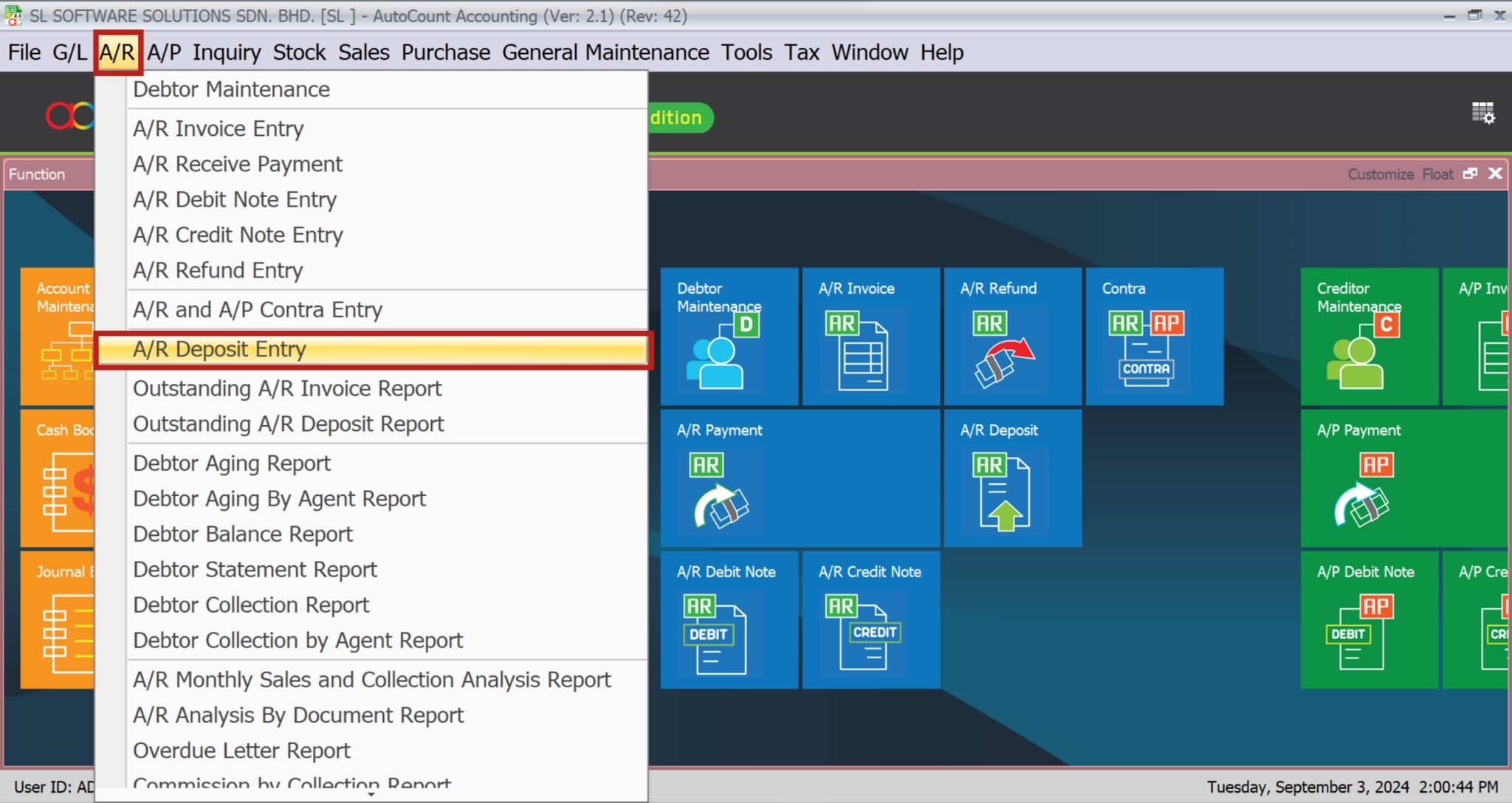
AutoCount’s deposit functionality and optional Advance Deposit Plugin can assist with documented deposit workflows, depending on the installed version and configuration.
See the AutoCount Advance Deposit Plugin guide for product-specific steps.
Do not use one adjustment method for every deposit
Deposit becomes non-refundable
If an originally refundable amount becomes non-refundable under the agreement, review the amount and date the new obligation arises.
Payment returned
For an ordinary refundable deposit returned without an original e-Invoice, retain payment evidence. For refunds linked to validated e-Invoices, assess the appropriate correction or refund-note procedure.
Check eligibility
Consolidated e-Invoicing is not universally available. Review the current transaction restrictions, buyer requests and LHDN deadlines before combining records.
Refundable vs Non-Refundable Deposits FAQs
Is an e-Invoice required for a refundable security deposit?
LHDN’s General FAQ states that an e-Invoice is not required when the deposit is refundable. Keep the relevant receipt and agreement.
When do I issue an e-Invoice for a non-refundable booking fee?
LHDN’s published Q&A says a seller subject to e-Invoicing must issue it upon receipt of the non-refundable deposit.
What if a refundable deposit later becomes non-refundable?
Review the forfeiture event and applicable current rules. The deposit should not remain classified as refundable if the agreement makes it non-refundable.
Can I automatically treat every deposit as sales income?
No. Proper accounting classification depends on contractual rights and obligations and the relevant accounting policy. e-Invoice issuance is a separate compliance question.
Can I issue a consolidated e-Invoice for every non-refundable deposit?
No. The rules contain eligibility requirements and transaction restrictions. Check the current LHDN Specific Guideline before relying on consolidation.
Manage Refundable vs Non-Refundable Deposits with Clearer Records
Explore AutoCount e-Invoicing or review the Advance Deposit Plugin guide to learn more about related workflows.
Discuss deposit requirementsPrepare before configuring
Bring the deposit agreement, refund and forfeiture terms, customer documents and sample accounting transactions.
LHDN deposit guidance
LHDN e-Invoice General FAQ, Question 57 · LHDN e-Invoice Guidelines (current versions).
Updated November 2026. Verify the current rules for your specific transactions and consult a qualified adviser for accounting and SST conclusions.