How Odoo MRP Helps Malaysian Manufacturers Improve Production Planning
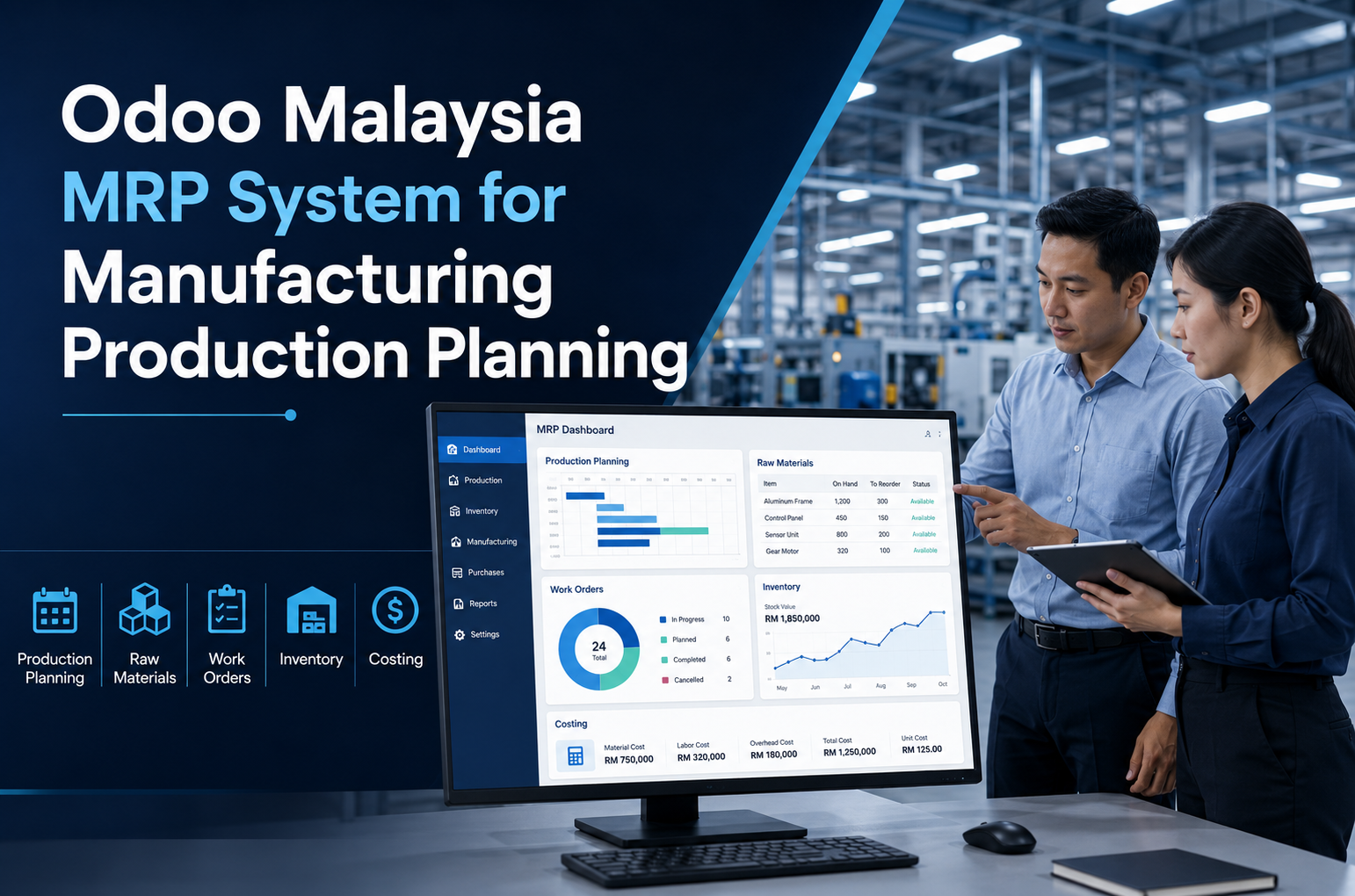
Odoo Malaysia helps manufacturers manage production planning, raw materials, BoM, work orders, shop floor activities, costing, and inventory flow in one connected ERP system.
Why Production Planning Becomes Difficult
Manufacturing companies do not only need to know what stock they have.
They also need to know what to produce, when to produce it, which raw materials are needed, which machines or workers are involved, and how much the production really costs.
For many Malaysian manufacturers, this becomes harder as the business grows.
At the early stage, Excel files, paper forms, simple stock records, and manual planning may still work. However, when production volume increases, the same method can cause delays, stock mistakes, unclear job priorities, and inaccurate costing.
This is where an MRP system becomes useful.
For manufacturers, Odoo MRP can support production planning, raw material planning, work order tracking, and production costing.
Odoo Malaysia can help manufacturing companies manage production planning, materials, work orders, production flow, and costing in one connected ERP system. Instead of handling manufacturing separately from inventory, sales, purchase, and accounting, Odoo MRP helps bring these processes together.
Common Manufacturing Planning Problems
Many manufacturers face the same problem.
Sales receives customer orders, while production plans jobs and purchasing secures the required materials. Meanwhile, the warehouse checks stock availability, and accounting reviews production costs and profit.
However, when these departments rely on separate records, production planning becomes slow and unclear.
Common problems include:
- The production team does not know whether enough raw materials are available.
- The warehouse does not receive updated production requirements.
- Purchasing only notices material shortages at the last minute.
- Management does not know which work orders are delayed.
- Customer orders are delayed because materials are not ready.
- Production stops because one component is missing.
- Stock is over-purchased because planning is not accurate.
- Product costing is unclear because material and labour usage are not properly recorded.
The issue is not only about inventory. The real issue is that production, materials, workflow, and costing are not connected properly.
- Important: Manufacturing Planning Reminder
If production, inventory, purchasing, and costing are not connected, the factory may look busy but still face delays, wrong stock planning, unclear job status, and inaccurate product cost.
What Is Odoo MRP?
Odoo MRP is the manufacturing module inside Odoo ERP.
MRP stands for Material Requirements Planning. In simple terms, it helps manufacturers plan the materials, production steps, work orders, and resources needed to produce finished goods.
Odoo MRP helps answer important questions such as:
- What product needs to be produced?
- How many units need to be made?
- What raw materials are required?
- Are the materials available?
- Which production steps are involved?
- Which work center or machine is needed?
- What is the status of each work order?
- What is the estimated or actual production cost?
This gives manufacturing companies better control over their production process.
Instead of planning production manually, the business can manage manufacturing activities in a more structured way.
This makes Odoo MRP system useful for manufacturers that need better control over production planning and material usage.
Connecting Sales Orders to Production
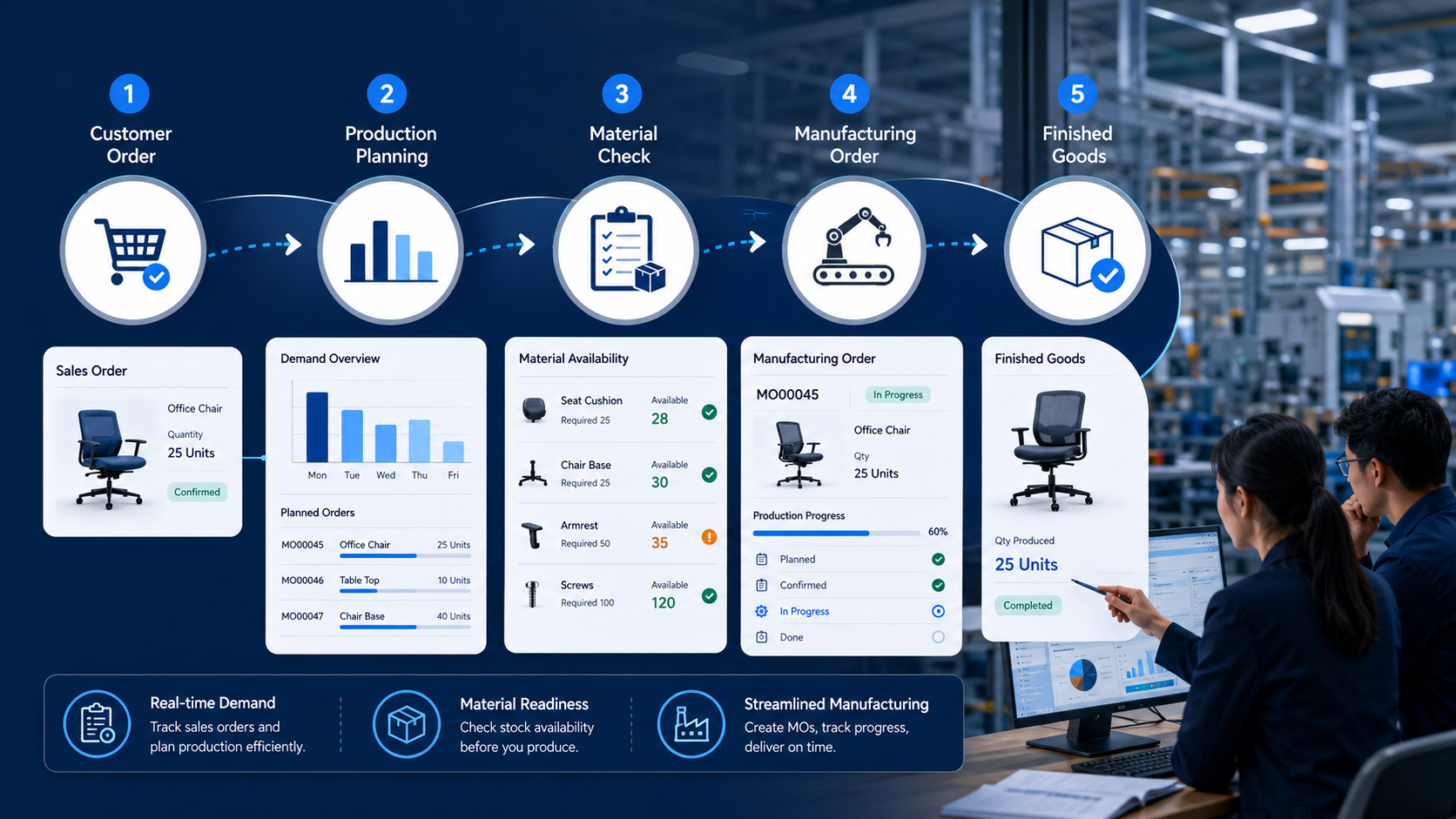
In many manufacturing companies, production starts when a customer order is confirmed.
But if sales and production are not connected, the handover may depend on WhatsApp messages, printed forms, verbal instructions, or manual Excel updates.
This can cause mistakes.
The production team may receive incomplete order details. The production team may produce the wrong quantity. A job may be missed. The customer may need to wait longer because production was not scheduled properly.
With Odoo MRP, manufacturing can be connected with sales and inventory.
When a sales order is confirmed, the system can help show what needs to be produced and what materials are required. This makes it easier for the production team to plan jobs based on actual demand.
This is useful for manufacturers that produce based on customer orders, custom products, or regular production schedules.
Bill of Materials Management
Bill of Materials, also called BoM, is one of the most important parts of manufacturing.
A BoM lists the materials, components, quantities, and sometimes operations needed to produce a finished product.
For example:
- A furniture manufacturer may need wood panels, screws, glue, fabric, packaging materials, and labour steps.
- A food manufacturer may need ingredients, packaging, labels, and processing steps.
- A metal fabricator may need raw metal, cutting, welding, finishing, and quality checking.
If BoM records are managed manually, mistakes can happen easily.
The wrong material quantity may be used. Different staff may follow different versions of the formula. Material cost may not be updated properly. Production may waste time checking what should be used.
Odoo MRP helps manufacturers manage BoM in a more organized way.
The company can define the required components, quantities, production steps, and product versions. This helps standardize production and reduce confusion on the factory floor.
In addition, a clearer BoM supports planning because the system can determine which materials are needed before production starts.
- BoM Example
If one finished product needs 2 raw materials, 1 packaging item, and 3 production steps, the BoM helps the system understand what must be prepared before production starts.
Raw Material Planning
Production cannot run smoothly if raw materials are not ready.
Many manufacturing delays happen because the company only discovers material shortages after the production team starts the job. This affects delivery time and customer satisfaction.
Odoo MRP helps connect production planning with inventory. When planners create a manufacturing order, the system checks material availability and shows whether the business has enough stock.
As a result, purchasing and warehouse teams gain better visibility of material availability.
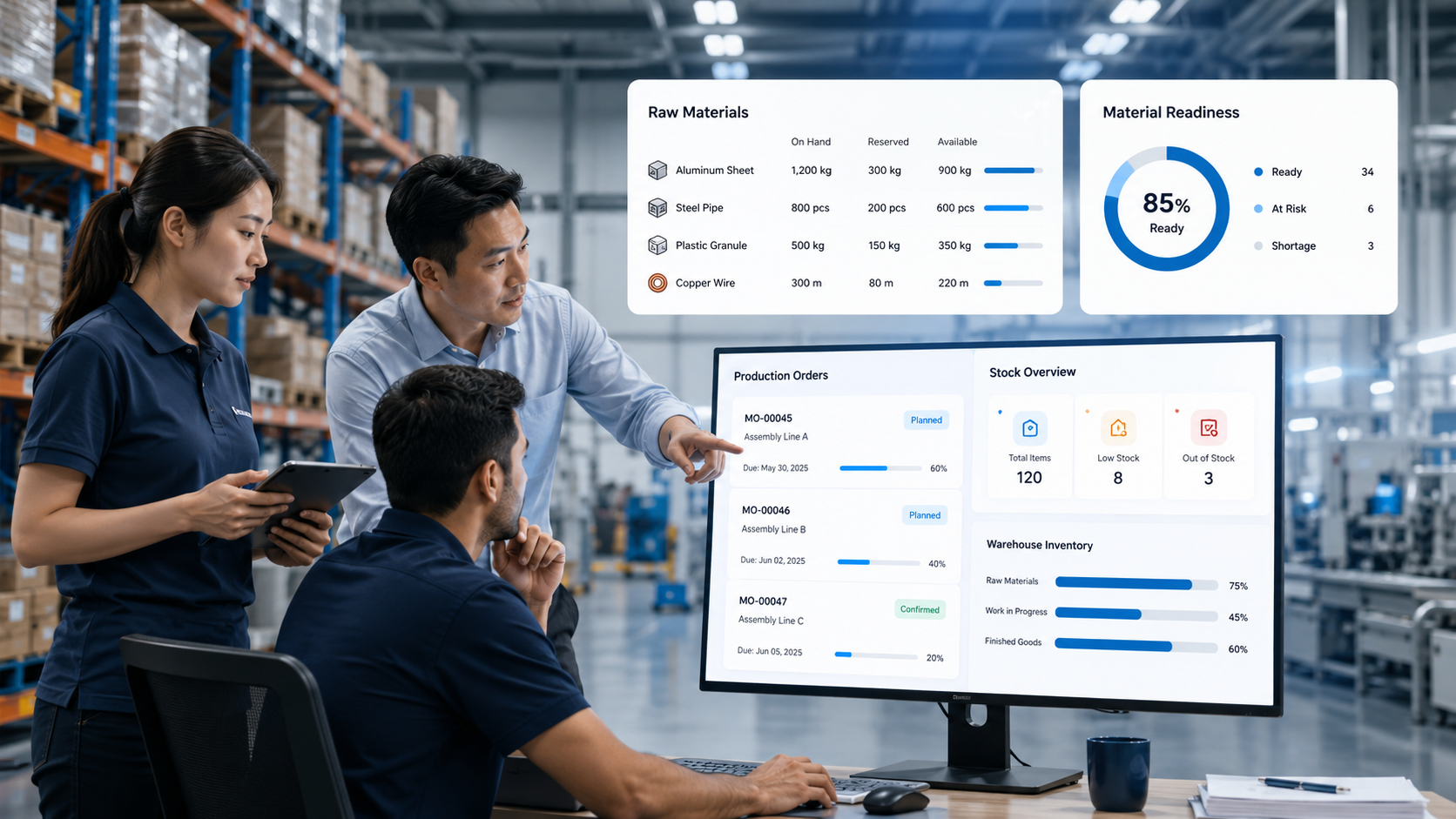
If materials are not enough, the business can plan purchases earlier. If materials are already available, production can proceed with more confidence.
This helps reduce last-minute buying, urgent supplier chasing, and production stoppages.
For Malaysian manufacturers with many raw materials or product variations, this can make daily planning much easier.
Manufacturing Orders
A manufacturing order is an instruction to produce a specific product and quantity.
Without a proper system, manufacturing orders may be handled using printed job sheets, Excel files, or manual notes. This can make it difficult to track what is pending, what is in progress, and what has been completed.
Odoo MRP helps businesses manage manufacturing orders more clearly.
A manufacturing order can show what product needs to be made, how many units are required, which materials are needed, and what production steps are involved.
This helps the production team understand the job better.
It also helps management monitor production progress without needing to ask every department manually.
For example, management can check whether a job is still waiting for materials, already in production, or completed.
Managing Work Orders and Work Centers
Some manufacturers have simple production processes. Others have multiple stages.
For example, production may include:
- Cutting
- Mixing
- Assembly
- Painting
- Quality checking
- Packing
- Machine processing
If these stages are not tracked properly, it becomes difficult to know where a delay happens.
Odoo MRP allows production work to be divided into work orders and work centers.
A work order represents a specific production task or stage. A work center can represent a machine, department, workstation, or production area.
This helps the company track production flow step by step.
For example, one product may need to go through cutting, assembly, inspection, and packing. With work orders, each stage can be monitored more clearly.
This is useful when the business wants better shop floor control, clearer job assignment, and better production progress tracking.
Improving Shop Floor Visibility
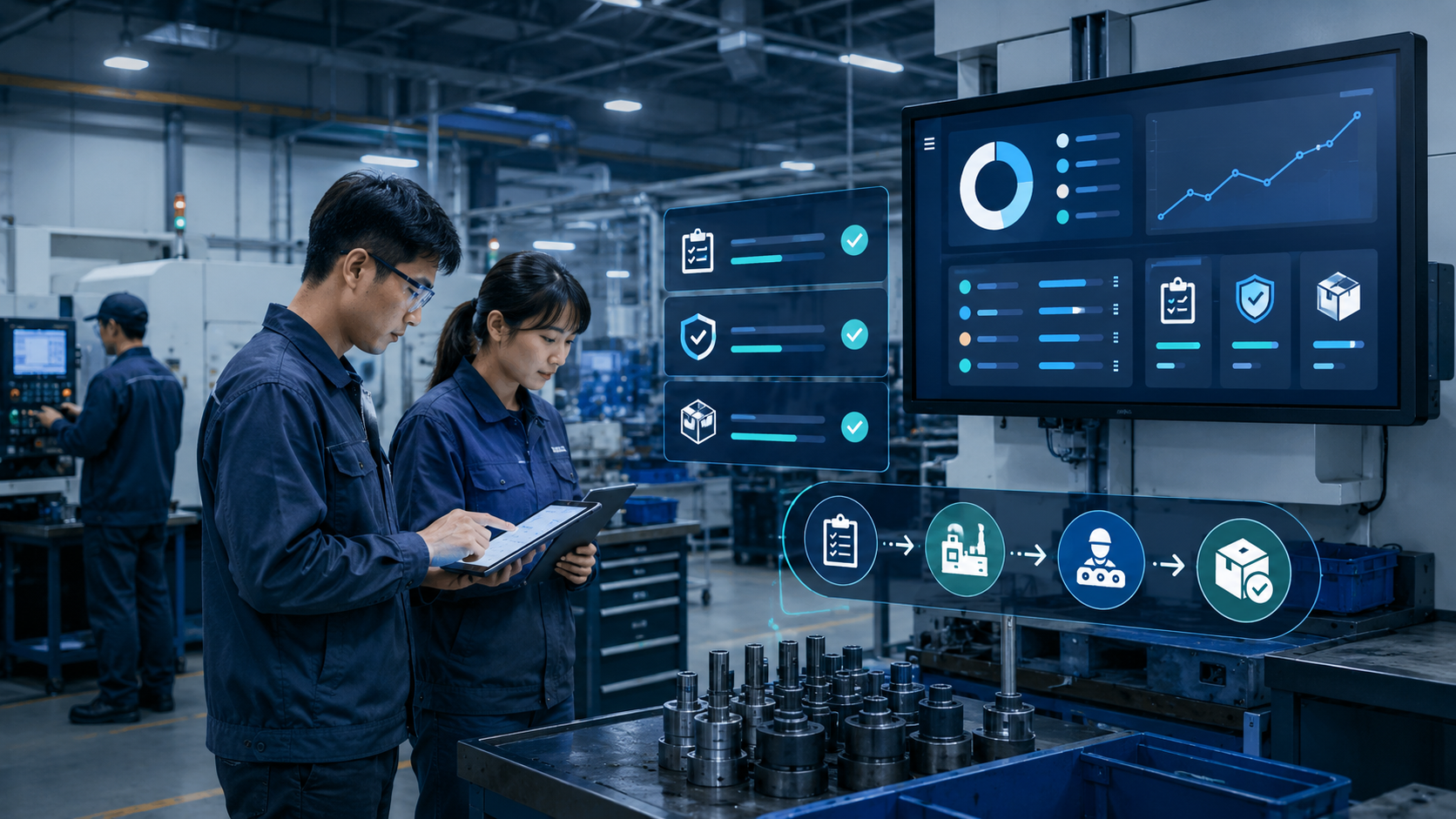
Many factories still depend on paper records at the shop floor.
Operators may write down production progress manually. Supervisors may collect forms later. Office staff may need to re-enter information into another system.
This creates delay and increases the chance of mistakes.
Odoo MRP can support shop floor management by giving operators a clearer way to view and update work orders. Depending on the setup, staff can record progress, production time, quality checks, and job completion more directly.
This helps reduce paper-based processes because production updates no longer need to depend only on handwritten forms or delayed manual entry.
It also gives management faster visibility into what is happening on the production floor. Instead of waiting for supervisors to collect and submit updates, managers can review job progress more clearly through the system.
For manufacturers that want to move toward paperless operations, this is an important step toward better shop floor control, faster reporting, and more organized production management.
Tracking Materials, Batches, and Traceability
Traceability is important for many manufacturing businesses.
Some companies need to know which raw materials were used in each finished product. Some need to track batch numbers, lot numbers, serial numbers, or product movement.
This is especially important for industries such as food and beverage, pharmaceuticals, chemicals, electronics, and other regulated or quality-sensitive industries.
Odoo MRP can help support material tracking, batch traceability, and barcode usage.
This allows the business to trace materials from purchase to production and from production to delivery.
If there is a quality issue, the company can investigate more easily. It can check which batch was affected, what materials were used, and where the finished goods went.
This gives better control compared with manual records.
- Important: Traceability Reminder
For quality-sensitive industries, traceability can help the business investigate product issues faster by checking which materials, batches, or finished goods are affected.
Understanding Production Cost More Clearly
Costing is one of the biggest challenges in manufacturing.
A product cost is not only based on raw materials. It may also include labour, machine time, wastage, overhead, subcontracting, and other production-related costs.
If production data is not properly recorded, the business may not know the real cost of each product.
This can affect pricing and profit.
For example, a company may think a product is profitable. But after including material waste, labour time, rework, and machine usage, the actual profit may be much lower.
Odoo MRP helps manufacturers connect production activities with material usage and costing information.
This gives management a better view of production cost and product performance.
For Malaysian manufacturers, this is useful when reviewing selling prices, product margins, production efficiency, and cost control.
Reducing Waste and Downtime
Manufacturing waste can happen in many ways.
It can be material waste, time waste, labour waste, machine downtime, or repeated rework due to quality issues.
When production is not tracked properly, it is difficult to find where the waste happens.
Odoo MRP helps create better visibility across the production process. Work orders, materials, quality checks, and managers can track production progress more clearly.
This makes it easier to identify problems such as:
- Frequent material shortages
- Delayed work orders
- Slow production stages
- Machine breakdowns
- High defect rates
- Repeated rework
- Poor planning between departments
Once the business can see these problems, it can take action to improve them.
Connecting Manufacturing with Inventory, Purchase, and Accounting
A manufacturing system should not work alone.
Production affects inventory. Inventory affects purchasing. Purchasing affects cost. Cost affects accounting and profit reporting.
If these areas are disconnected, the business will not have a clear picture.
Odoo MRP connects manufacturing with other Odoo modules such as Inventory, Purchase, Sales, Accounting, Quality, Maintenance, and Reporting.
This helps the business manage the full flow more smoothly.
For example:
- A sales order creates demand.
- Production planning checks materials.
- Inventory shows available stock.
- Purchase can prepare required materials.
- Manufacturing orders control production.
- Finished goods update stock.
- Accounting can review cost and financial impact.
- Management can view reports.
This connected flow is one of the main reasons manufacturers consider ERP systems.
It helps reduce repeated data entry and improves visibility across departments.
Connected Manufacturing Workflow Table
| Manufacturing Area | When It Is Disconnected | How Odoo MRP Helps |
|---|---|---|
| Sales | Production teams may receive incomplete or unclear confirmed order details. | Confirmed sales orders can create clear demand for production planning. |
| Inventory | Teams may not know whether enough raw materials are available. | Odoo lets planners check material availability before production starts. |
| Purchasing | Purchasing teams may order materials too late or buy more than the factory needs. | Purchasing teams can plan orders based on actual production requirements. |
| Production | Managers may struggle to track work order progress. | Manufacturing orders and work orders show the status of each job. |
| Accounting | Accounting teams may not see the full product cost clearly. | Material usage and production activities give accounting teams clearer costing information. |
| Management | Managers may receive delayed or incomplete reports. | Managers can review production, stock, and costing information in one connected system. |
When Should a Manufacturer Consider Odoo MRP?
A Malaysian manufacturing company may consider Odoo MRP when it starts facing problems such as:
- Production planning is still done manually.
- Raw material shortages happen often.
- The team cannot clearly track work order progress.
- BoM records are not consistent.
- Stock balance does not match production needs.
- Purchasing is not aligned with production demand.
- Product costing is unclear.
- Management does not have real-time production reports.
- Quality issues are difficult to trace.
- The company wants to reduce paper-based factory records.
These problems usually become more serious when production volume increases.
A simple stock system may show what items are in the warehouse, but it may not be enough to manage production planning, materials, work orders, and manufacturing cost.
This is where an MRP system can provide better structure.
Why Implementation Planning Matters
Manufacturing ERP implementation is more complex than a normal accounting or inventory setup because every manufacturer has a different production flow.
One company may produce standard products, while another handles custom orders or manufactures only after receiving a customer order.
Depending on the operation, the business may also need batch tracking, serial number tracking, multi-level BoM, quality control, or maintenance tracking.
Therefore, the company must plan the system carefully around its actual factory workflow.
A proper Odoo MRP implementation should include:
- Understanding the production workflow
- Identifying current bottlenecks
- Selecting the right Odoo modules
- Setting up product master data
- Configuring BoM and manufacturing flow
- Connecting sales, inventory, purchase, and finance
- Migrating important data
- Training users
- Testing before go-live
- Supporting the team after launch
This helps ensure the system fits the real factory process.
- Warning: Manufacturing ERP Planning
Do not set up manufacturing ERP based only on theory. The system should follow the real factory workflow, including materials, machines, workers, production stages, quality checks, costing, and reporting needs.
The Role of a Local Odoo Partner
For Malaysian manufacturers, working with a local implementation partner can make the project easier.
A local partner can understand local business practices, communication style, accounting needs, user training requirements, and common operational challenges.
SL Software Solutions Sdn Bhd is a Malaysian business software solutions provider and authorized Odoo partner. The company helps manufacturers implement Odoo MRP based on their actual production workflow, business operation, and long-term growth needs.
This is important because manufacturing software should not be set up based on theory only.
It must match how the factory actually works every day.

Conclusion
Odoo MRP helps Malaysian manufacturers connect production planning, raw materials, work orders, inventory, and costing in one ERP system.
It is especially useful for businesses that manage BoM, manufacturing orders, work centres, shop-floor activities, batch traceability, quality control, and production costs. However, successful implementation depends on accurate data and a clear understanding of the factory workflow.
With proper planning and local support, Odoo MRP can create a more organised and scalable production process. Learn more about Odoo MRP System for Manufacturing Companies in Malaysia.
Frequently Asked Questions
What is Odoo MRP used for?
Odoo MRP is used to manage manufacturing processes such as BoM, manufacturing orders, raw material planning, work orders, production flow, and costing. It helps manufacturers organize production more clearly instead of relying only on manual records.
How does Odoo MRP help with production planning?
Odoo MRP helps manufacturers see what needs to be produced, what materials are required, and whether those materials are available. This makes it easier to plan production before the job starts.
Why is Bill of Materials important in manufacturing?
Bill of Materials shows the materials, components, quantities, and production steps needed to make a finished product. A clear BoM helps reduce material mistakes, costing errors, and confusion on the factory floor.
Can Odoo MRP help reduce production delays?
Yes, Odoo MRP can help reduce delays by connecting production planning with inventory, purchasing, and work order tracking. When teams can see material availability and job progress more clearly, they can respond earlier to possible problems.
Is Odoo MRP suitable for Malaysian manufacturers?
Odoo MRP can be suitable for Malaysian manufacturers that need better control over raw materials, production planning, BoM, work orders, costing, and reporting. The system should be planned properly based on the company’s actual factory workflow.
Ready to Improve Your Inventory Workflow?
If your wholesale or trading business needs better stock visibility, smoother order processing, and clearer delivery workflow, AutoCount Software can help you manage daily operations in a more organised way.
Contact SL Software Solutions to learn how AutoCount can support your inventory, sales order, and delivery process.