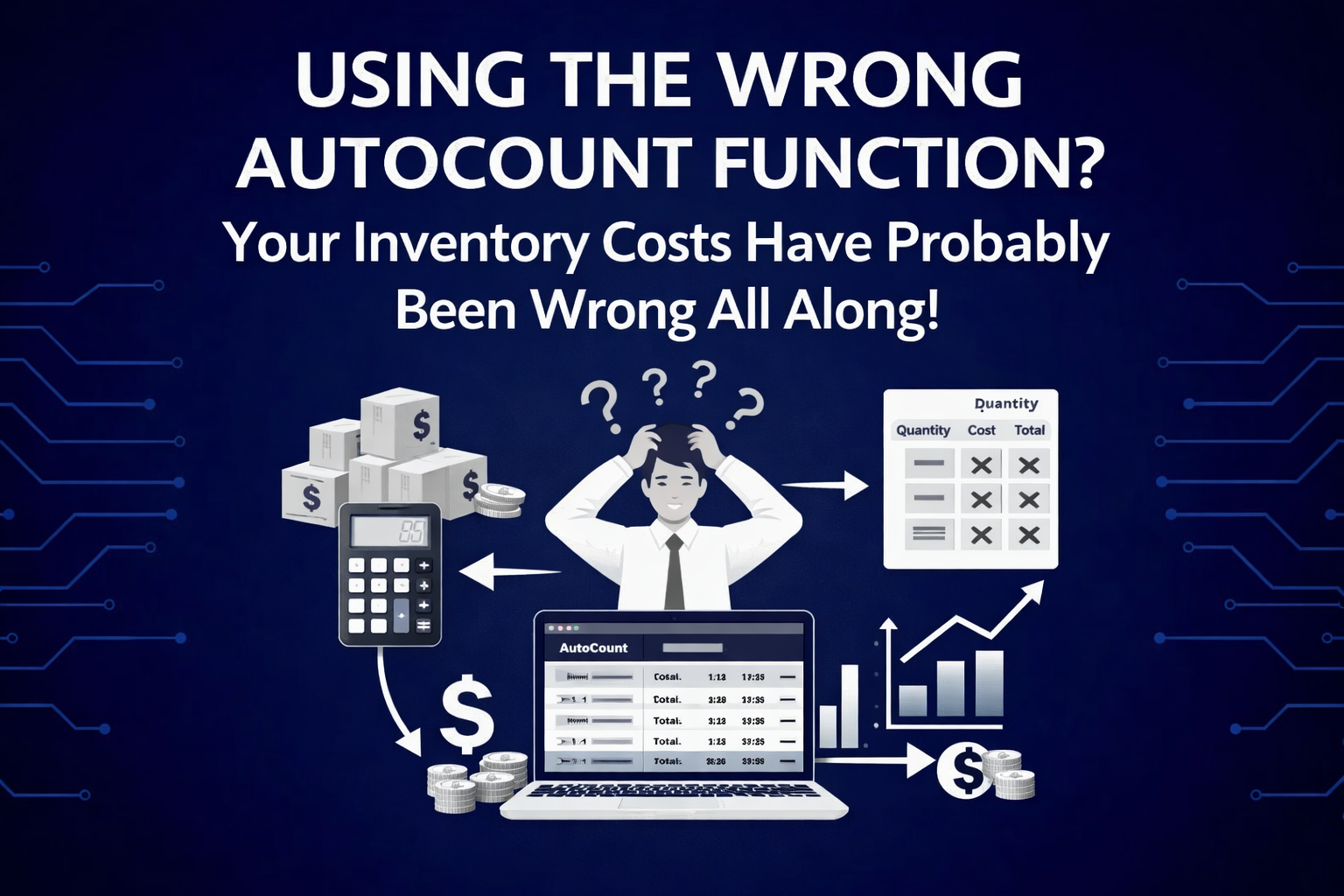
Using the Wrong AutoCount Function? Your Inventory Costs Have Probably Been Wrong All Along!
A small grocery store owner’s real-life lesson: Both functions reduce stock, so why was his profit so different at the end of the month?
Mr. Wang , who runs a small grocery store. Business was doing pretty well
One day, he bought a tray of eggs from his supplier:
10 eggs
Cost per egg: RM1
Total cost: RM10
Everything seemed normal. But while moving the stock, his employee, Ah Lee, slipped
Smack!
One egg fell and broke. Mr. Wang waved his hand dismissively.
“It’s broken. Just remove it from the system.”
Ah Lee nodded, opened AutoCount, and got ready to handle the broken egg. Then he froze.
The system had two functions that could both “reduce stock”
One was Stock Write-off.
The other was Stock Adjustment.
Which one should he click?
Ah Lee scratched his head.
“They both remove one egg. Should be the same, right?”
He clicked randomly.
At month-end, when Mr. Wang looked at the reports, his frown deepened:
“Why does this month’s gross profit look so strange?
The cost of eggs seems off?”
Where was the problem?
It all came down to that one button Ah Lee clicked.

Two Operations, Worlds Apart
At month-end, when Mr. Wang looked at the reports, his frown deepened:
Scenario 1: If Ah Lee Chose Stock Write-off
The system would think:
The egg is broken, the supplier won’t compensate. This loss is part of doing business. The remaining eggs need to bear this cost together.
Item
Remaining Quantity
Total Cost
New Unit Cost
Result
9 eggs
RM10 (unchanged)
RM10 ÷ 9 = RM1.11
The outcome:
The remaining 9 eggs now cost RM1.11 each, up from RM1.00.
Total inventory value remains RM10.
What does this mean?
The RM 1 cost of the broken egg hasn’t disappeared. It has been absorbed by the remaining eggs.
This reflects reality, you genuinely lost RM1, and this loss must be reflected in your costs.
Scenario 2: If Ah Lee Chose Stock Adjustment
The system would think:
The quantity is just wrong. Let me fix it by removing that one egg along with its cost.
Item
Remaining Quantity
Cost Removed
New Total Cost
New Unit Cost
Result
9 eggs
1 egg × RM 1 = RM 1
RM10 – RM 1 = RM9
RM9 ÷ 9 = RM 1
The outcome:
The remaining 9 eggs still cost RM1 each.
Total inventory value becomes RM9.
Total inventory value remains RM10.
What does this mean?
The broken egg seems to have never existed. Its cost has simply vanished.
To prevent such discrepancies, stock adjustment is commonly used in inventory management system to ensure stock accuracy and proper tracking.
Both stock write-off and stock adjustment will affect your financial records, especially when integrated with accounting software.
But is this accurate?
No. You actually spent RM1 on that egg. It broke. You lost that money. This loss should appear in your books, not be erased.
How Serious Is Using the Wrong Function?
Suppose Mr. Wang sells all 9 remaining eggs.
If Ah Lee used Write-off:
Cost of eggs sold = 9 eggs × RM1.11 = RM10
Sales revenue = Assuming selling price RM2 each, 9 eggs = RM18
Gross profit = RM8
If Ah Lee used Adjustment:
Cost of eggs sold = 9 eggs × RM1 = RM9
Sales revenue = RM18
Gross profit = RM9
See the problem?
Using Adjustment inflated the gross profit by RM 1.
That RM 1 is exactly the cost of the broken egg, it should have been included in costs, but it wasn’t.
If this happens ten or twenty times in a month?
Your gross profit will become more and more inaccurate, your inventory costs increasingly wrong, and you might even face issues during year-end tax reporting.
So When Do You Use Which Function?
Mr. Wang eventually consulted an accountant and finally understood:
Use Stock Write-off when;
The loss should be borne by remaining stock
- Goods are damaged (eggs broken, items smashed)
- Goods have expired (like food products)
- Goods are stolen
- Goods are lost
- Items cannot be returned to supplier
The common thread: Money was spent, goods are gone, the loss is real.
Use Stock Adjustment when;
Just correcting quantities, no loss involved
Stock count discrepancies (system shows 10, physical count shows 9)
- Quantity was entered incorrectly earlier
- Just need to match system quantity with actual quantity
The common thread: No actual loss, just data correction.
An Easy-to-Remember Rule
Mr. Wang taped this sentence next to his computer for all employees to remember:
Write-off = There’s a loss, costs need to be absorbed
Adjustment = Just correction, costs remain unchanged
If you’re in:
- Grocery retail
- Food and beverage
- Retail business
- Wholesale trade
- Any industry with inventory loses
- Any industry with inventory loses
Using Stock Write-off correctly means your inventory costs and profits will be truly accurate.
If you’re using an inventory system like AutoCount, understanding the difference between stock write-off and stock adjustment is essential for accurate stock control.
Simplify Accounting & Tax Compliance with AutoCount
Experience the most trusted accounting software in Malaysia. Automate your daily posting, ensure 100% SST compliance, and generate real-time financial reports with AutoCount Accounting.