Selling on 3 Platforms, One Accounting System: The AutoCount Ecommerce Stack Malaysian Brands Are Using
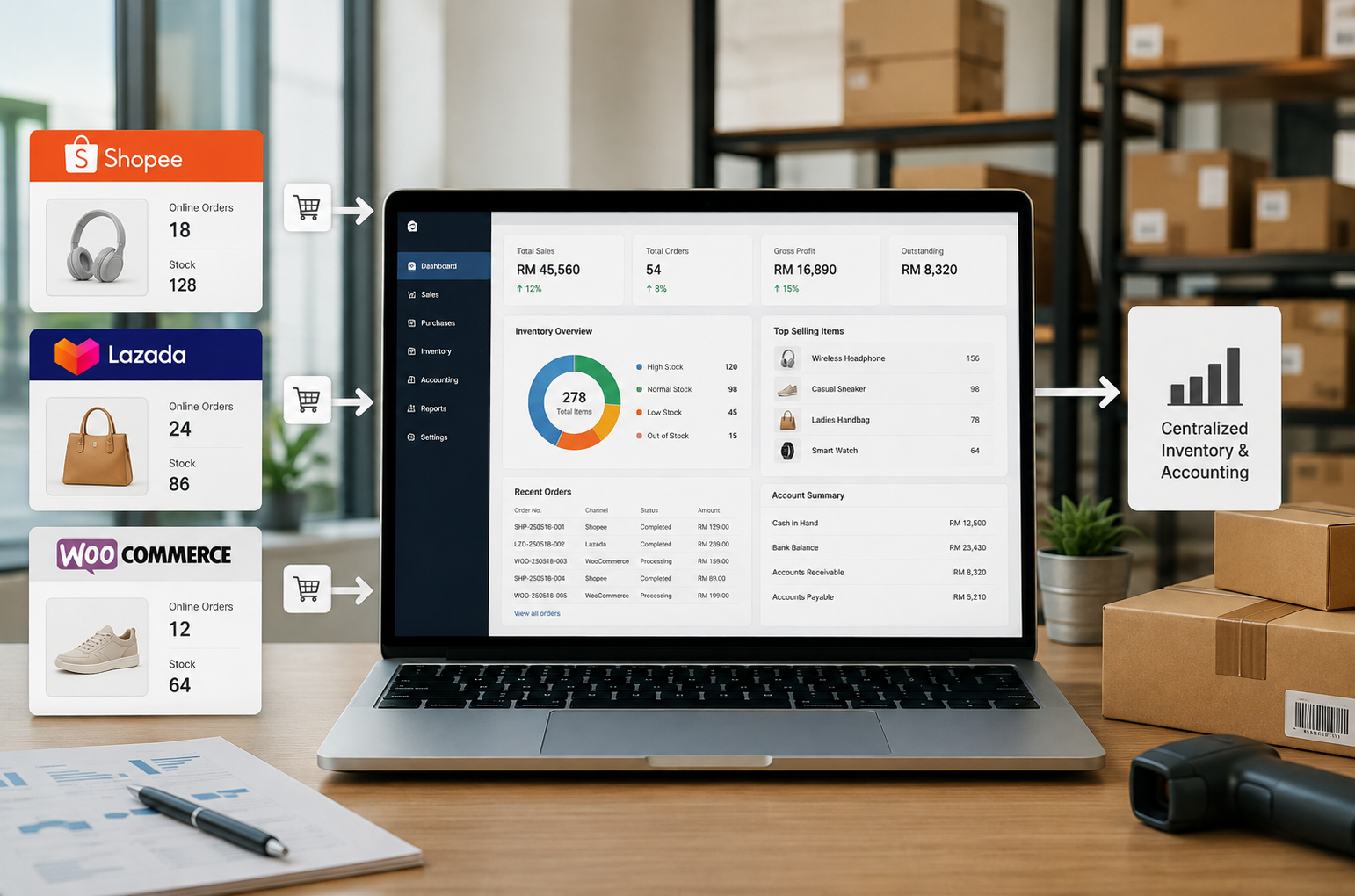
Selling on Shopee, Lazada and WooCommerce can quickly create separate order, stock and accounting records. AutoCount ecommerce integration Malaysia helps sellers centralise sales data, synchronise inventory and connect marketplace activity with accounting and e-Invoice workflows in one system.
The Multichannel Problem Malaysian Sellers Are Not Talking About
Selling through Shopee, Lazada and your own ecommerce website can increase your reach, but it also creates an operational problem: every channel can become a separate source of orders, stock information and transaction records.
Without integration, staff may have to check several dashboards, copy order information into the accounting system, update stock quantities and reconcile marketplace transactions separately.
The problems become more noticeable as order volume and SKU count increase.
Common problems include:
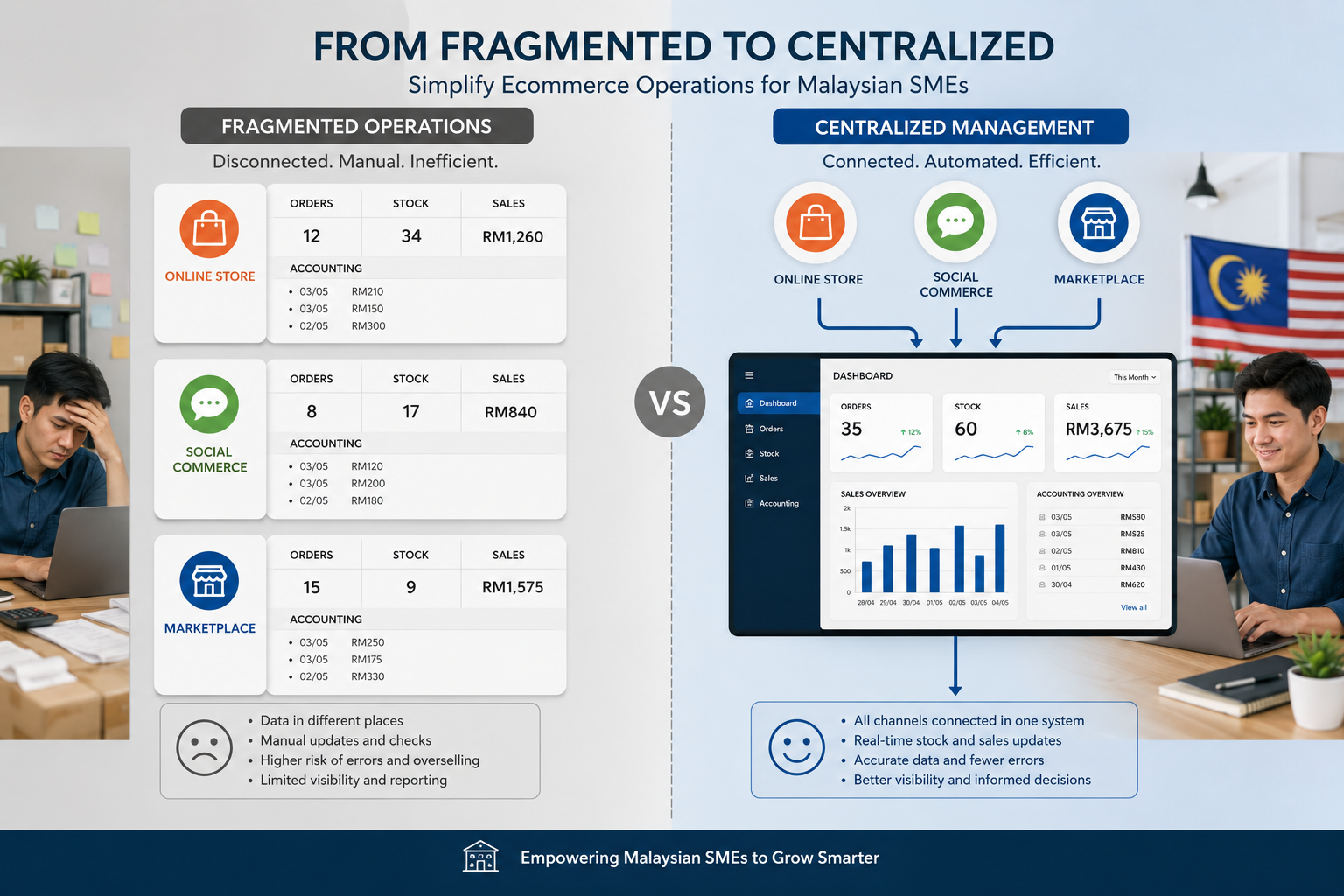
- Overselling: Stock sold through one channel may still appear available elsewhere if inventory is not synchronised quickly enough.
- Repeated data entry: Online orders may need to be entered again into the accounting system.
- Marketplace reconciliation: Different platforms have their own fees, settlements, refunds and transaction reports.
- Inventory blind spots: Teams may not have one reliable stock balance across every sales channel.
- Fragmented reporting: Comparing sales and profitability across platforms becomes more difficult when data is stored separately.
The goal of ecommerce integration is therefore not simply to connect software. It is to create one operational flow between online orders, stock control and accounting.
AutoCount’s current ecommerce integration offering supports centralised sales management and inventory synchronisation across multiple ecommerce platforms.
How Does AutoCount Ecommerce Integration Actually Work?
AutoCount ecommerce integration connects online sales activity with the accounting and inventory workflow instead of requiring staff to repeatedly transfer the same information between systems.
Depending on the ecommerce platform and connector being used, the exact integration method can differ. AutoCount supports ecommerce plugins, integrations and middleware solutions for different sales channels.
A typical multichannel order workflow looks like this:
- A customer places an order through an ecommerce marketplace or online store.
- The connected ecommerce solution imports the order into the central sales workflow.
- Inventory records are updated based on the transaction.
- Revised stock information can be synchronised with other connected sales channels.
- The order information becomes available for accounting, reporting and fulfilment.
- The appropriate e-Invoice treatment can then be applied based on the transaction type and current LHDN requirements.
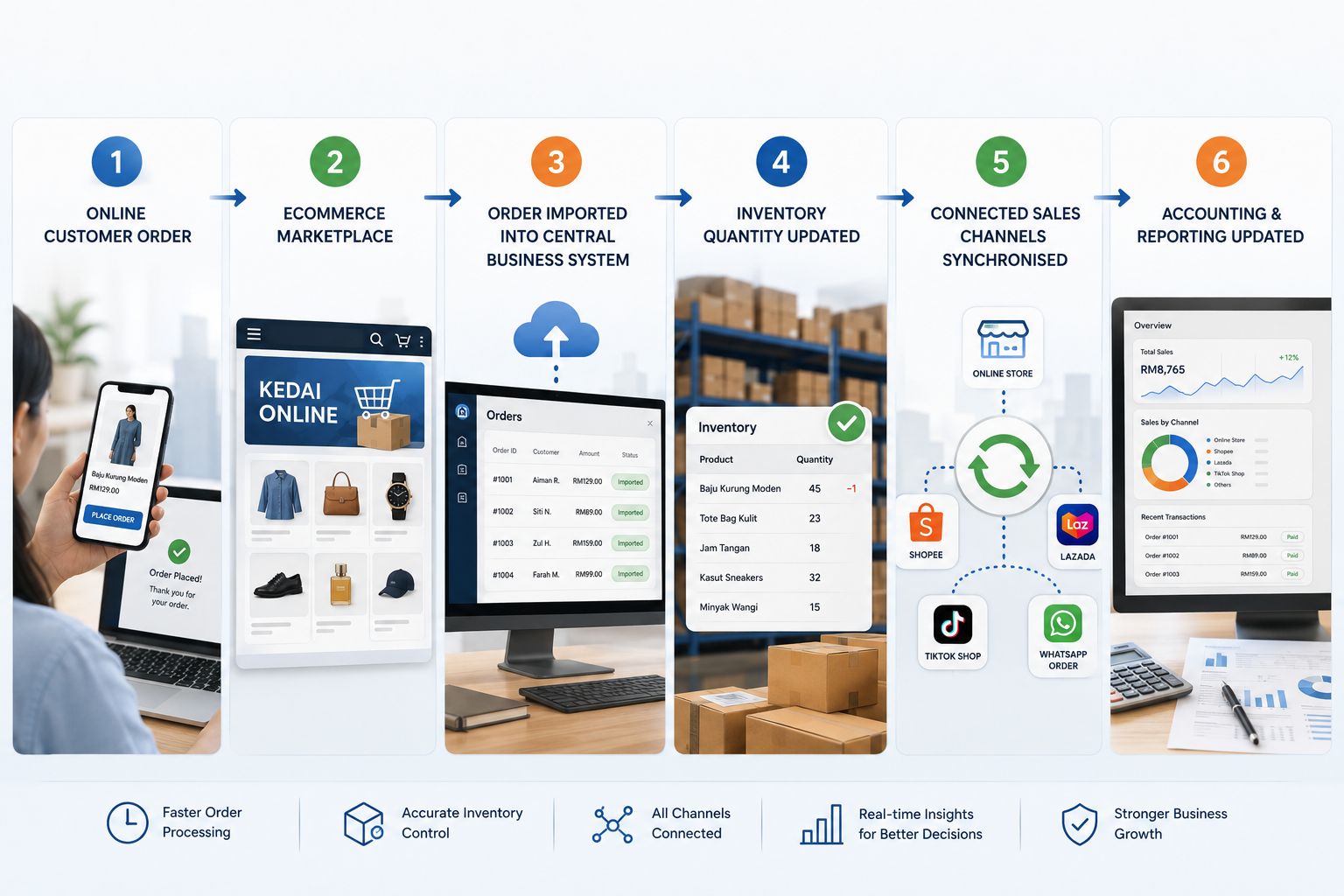
For example, if a product sells through Shopee, the business should not need to manually reduce the same product quantity in every other connected channel. The central inventory record becomes the reference point for the connected ecommerce workflow.
This reduces duplicate data entry and gives sales, warehouse and accounting teams a more consistent set of information.
Which Ecommerce Platforms Integrate with AutoCount in Malaysia?
AutoCount’s current ecommerce integration page lists a broader range of supported channels than Shopee, Lazada and WooCommerce alone. Options currently shown include EasyStore, Lazada, Shopee, Shopify, SiteGiant, TikTok, WooCommerce and Facebook-related integrations.
For this article, the three most relevant channels are Shopee, Lazada and WooCommerce because they demonstrate how marketplace orders and a company’s own ecommerce store can be managed through one connected workflow.
| Platform | AutoCount Integration | Main Use |
|---|---|---|
| Shopee | Supported | Online orders, sales records and inventory synchronisation |
| Lazada | Supported | Online orders, inventory and marketplace sales management |
| WooCommerce | Supported | Connect a company's own ecommerce website with AutoCount |
| Shopify | Supported | Connect Shopify sales with accounting and inventory records |
| EasyStore | Supported | Ecommerce sales and inventory integration |
| SiteGiant | Supported | Multichannel marketplace management and synchronisation |
| TikTok / Live Commerce | Integration options available | Connect social commerce activity through supported integration solutions |
The exact features, synchronisation method and frequency can vary depending on the connector, plugin or middleware used. Businesses should confirm their required workflow before implementation.
Why Unified Inventory Sync Is the Game Changer for Multichannel Sellers
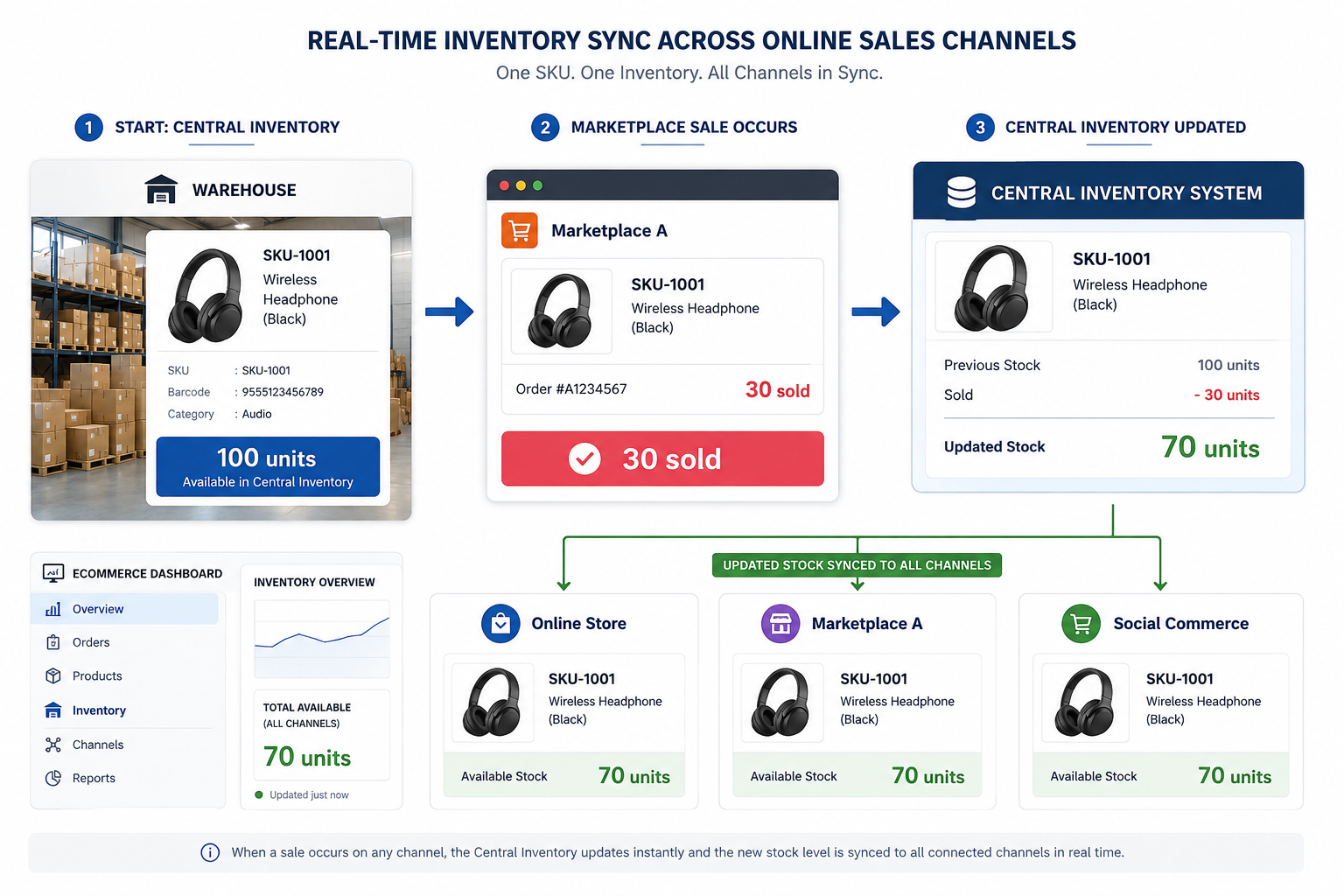
Inventory is one of the biggest reasons to connect multiple ecommerce channels to a central system.
Consider a seller with 100 units of the same product available across Shopee, Lazada and WooCommerce.
If Shopee sells 30 units, the actual available quantity becomes 70.
Without proper integration, Lazada or WooCommerce may continue displaying an outdated quantity until somebody manually updates it. During busy campaign periods such as 11.11 or 12.12, even a short information gap can increase the risk of accepting orders for stock that is no longer available.
With a central inventory workflow, the transaction updates the main stock record and revised inventory can be synchronised to the connected channels.
AutoCount describes real-time inventory synchronisation as one of the key benefits of its ecommerce integrations, helping businesses maintain more consistent stock information across sales channels.
For businesses managing hundreds or thousands of SKUs, this becomes much more than an accounting feature. It supports purchasing, fulfilment, warehouse planning and customer service.
How Does AutoCount Support e-Invoice Workflows for Ecommerce Sellers?
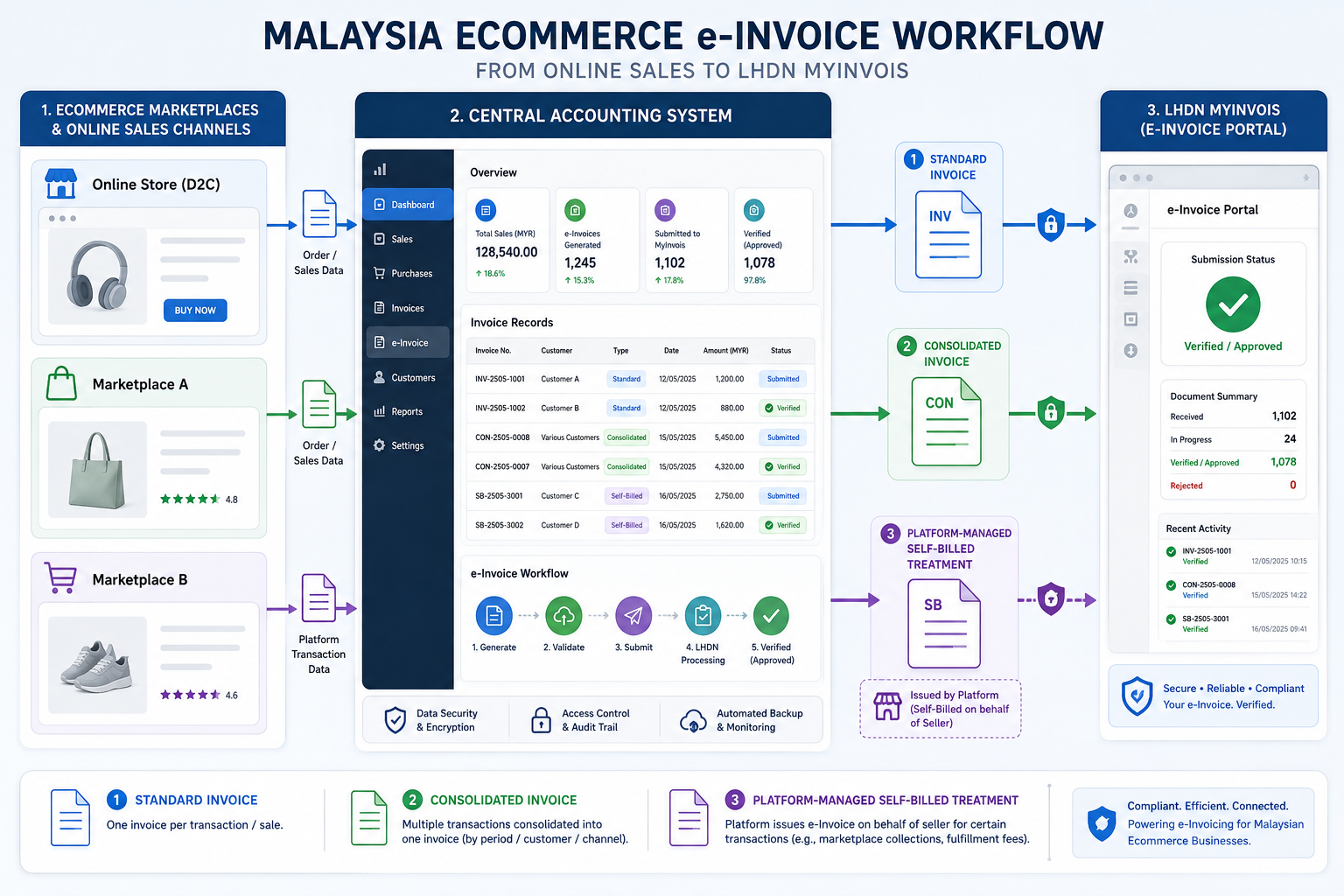
Malaysia’s e-Invoice requirements make accurate ecommerce accounting even more important, but marketplace transactions need to be handled according to the correct transaction type.
AutoCount’s E-Invoice Platform can connect eligible invoices with LHDN’s MyInvois system and supports standard, consolidated and self-billed e-Invoice workflows.
However, ecommerce sellers should not assume that every marketplace transaction must automatically be submitted again as a seller-issued e-Invoice.
For certain ecommerce transactions involving platforms such as Shopee and Lazada, the platform may issue self-billed e-Invoices. AutoCount’s own ecommerce e-Invoice guidance specifically explains that businesses should configure these platform-managed transactions correctly to avoid duplicate submissions.
Therefore, the better ecommerce workflow is:
- Import and record marketplace transactions accurately.
- Maintain consistent sales and inventory records.
- Identify whether the transaction requires a standard, consolidated or self-billed e-Invoice treatment.
- Submit eligible e-Invoices through the configured AutoCount e-Invoice workflow.
- Prevent duplicate submissions for transactions already handled through platform-managed self-billing.
- Important
As of August 2026, LHDN’s published implementation timeline states that taxpayers with annual turnover or revenue of up to RM5 million entered implementation from 1 January 2026, while taxpayers below RM1 million annual turnover or revenue are exempt under the current timeline, subject to the relevant rules and conditions.
Businesses should always check the latest LHDN guidance when configuring ecommerce e-Invoice workflows.
AutoCount Integration vs Manual Reconciliation: What Actually Changes?
The value of ecommerce integration becomes clearer when you compare the workflow rather than relying only on estimated time savings.
| Task | Manual Multichannel Process | Integrated Workflow |
|---|---|---|
| Online order entry | Check marketplace and re-enter information | Connected orders can flow into the central system |
| Inventory updates | Update quantities on different platforms | Central inventory supports synchronised stock information |
| Marketplace reconciliation | Compare separate exports and transaction reports | Sales records are kept in a more centralised workflow |
| Accounting records | Re-enter or import information manually | Ecommerce activity connects with accounting records |
| e-Invoice handling | Review and prepare transactions separately | Apply the appropriate configured e-Invoice workflow |
| Reporting | Combine multiple spreadsheets | Analyse more consolidated sales and inventory information |
| SKU management | Maintain information separately | Central product and inventory data can support multiple channels |
The biggest benefit is not eliminating every administrative task.
Businesses still need to review exceptions, refunds, marketplace fees, returns and accounting accuracy.
The benefit is reducing repetitive work so staff can spend more time reviewing exceptions instead of copying the same transaction between systems.
AutoCount’s ecommerce material similarly focuses on automated order management, inventory synchronisation and reducing manual processes rather than removing human review entirely.
Who Actually Needs AutoCount Ecommerce Integration in Malaysia?
Ecommerce integration becomes most valuable when managing multiple channels manually starts affecting stock accuracy, fulfilment speed or accounting workload.
Businesses that are likely to benefit include:
- FMCG and beauty brands selling through Shopee, Lazada and other marketplaces with large SKU ranges.
- Fashion and apparel sellers managing colours, sizes and product variants across marketplaces and their own ecommerce store.
- Electronics businesses that require stronger inventory, serial-number and transaction tracking.
- F&B brands selling packaged products through marketplaces and their own website.
- Wholesalers moving into ecommerce while continuing to manage traditional sales orders.
- Retail businesses with online and physical sales channels that need better inventory visibility.
- Growing ecommerce teams where staff are repeatedly copying orders, updating stock or combining marketplace reports.
A small seller operating a single marketplace with relatively few transactions may still be comfortable managing the process manually.
The need for integration usually appears when the business starts asking questions such as:“Which platform has the correct stock quantity?”
“Has this order already been entered into accounting?”
“Why does the marketplace sales total not match our accounts?”
“Which channel is actually generating the best margin?”
When those questions become frequent, centralising the ecommerce workflow starts to provide much greater operational value.
Businesses combining online and physical sales can also explore AutoCount OneSales, which connects POS, ecommerce and inventory workflows within the AutoCount ecosystem.
Conclusion
- Selling through several ecommerce channels creates separate order, inventory and transaction records unless those systems are connected.
- AutoCount currently supports integration options for major ecommerce channels including Shopee, Lazada, WooCommerce, Shopify, EasyStore, SiteGiant and TikTok-related commerce workflows.
- Centralised inventory helps reduce the risk of different channels displaying inconsistent stock quantities.
- Connected order workflows reduce repeated data entry between ecommerce platforms and accounting.
- Helps predict a meaningful business outcome
- Integration is most valuable when multiple channels, higher order volumes or larger SKU ranges make manual processes difficult to control.
- Businesses operating both online and physical sales channels can extend the workflow through solutions such as AutoCount OneSales.
Frequently Asked Questions
Which ecommerce platforms can integrate with AutoCount in Malaysia?
AutoCount currently lists integration options for platforms including Shopee, Lazada, WooCommerce, Shopify, EasyStore, SiteGiant, TikTok and other ecommerce or live-commerce channels. The exact functionality depends on the integration solution used.
Does AutoCount ecommerce integration update inventory in real time?
AutoCount promotes real-time inventory synchronisation as a key benefit of its ecommerce integration solutions. However, the exact synchronisation method and interval can depend on the platform, plugin or middleware configuration, so businesses should confirm their implementation requirements before setup.
Does every Shopee or Lazada order automatically need an e-Invoice from AutoCount?
Not necessarily. Marketplace e-Invoice treatment depends on the transaction type. AutoCount’s guidance notes that platforms such as Shopee and Lazada may issue self-billed e-Invoices for certain platform-managed transactions, so businesses should configure AutoCount carefully to avoid duplicate submissions.
Can ecommerce integration help prevent overselling?
Yes. Keeping inventory in a central system and synchronising the updated quantity with connected sales channels reduces the risk of one platform continuing to display stock that has already been sold elsewhere. It also gives the warehouse and sales teams a more consistent inventory reference.
Is AutoCount ecommerce integration suitable for small businesses?
It can be, especially when a business operates multiple online stores, carries many SKUs or spends significant time transferring orders and updating inventory manually. A very small single-channel seller may not need the same level of integration, while growing multichannel businesses usually gain more value from centralisation.