
-
AutoCount Accounting Features
-
- Approval Workflow
- Audit Trail
- Auto Save in Draft Folder
- AutoCount Contra Account
- AutoCount License Setting Guide
- Deposit Tracking & Management
- Documents Numbering Format
- Full Transfer and Partial Transfer
- Import Data to AutoCount Accounting Using Excel
- Informative Charts and Analytical Data
- Layout Customization
- Multi Pricing
- Sales and Services Tax
- Schedule Backup
- Search Lookup Edit
- View Documents Flow
- AutoCount Feature Stock Take
- Column Chooser
- Show Remaining (3) Collapse
-
AutoCount Cloud Accounting
-
AutoCount E-Invoice
-
AutoCount HRMS User Guide
-
AutoCount Modules
-
- Activity Stream
- Advanced Financial Report
- Advanced Item
- Advanced Multi-UOM
- Advanced Quotation Module
- Basic Multi-UOM
- Budget Module
- Consignment
- Filter By Salesman
- FOC Quantity
- Formula
- Item Batch
- Item Package
- Landing Cost
- Multi-Currency
- Multi-Dimensional Analysis
- Multi-Location
- Project Account
- Recurrence
- Remote Credit Control Module
- Stock Assembly
- User Defined Fields (UDF)
- AutoCount SST Hidden Functions
- AutoCount SST Submission - Service Tax
- AutoCount Scripting Module User Guide
- AutoCount Bonus Point Module User Guide
- AutoCount Service Management Plugin User Guide
- Show Remaining (12) Collapse
-
AutoCount Plugins
-
- Fixed Assets Management
- Goldsmith
- TD Ordering Mobile Apps
- TD Stock Mobile Apps
- Universal Import Plugin
- DMS Import Plugin
- AutoCount Pick List Plugin User Guide
- AutoCount Credit Memo Plugin User Guide
- AutoCount Lock Price Plugin
- AutoCount Progressive Billing
- AutoCount Easy Recurrence Plugin
- Batch Update Unit Price Plugin
- AutoCount Production order
- AutoCount Car Tint Film Plugin
-
- Event Management System
- AutoCount To-Do List Plugin
- AutoCount AutoBank Reconciliation Plugin
- Intercompany Billing Plugin User Guide
- Lead Management 2.0 Plugin
- AutoCount Service Contract Plugin User Guide
- AutoCount Optical Plugin
- AutoCount Integrator Plugin
- AutoCount Procurement Planning Plugin
- Cage Management Plugin
- AutoCount Vehicle Plugin
- AutoCount Agent Validation Plugin User Guide
- AutoCount Barcode Generator Plugin User Guide
- AutoCount Easy Batch Number Entry Plugin User Guide
- Warranty 2.0 Plugin
- AutoCount Easy Photo 2.0 User Guide
- AutoCount Recurring Invoice Plugin User Guide
- AutoCount Scale Barcode Plugin User Guide
- AutoCount Recurrence Late Interest Plugin
- AutoCount Item Visibility Control
- AutoCount Bill Remark Plugin User Guide
- AutoCount Pain Tracker User Guide
- AutoCount Easy Payment
- AutoCount Easy Deposit Plugin
- AutoCount Easy Knock Off Plugin
- AutoCount Daily Collection Summary Plugin
- Timber Log Plugins
- Batch Transfer SODO Plugin
- AutoCount Vege Basket Plugin Guide
- AutoCount Fruit Basket Plugin Guide
- Referral Management Plugin
- AutoCount Migrator Plugin
- AutoCount Email&WhatsApp Plugin
- AutoCount Multi Company Knock Off Plugin
- AutoCount Advance Aging Format Plugin
- AutoCount Payment Request Plugin
- AutoCount Vehicle Master Plugin
- AutoCount Advance Deposit Plugin
- AutoCount IC Checker Plugin
- AutoCount RMA Plugin
- AutoCount Historical Outstanding DO Listing Plugin
- AutoCount Project Department Visibility Control Plugin
- AutoCount MRP Order Plugin
- AutoCount GridToExcel Plugin
- AutoCount Stock Availability Report Plugin
- AutoCount Batch Transfer SO DO Plugin
- AutoCount Centralized Kitchen Management Plugin
- SL AutoCount API
- AutoCount InterCompany Billing Plugin
- AutoCount Sales Commission Plugin
- AutoCount Advanced Credit Term Plugin
- AutoCount Advanced Stock Assembly Plugin
- AutoCount Shipment Plugin
- AutoCount Tour Plugin
- AutoCount Smart Analysis
- AutoCount Rental Management
- Show Remaining (41) Collapse
-
-
Form Template
-
Report Template
-
- Advance Quotation
- Cash Sale
- Consignment
- Consignment Movement
- Credit Note
- Debit Note
- Delivery Order
- FOC Quantity Analysis By Document Report
- Invoice
- Item Package Sales Report
- Monthly Sales Analysis
- Outstanding Sales Order Listing
- Profit And Loss Of Documents
- Quotation
- Sales Agent Contribution Report
- Sales Order
- Top/Bottom Sales Ranking
- Show Remaining (2) Collapse
-
- Available Stock Status Report
- Expired Item Batch Listing
- Inventory Physical Worksheet
- Stock Adjustment
- Stock Aging Report
- Stock Assembly
- Stock Assembly Order
- Stock Balance By Location
- Stock Balance Report
- Stock Card Report
- Stock Disassembly
- Stock Issue
- Stock Item Profit Margin
- Stock Movement Report
- Stock Receive
- Stock Take
- Stock Transfer
- Stock Write Off
- Show Remaining (3) Collapse
-
B2B ORDERING
-
AutoCount AI Agent
AutoCount GridToExcel Plugin User Guide
What Is AutoCount GridToExcel Plugin?
The AutoCount GridToExcel Plugin adds an Export to Excel command to the standard Debtor Aging Report in AutoCount Accounting. It is useful for companies that want debtor aging, with its document details, in an Excel file for further analysis or sharing.
Why Use AutoCount GridToExcel Plugin?
Without an export, getting debtor aging into Excel means copying, pasting and reformatting the report by hand. The GridToExcel Plugin helps businesses:
Export debtor aging in one click
Get document-level detail in the file
Analyse and filter aging in Excel
Share aging with people outside AutoCount
This is particularly important for businesses that review or share debtor aging in Excel every month.
Key Features of AutoCount GridToExcel Plugin
One-Click Export
Export the Debtor Aging Report to Excel from an Export menu on the report screen.
Document-Level Detail
The file includes account and company details, document information, and total and aging values.
Ready-Named File
The default file name starts with “Debtor Aging for” and includes the company name and report date.
Follows Existing Permissions
The export is allowed only for users who have AutoCount’s Debtor Aging export permission.
Who Should Use AutoCount GridToExcel Plugin?
Physiotherapy Clinics
Helps physiotherapists record customer pain areas, treatment notes, and progress history for each session.
TCM Centres
Allows TCM centres to keep clearer customer treatment records, pain points, and follow-up notes in one place.
Massage Therapy Centres
Helps massage centres record customer pain areas and previous session remarks for better follow-up service.
Beauty and Wellness Providers
Useful for wellness and beauty businesses that need to track customer concerns, treatment notes, and service progress over time.
How AutoCount GridToExcel Plugin Works
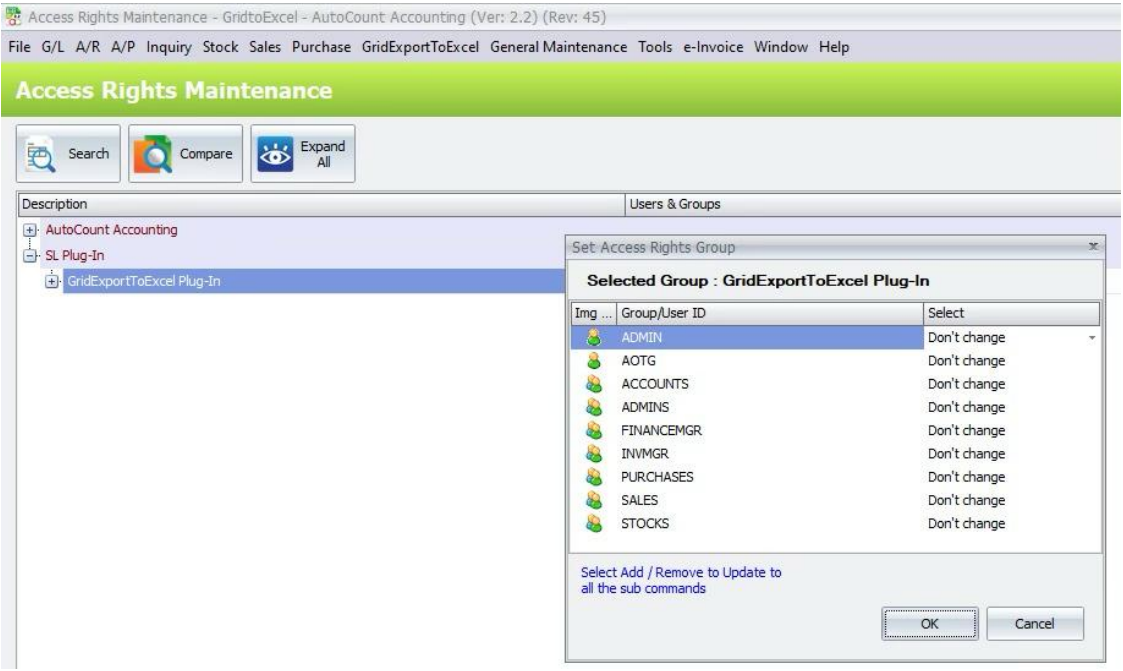
A. Access Rights
GridToExcel uses AutoCount’s Debtor Aging export permission before it allows an Excel export. Theplugin also registers a Show License Status access right under its SL Plug-In access-right group.
1. Open General Maintenance > Access Right Maintenance.

2. Select the required user or user group.
3. Make sure the user is allowed to export the Debtor Aging report. If this permission is not available, theplugin stops the Excel export.
4. If the user needs to open the plugin license screen, enable SL Plug-In > GridExportToExcel Plug-In>Show License Status.
5. Save the access-right changes.
B. Export Debtor Aging to Excel
GridToExcel adds an Export to Excel button to the standard Debtor Aging Report. The exportedfileiscreated from the Debtor Aging data for the selected report date and criteria.
1. Open the standard Debtor Aging Report in AutoCount.
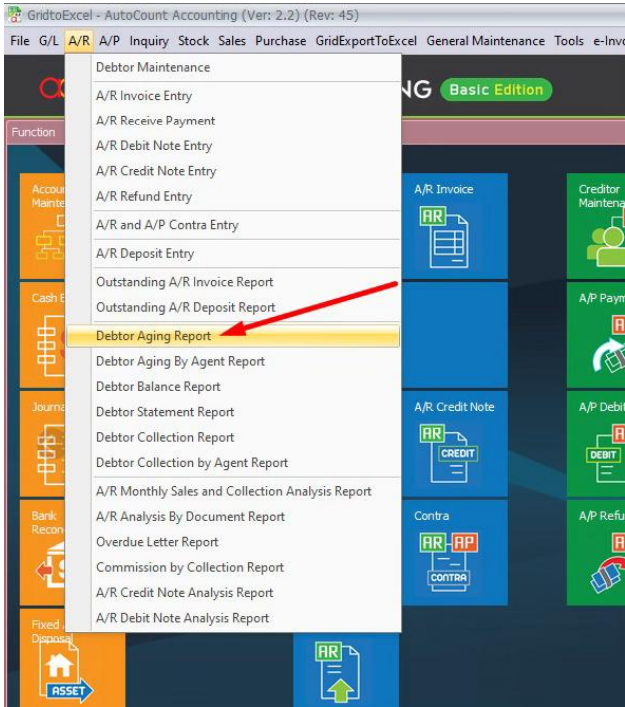
2. Set the required report date and Debtor Aging criteria.
3. Click Export to Excel. If the inquiry result has not been loaded yet, the plugin first runs the normal
Debtor Aging inquiry.

4. When “Where do you want to save the Debtor Aging file?” appears, select the folder and file name.
5. Click Save. The plugin saves the file in .xls format. The default file name starts with “Debtor Agingfor”and includes the company name and report date.

C. Review the Exported Excel File
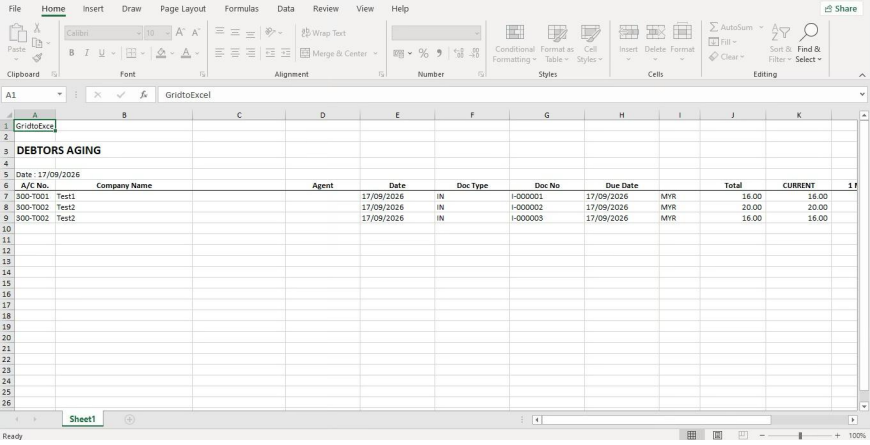
After the export is completed, AutoCount shows “Debtor Aging file has saved successfully. Do youwant toopen it?”. Choose whether to open the saved workbook immediately.
1. Click Yes to open the Excel file, or No to remain in AutoCount.

2. Review the company name, DEBTORS AGING title and report date at the top of the worksheet.
3. Review the debtor and document details. The export includes account and company details, document
information, total and aging values, and additional debtor information used by the report.
4. The exported rows follow the Debtor Aging report data and its selected debtor and detail sorting.
This is particularly important for businesses that rely on repeat treatment sessions and progress tracking.
Benefits of AutoCount GridToExcel Plugin
Saves Time
Debtor aging reaches Excel in one step, with no copying or reformatting.
More Detail for Analysis
Document-level rows let you filter, sort and total the aging in ways the printed report cannot.
Easy to Share
An Excel file can be emailed to salespeople, managers or auditors who do not use AutoCount.
Uses Existing Permissions
The export follows the Debtor Aging export permission, so there is no separate access setup to manage.
Conclusion
The AutoCount GridToExcel Plugin is a small add-on that removes a repeated manual task. By adding Export to Excel to the Debtor Aging Report, it gives accounts and credit control teams the data they need in the format they already work in.
Frequently Asked Questions
What does the GridToExcel Plugin do?
It adds a direct export function to AutoCount’s standard Debtor Aging Report, enabling users to export complete debtor aging data into Microsoft Excel spreadsheets with a single click.
Why should I use the GridToExcel Plugin?
It eliminates manual copy-pasting, retains complete aging breakdown columns and debtor details, and formats spreadsheets automatically for faster financial reporting and analysis.
How do I export Debtor Aging reports to Excel?
Open A/R > Debtor Aging Report, specify your report date and filtering criteria, and click the Export to Excel button in the top menu bar.
What details are included in the exported Excel spreadsheet?
The exported workbook includes the company name, report date, debtor account codes, debtor company names, agents, document numbers, due dates, total balances, and aging interval periods.
How does the plugin format and save the exported file?
It saves the file as an Excel .xls workbook with a default filename containing “Debtor Aging for”, your company name, and the report date, followed by a prompt asking if you want to open the file immediately.
What access rights are required to use the export feature?
Users must have standard AutoCount Debtor Aging export permissions granted under General Maintenance > Access Right Maintenance; access to the plugin license view is managed under SL Plug-In > GridExportToExcel Plug-In.
Start Exporting Your Debtor Aging to Excel Today!
This plugin enables us to export complete Debtor Aging reports directly to Excel with a single click, eliminating manual copying while preserving detailed aging buckets and sort orders. We can efficiently standardize financial workbook archives with automated naming conventions, streamline receivables auditing, and protect data integrity through native AutoCount access control.