
-
AutoCount Accounting Features
-
- Approval Workflow
- Audit Trail
- Auto Save in Draft Folder
- AutoCount Contra Account
- AutoCount License Setting Guide
- Deposit Tracking & Management
- Documents Numbering Format
- Full Transfer and Partial Transfer
- Import Data to AutoCount Accounting Using Excel
- Informative Charts and Analytical Data
- Layout Customization
- Multi Pricing
- Sales and Services Tax
- Schedule Backup
- Search Lookup Edit
- View Documents Flow
- AutoCount Feature Stock Take
- Column Chooser
- Show Remaining (3) Collapse
-
AutoCount Cloud Accounting
-
AutoCount E-Invoice
-
AutoCount HRMS User Guide
-
AutoCount Modules
-
- Activity Stream
- Advanced Financial Report
- Advanced Item
- Advanced Multi-UOM
- Advanced Quotation Module
- Basic Multi-UOM
- Budget Module
- Consignment
- Filter By Salesman
- FOC Quantity
- Formula
- Item Batch
- Item Package
- Landing Cost
- Multi-Currency
- Multi-Dimensional Analysis
- Multi-Location
- Project Account
- Recurrence
- Remote Credit Control Module
- Stock Assembly
- User Defined Fields (UDF)
- AutoCount SST Hidden Functions
- AutoCount SST Submission - Service Tax
- AutoCount Scripting Module User Guide
- AutoCount Bonus Point Module User Guide
- AutoCount Service Management Plugin User Guide
- Show Remaining (12) Collapse
-
AutoCount Plugins
-
- Fixed Assets Management
- Goldsmith
- TD Ordering Mobile Apps
- TD Stock Mobile Apps
- Universal Import Plugin
- DMS Import Plugin
- AutoCount Pick List Plugin User Guide
- AutoCount Credit Memo Plugin User Guide
- AutoCount Lock Price Plugin
- AutoCount Progressive Billing
- AutoCount Easy Recurrence Plugin
- Batch Update Unit Price Plugin
- AutoCount Production order
- AutoCount Car Tint Film Plugin
-
- Event Management System
- AutoCount To-Do List Plugin
- AutoCount AutoBank Reconciliation Plugin
- Intercompany Billing Plugin User Guide
- Lead Management 2.0 Plugin
- AutoCount Service Contract Plugin User Guide
- AutoCount Optical Plugin
- AutoCount Integrator Plugin
- AutoCount Procurement Planning Plugin
- Cage Management Plugin
- AutoCount Vehicle Plugin
- AutoCount Agent Validation Plugin User Guide
- AutoCount Barcode Generator Plugin User Guide
- AutoCount Easy Batch Number Entry Plugin User Guide
- Warranty 2.0 Plugin
- AutoCount Easy Photo 2.0 User Guide
- AutoCount Recurring Invoice Plugin User Guide
- AutoCount Scale Barcode Plugin User Guide
- AutoCount Recurrence Late Interest Plugin
- AutoCount Item Visibility Control
- AutoCount Bill Remark Plugin User Guide
- AutoCount Pain Tracker User Guide
- AutoCount Easy Payment
- AutoCount Easy Deposit Plugin
- AutoCount Easy Knock Off Plugin
- AutoCount Daily Collection Summary Plugin
- Timber Log Plugins
- Batch Transfer SODO Plugin
- AutoCount Vege Basket Plugin Guide
- AutoCount Fruit Basket Plugin Guide
- Referral Management Plugin
- AutoCount Migrator Plugin
- AutoCount Email & WhatsApp Plugin
- AutoCount Multi Company Knock Off Plugin
- AutoCount Advance Aging Format Plugin
- AutoCount Payment Request Plugin
- AutoCount Vehicle Master Plugin
- AutoCount Advance Deposit Plugin
- AutoCount IC Checker Plugin
- AutoCount RMA Plugin
- AutoCount Historical Outstanding DO Listing Plugin
- AutoCount Project Department Visibility Control Plugin
- AutoCount MRP Order Plugin
- AutoCount GridToExcel Plugin
- AutoCount Stock Availability Report Plugin
- AutoCount Batch Transfer SO DO Plugin
- AutoCount Centralized Kitchen Management Plugin
- SL AutoCount API
- AutoCount InterCompany Billing Plugin
- AutoCount Sales Commission Plugin
- AutoCount Advanced Credit Term Plugin
- AutoCount Advanced Stock Assembly Plugin
- AutoCount Shipment Plugin
- AutoCount Tour Plugin
- AutoCount Smart Analysis
- AutoCount Rental Management
- Show Remaining (41) Collapse
-
-
Form Template
-
Report Template
-
- Advance Quotation
- Cash Sale
- Consignment
- Consignment Movement
- Credit Note
- Debit Note
- Delivery Order
- FOC Quantity Analysis By Document Report
- Invoice
- Item Package Sales Report
- Monthly Sales Analysis
- Outstanding Sales Order Listing
- Profit And Loss Of Documents
- Quotation
- Sales Agent Contribution Report
- Sales Order
- Top/Bottom Sales Ranking
- Show Remaining (2) Collapse
-
- Available Stock Status Report
- Expired Item Batch Listing
- Inventory Physical Worksheet
- Stock Adjustment
- Stock Aging Report
- Stock Assembly
- Stock Assembly Order
- Stock Balance By Location
- Stock Balance Report
- Stock Card Report
- Stock Disassembly
- Stock Issue
- Stock Item Profit Margin
- Stock Movement Report
- Stock Receive
- Stock Take
- Stock Transfer
- Stock Write Off
- Show Remaining (3) Collapse
-
B2B ORDERING
-
AutoCount AI Agent
SL AutoCount Rental Management Setup Guide
Understanding Rental Management Plugin
The AutoCount Rental Management Plugin helps businesses manage the complete rental lifecycle, from creating rental contracts and scheduling dispatch to monthly billing, return tracking, expiry reminders, and billing analysis. Users can configure rental settings, maintain rental pricing, monitor rental status, and streamline rental operations through a centralized workflow
Benefits of Using the Rental Management Plugin
Centralizes Rental Operations
Simplifies Rental Contracts
Tracks Rental Status
Automates Monthly Billing
Monitors Expiry & Reports
How SL AutoCount Rental Management Works
A. Access Rights
Rental Management access rights control rental records, calendar visibility, settings, trip processing, invoice transfer, and analysis reports.
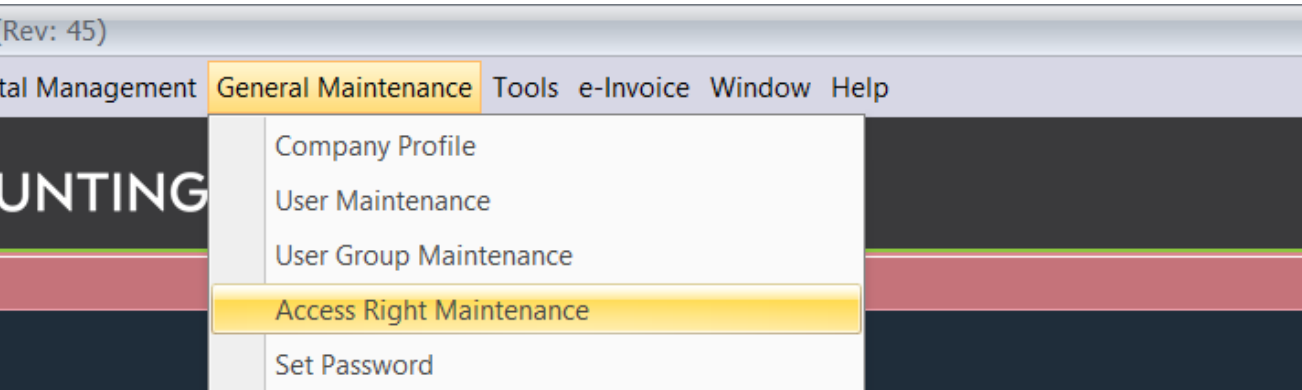
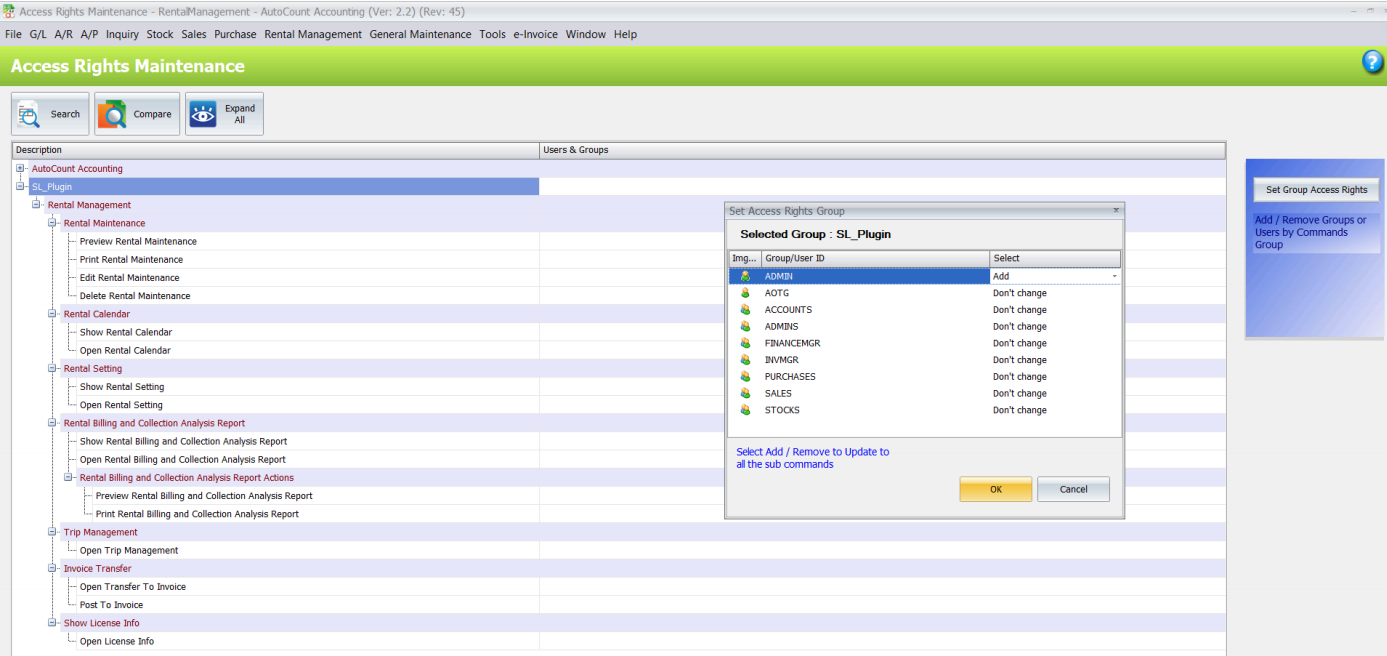
- Open Access Rights and expand SL Plug-In > Rental Management.
- Assign Rental Maintenance preview, print, edit, and delete rights according to each user role.
- Assign Show and Open Rental Calendar and Rental Setting only to users who require those functions.
- Assign Trip Management access to dispatch and return users.
- Assign Open Transfer To Invoice and Post To Invoice only to authorised billing users.
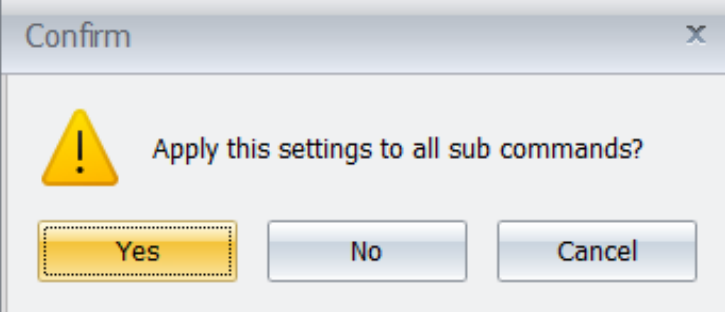
- Assign billing-analysis report preview and print rights to management or finance users, then save the access-right changes.
B. Configure Rental Settings and Item Pricing
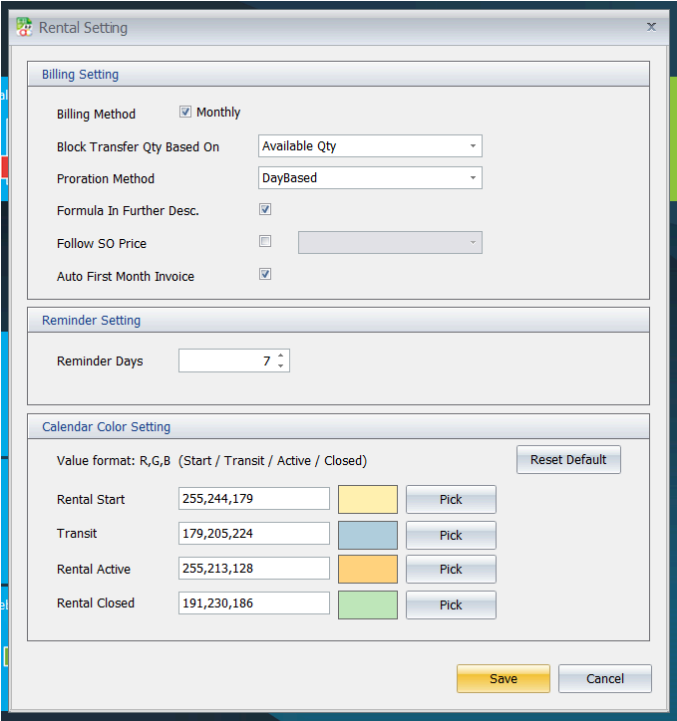
Rental Setting defines billing behaviour, reminders, and calendar colours. Rental item pricing defines the rental charge and reservation details for each rental item.
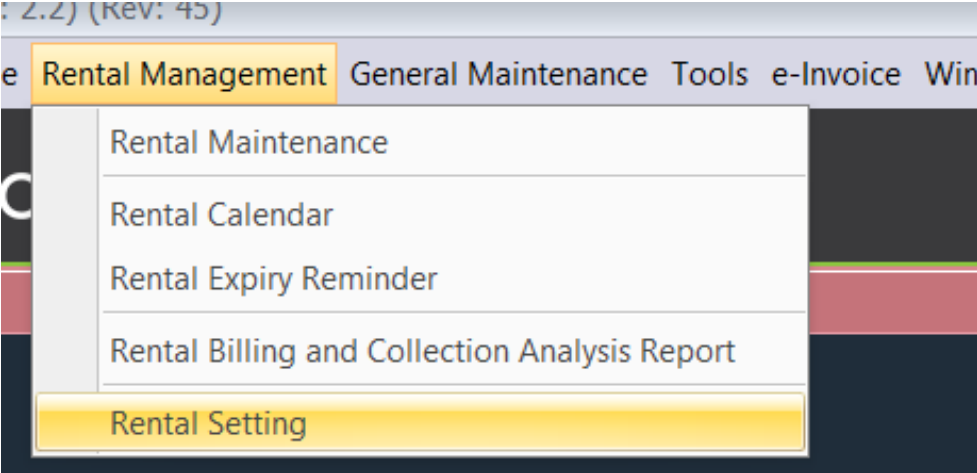
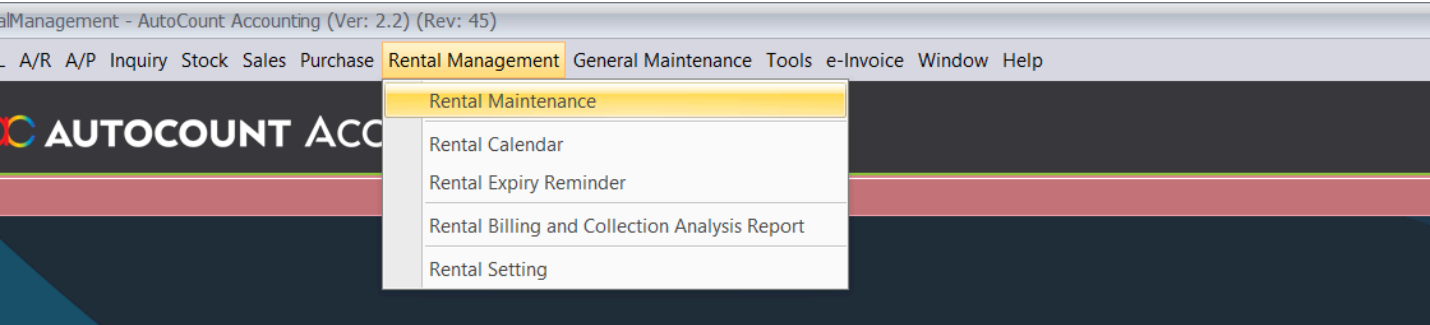
- Open Rental Management > Rental Setting.
- Set the Billing Method and Default Item Code used by the rental workflow.
- Choose whether rental invoices follow Sales Order prices, whether the formula is written in Further Description, and whether the first month is invoiced automatically at rental start.
- Set the Proration Method, Monthly billing option, and the rule used to block transfer quantity when required.
- Set Reminder Days and the calendar colours for rental start, transit, rental active, and rental closed. Click Save.
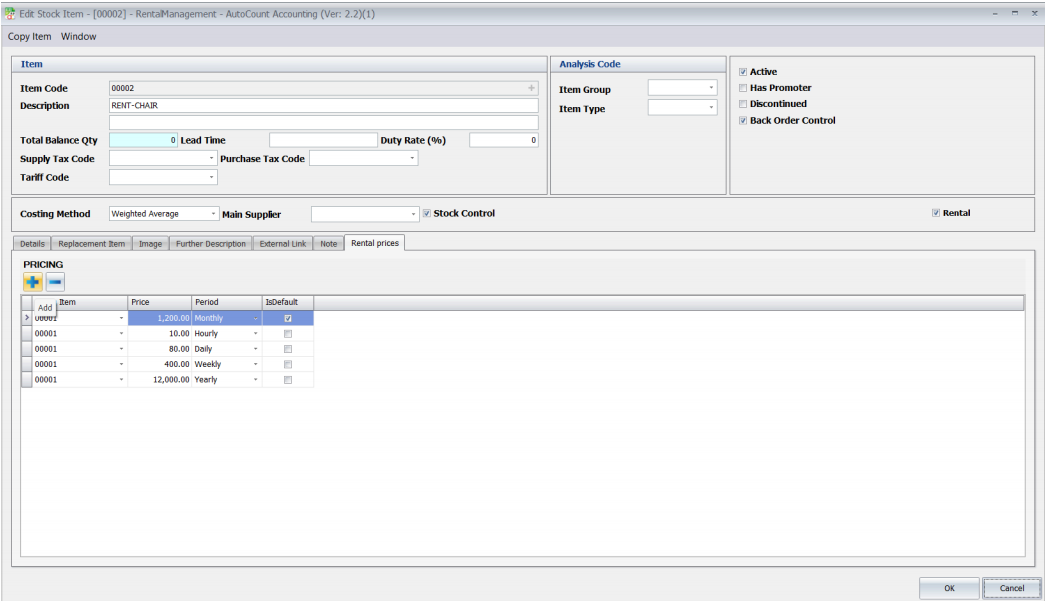
- In Stock Item Maintenance, open the rental item pricing section and maintain the billing item, monthly, daily, and hourly rental prices, plus any hourly or daily late fine.
C. Create a Rental Contract
Rental Maintenance records the debtor, rental period, rental location, contracted items, prices, deposits, and delivery information.
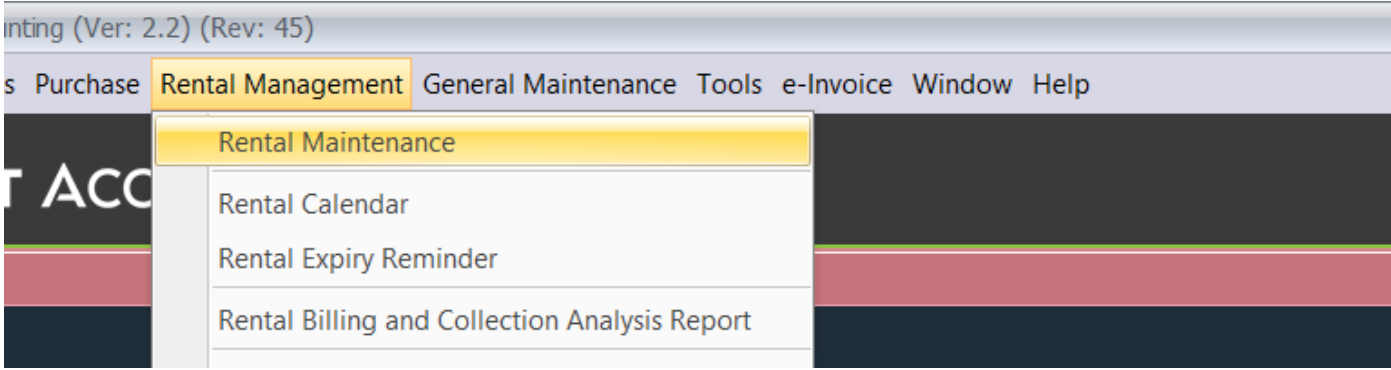
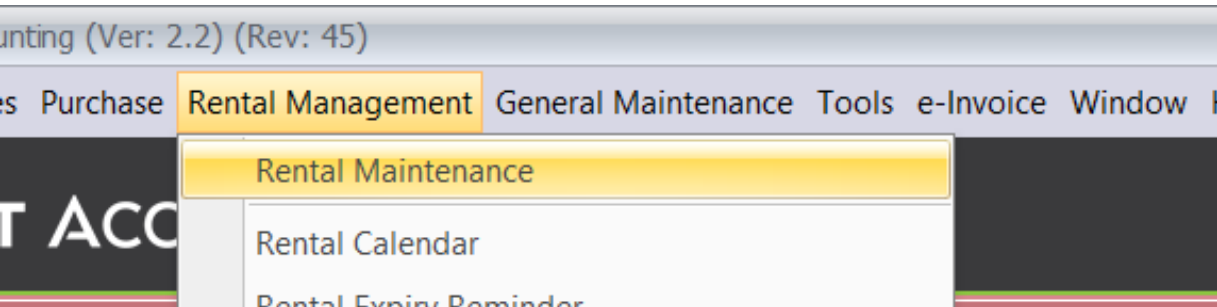
- Open Rental Management > Rental Maintenance and click New.
- Enter Debtor Code, document date, company information, description, sales agent, and attention details.
- Enter Rental Start, Rental End, Location, Credit Terms, and reference document details.
- Add rental item rows and confirm the Rental Item, Contract Qty, Billing Item Code, Rate per Unit, Daily Rate per Unit, Hourly Rate per Unit, and Price Total.
- Open the Deposit tab and record payment method, payment amount, and other deposit details when required.
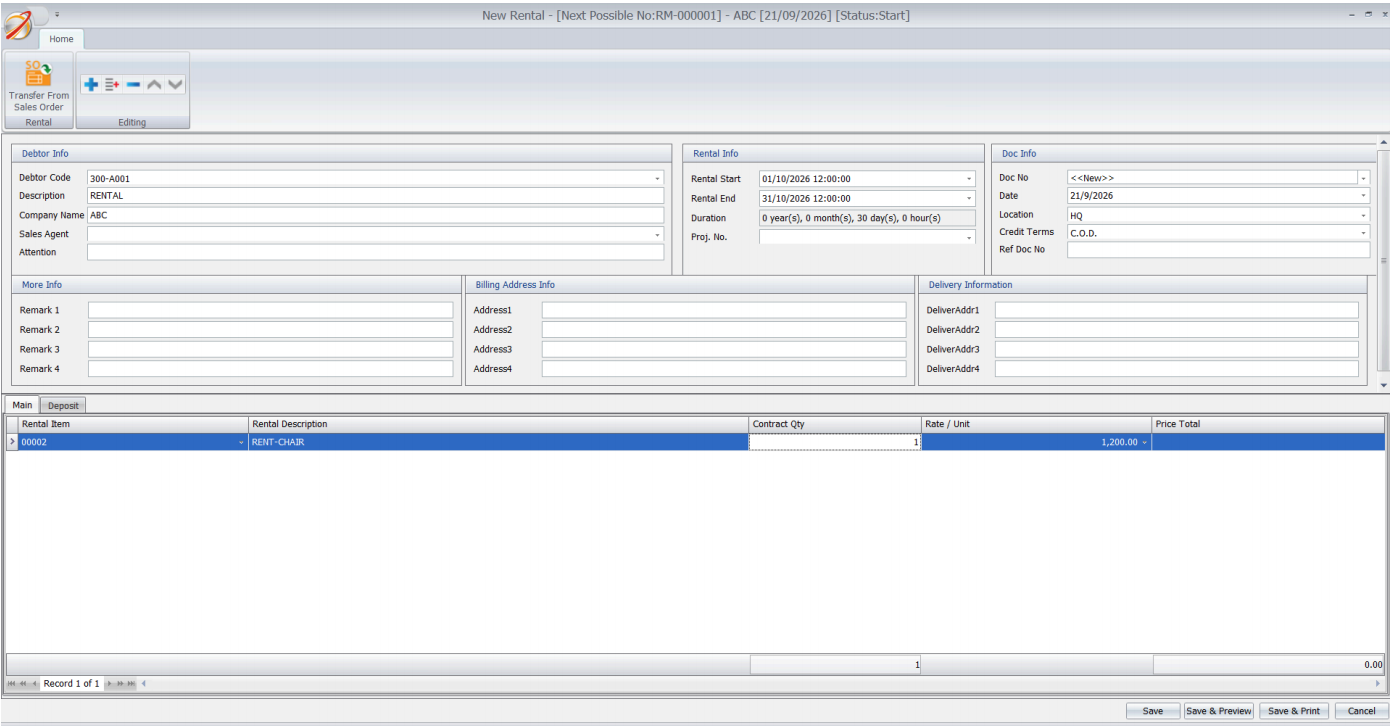
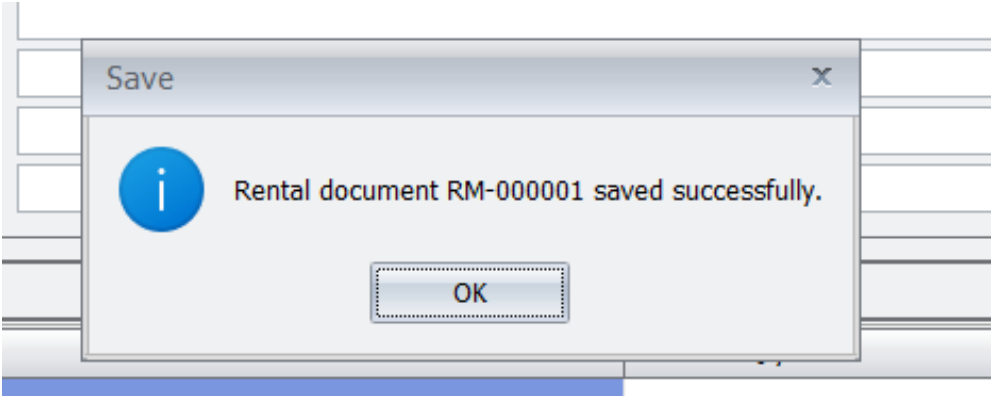
- Save the rental. Use Save and Preview or Save and Print when a Rental Note is required.
D. Transfer From Sales Order and Track the Rental
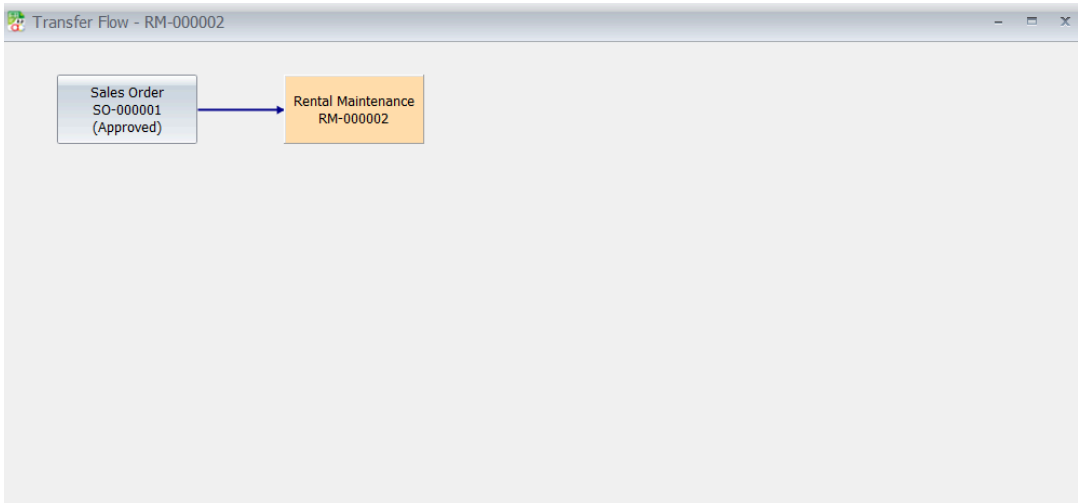
A rental may be created from a Sales Order. The Rental Maintenance list shows the source in Transfer From and the linked output documents in Transfer To.
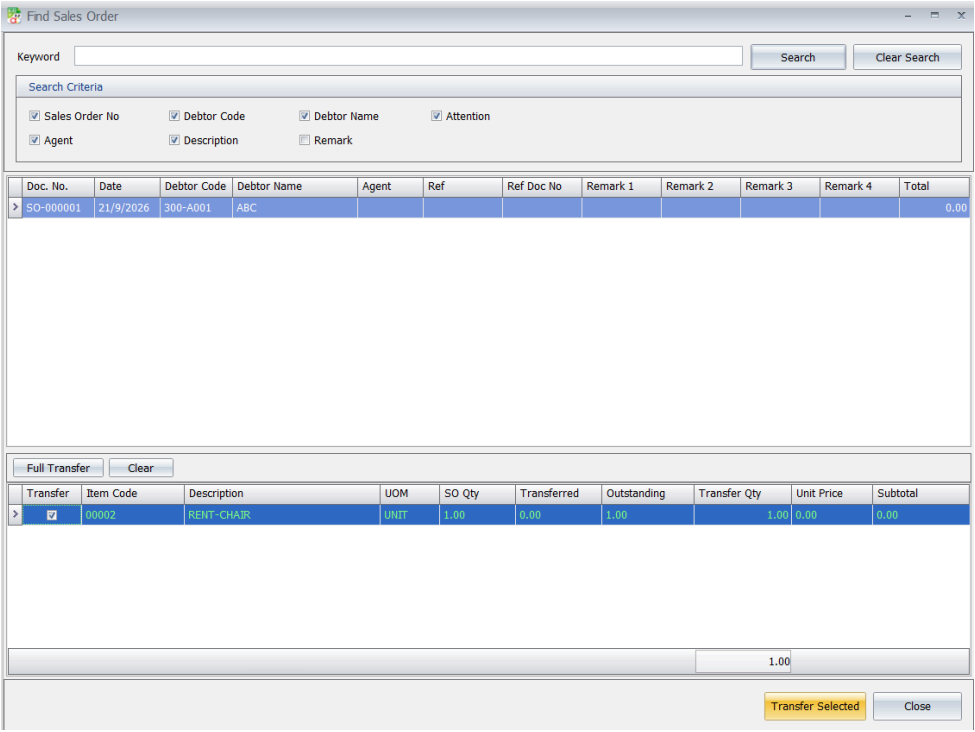
- Open a new or editable rental and choose Transfer From Sales Order.
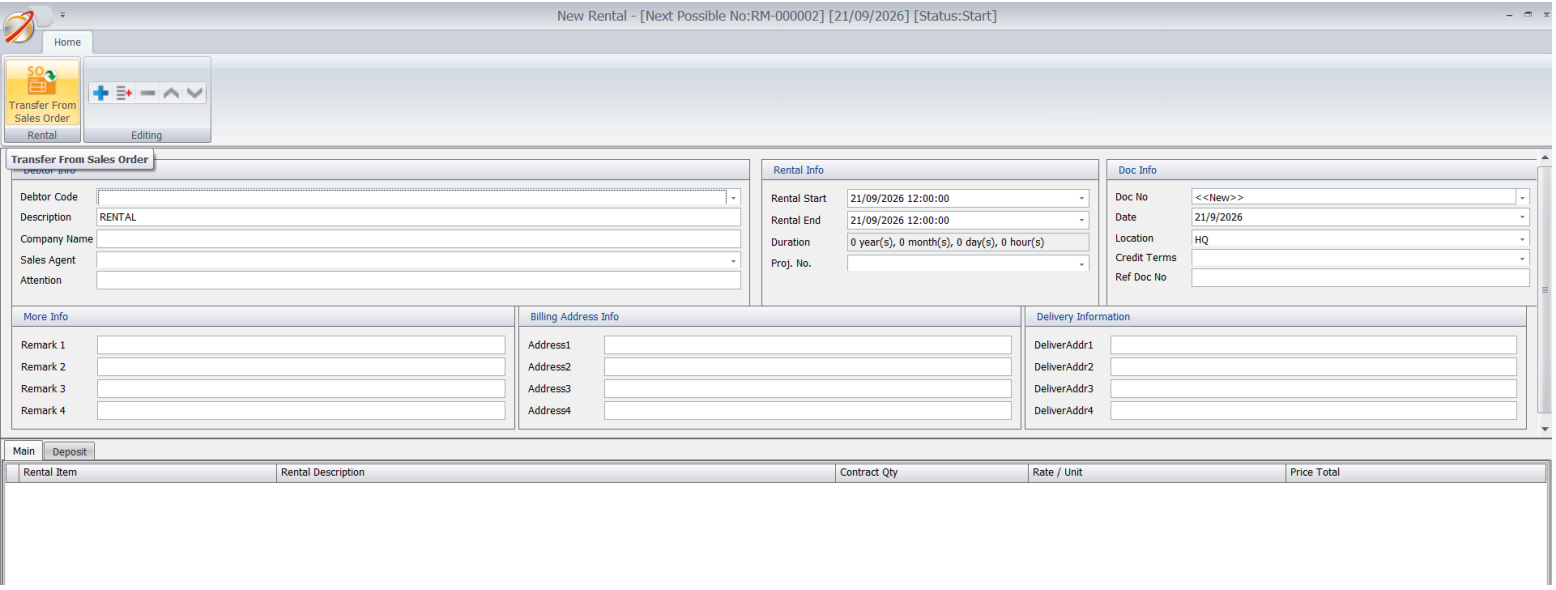
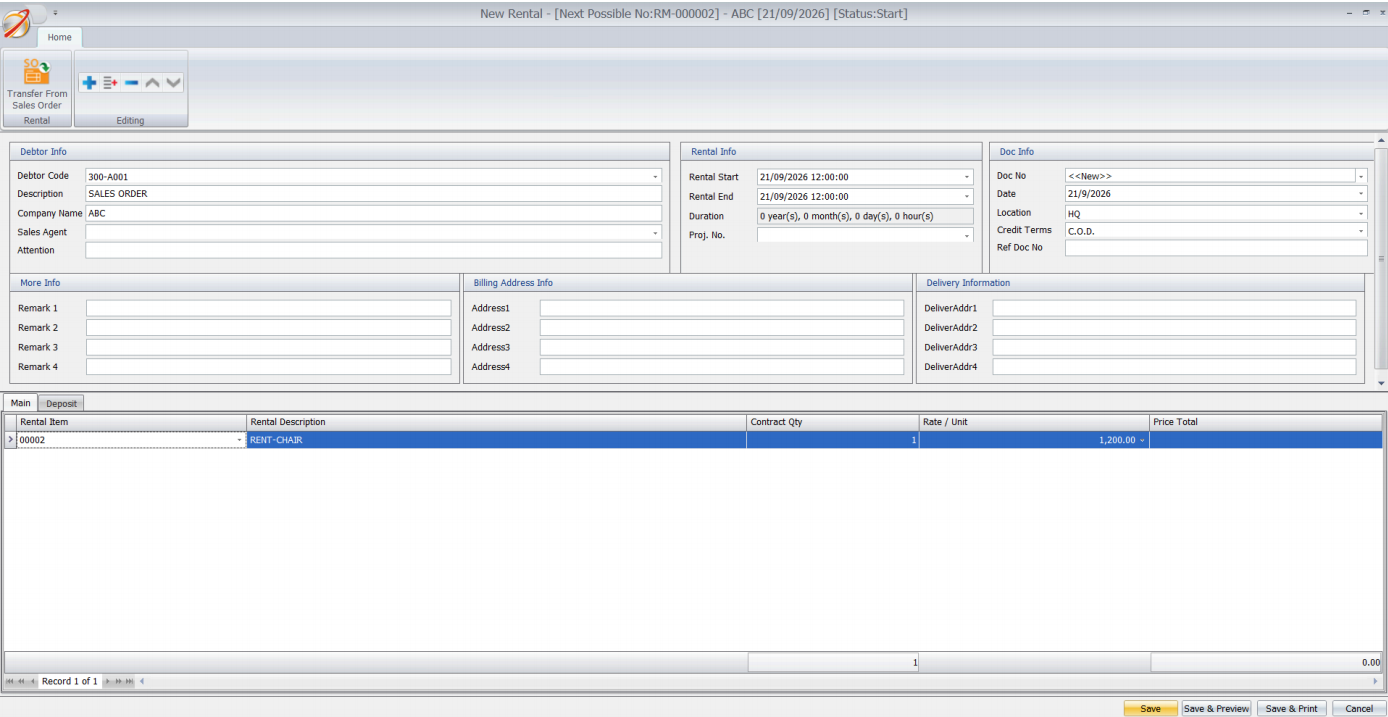
- Select the eligible Sales Order and confirm the transferred debtor, item, and document details.
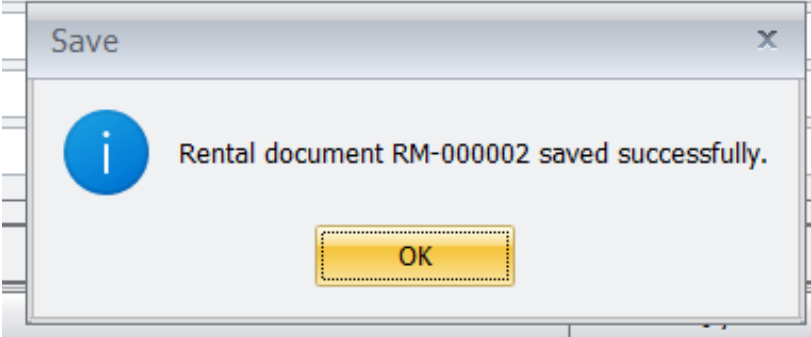
- Save the rental and return to Rental Maintenance.
- Use View Flow to review the linked source, rental, trip, and invoice documents.

E. Plan Dispatch Return and Rental Status
Trip Management controls the physical rental lifecycle from stock dispatch through rental start, return, and invoice transfer.
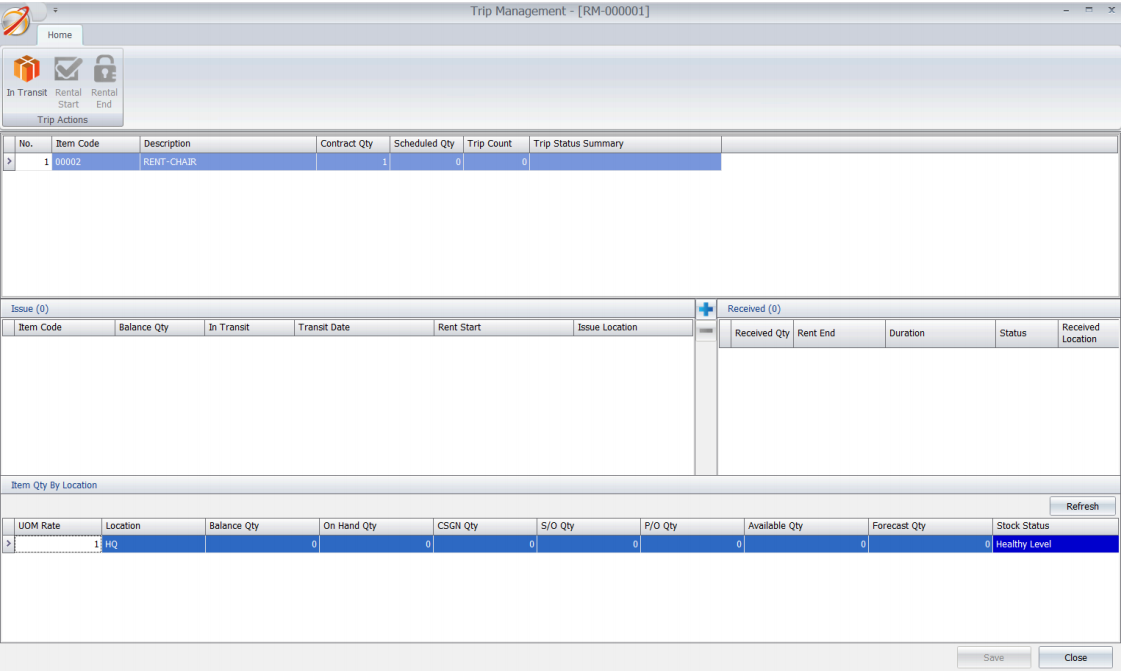
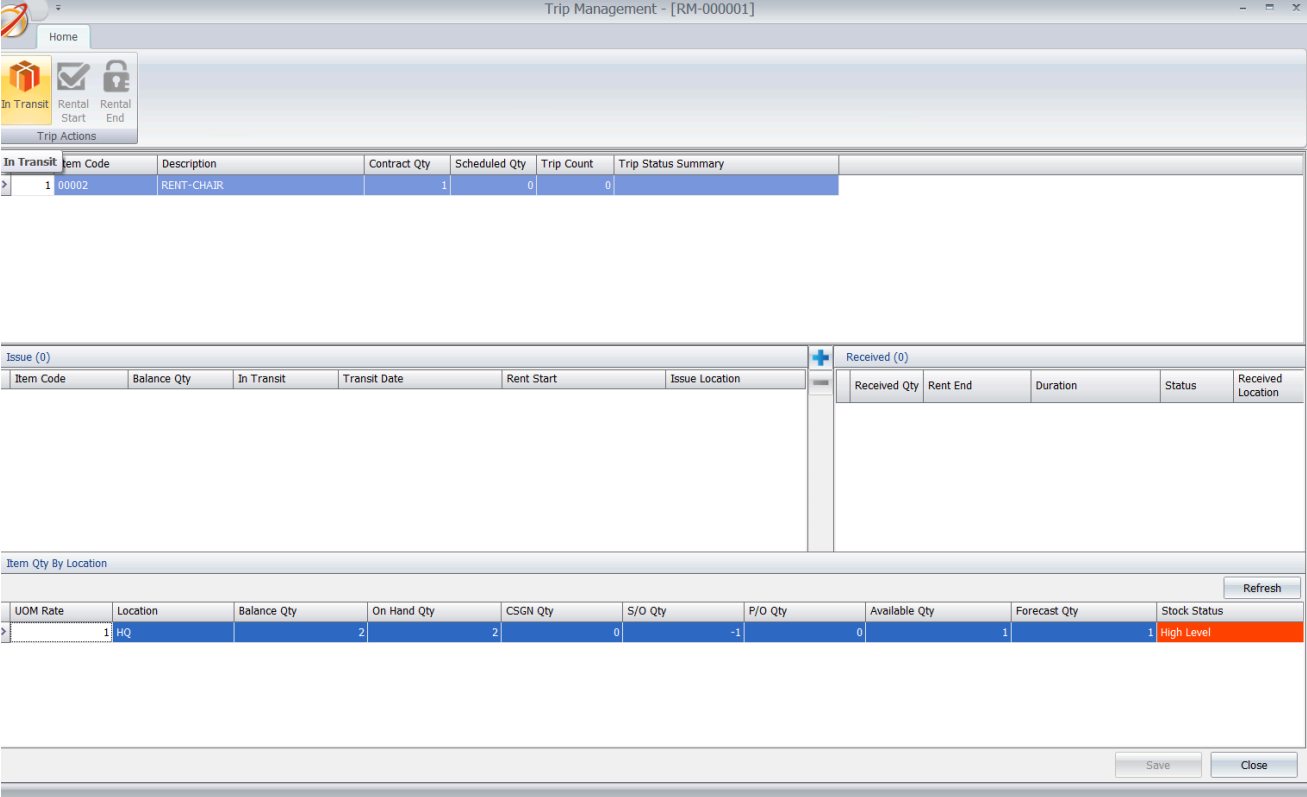
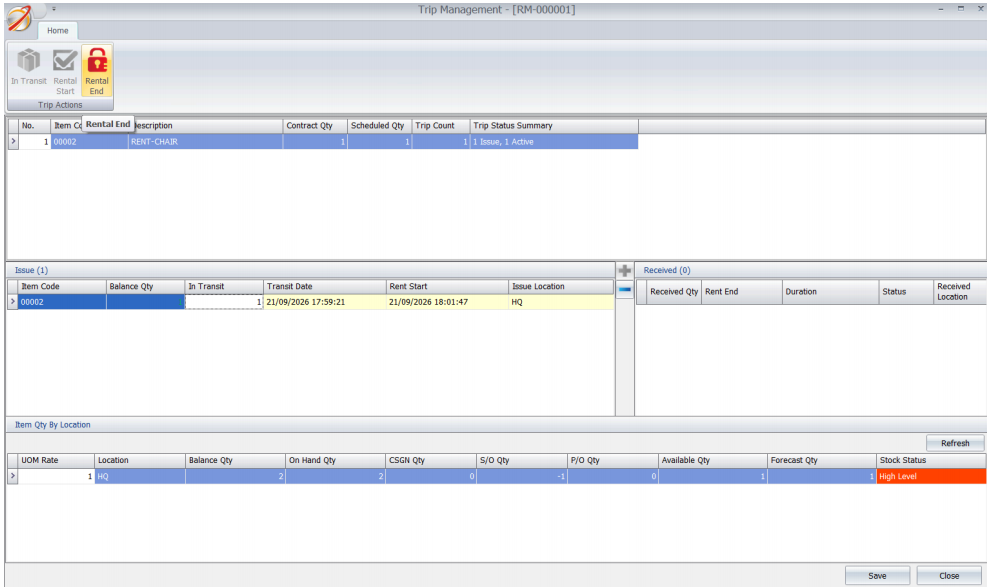
- Select a rental in Rental Maintenance and click Trip Management.

- Review contracted, scheduled, and trip quantities for each rental item.
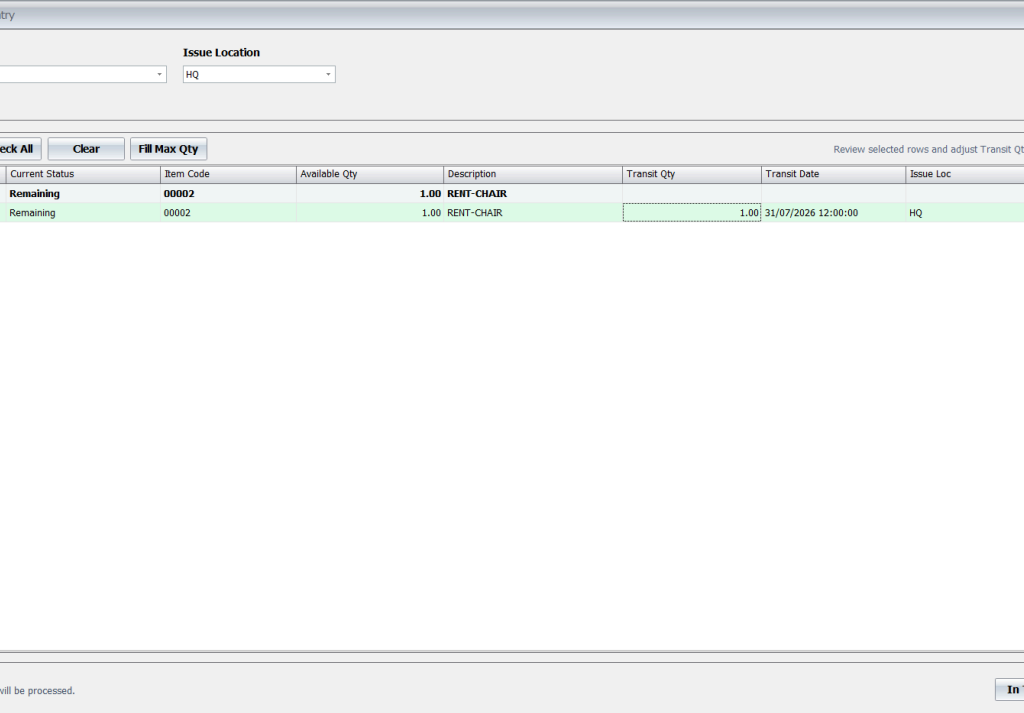
- Use Easy Entry when appropriate, then save the trip lines.
- Mark items In Transit when they leave the issue location.
- Mark Rental Start after the item is received and the rental period begins.
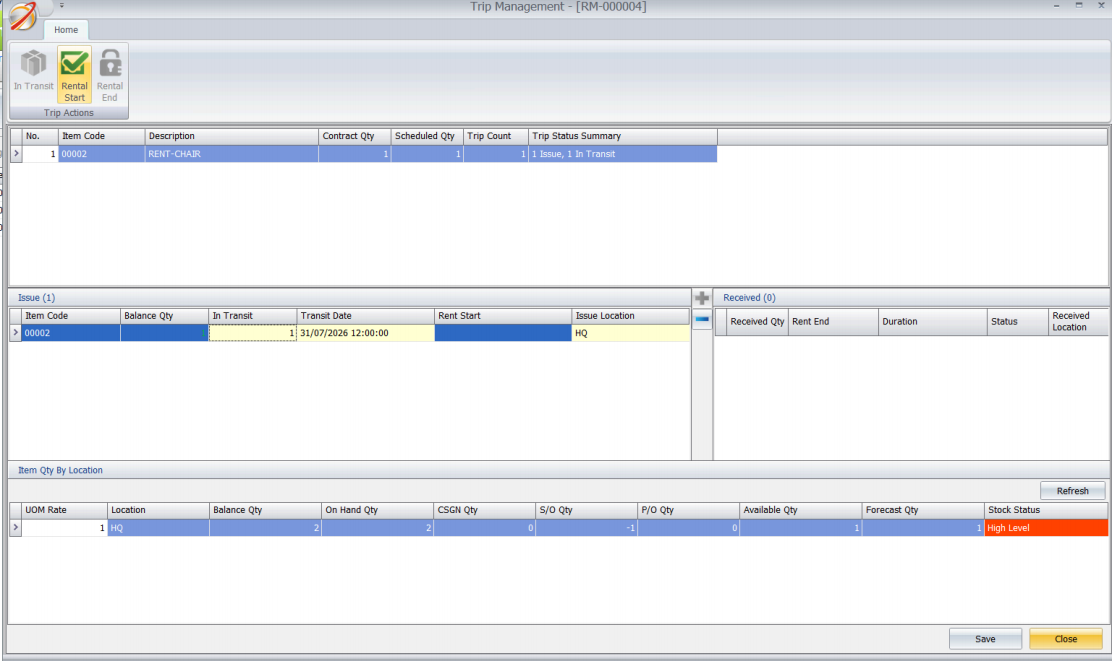
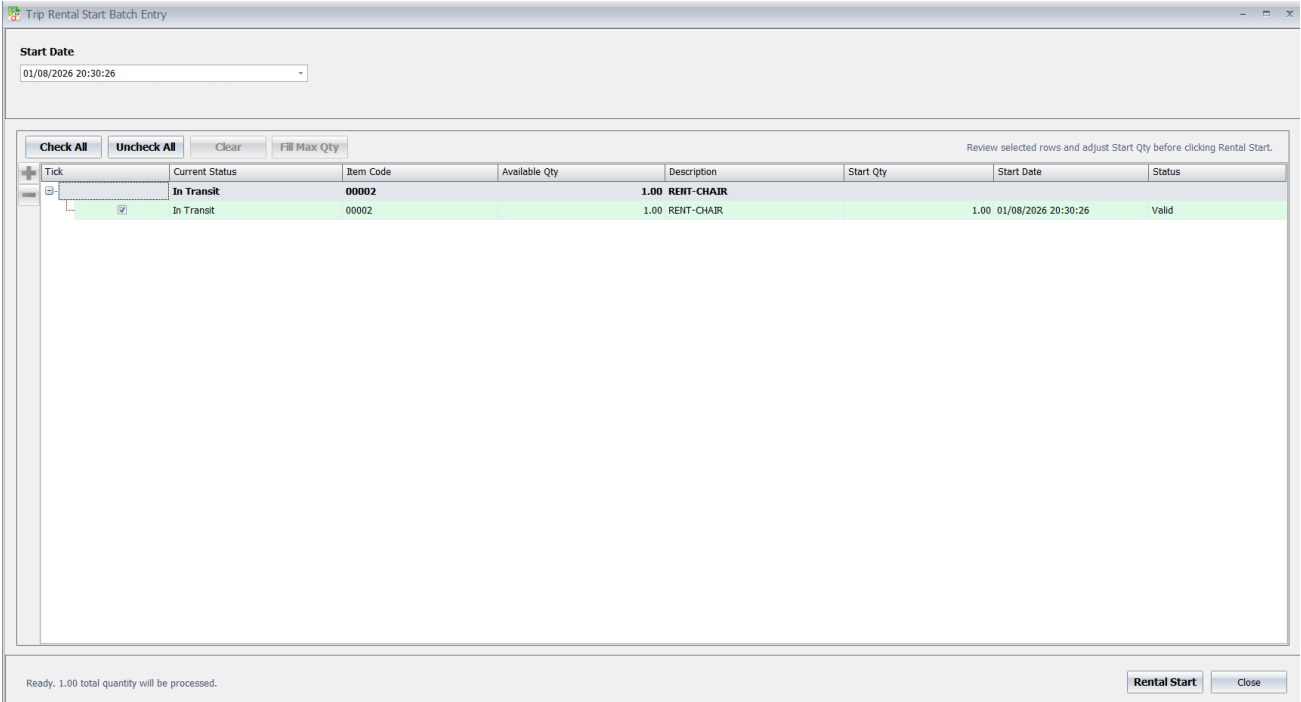
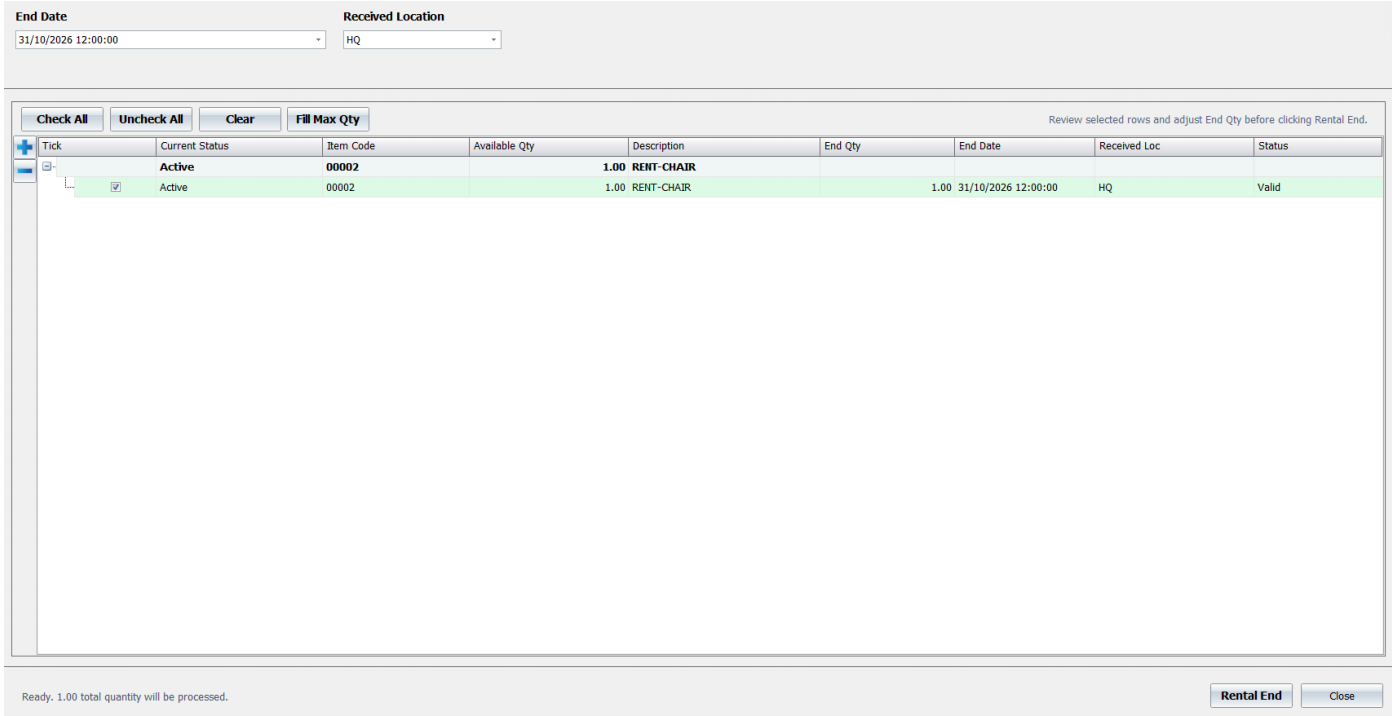
- Mark Rental End when the rental is closed and process the received quantities and return details.
F. Transfer Monthly Billing to Invoice
Transfer To Invoice generates invoices for the selected eligible rental billing periods and preserves a trace of billed periods.
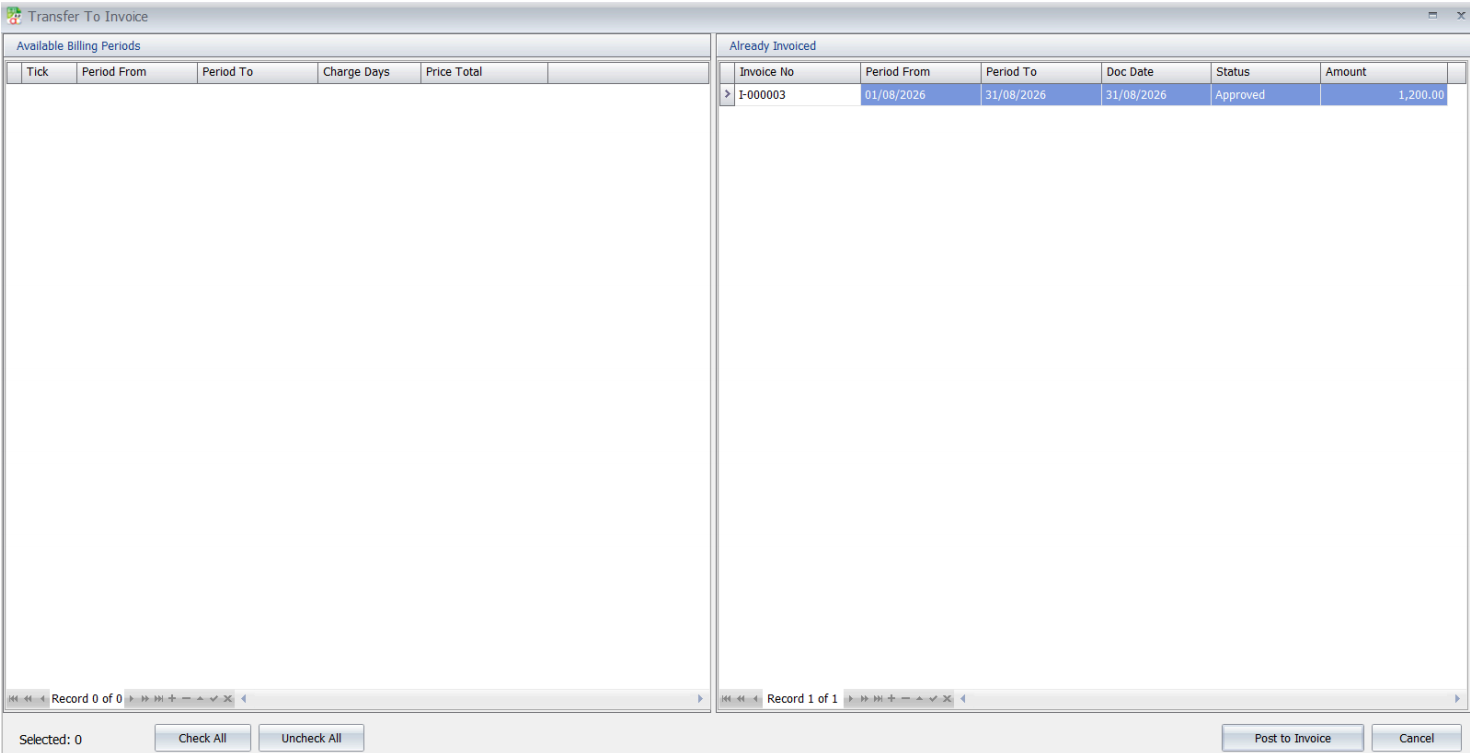
- Select the rental in Rental Maintenance and click Transfer to Invoice.

- Review Available Billing Periods, including Period From, Period To, Charge Days, and Price Total.
- Tick the periods to invoice. Use Check All or Uncheck All when appropriate.
- Review Already Invoiced to avoid duplicating a billed period.
- Return to Rental Maintenance and review the Transfer To display for the linked invoice records.
G. Monitor Calendar and Expiry Reminders
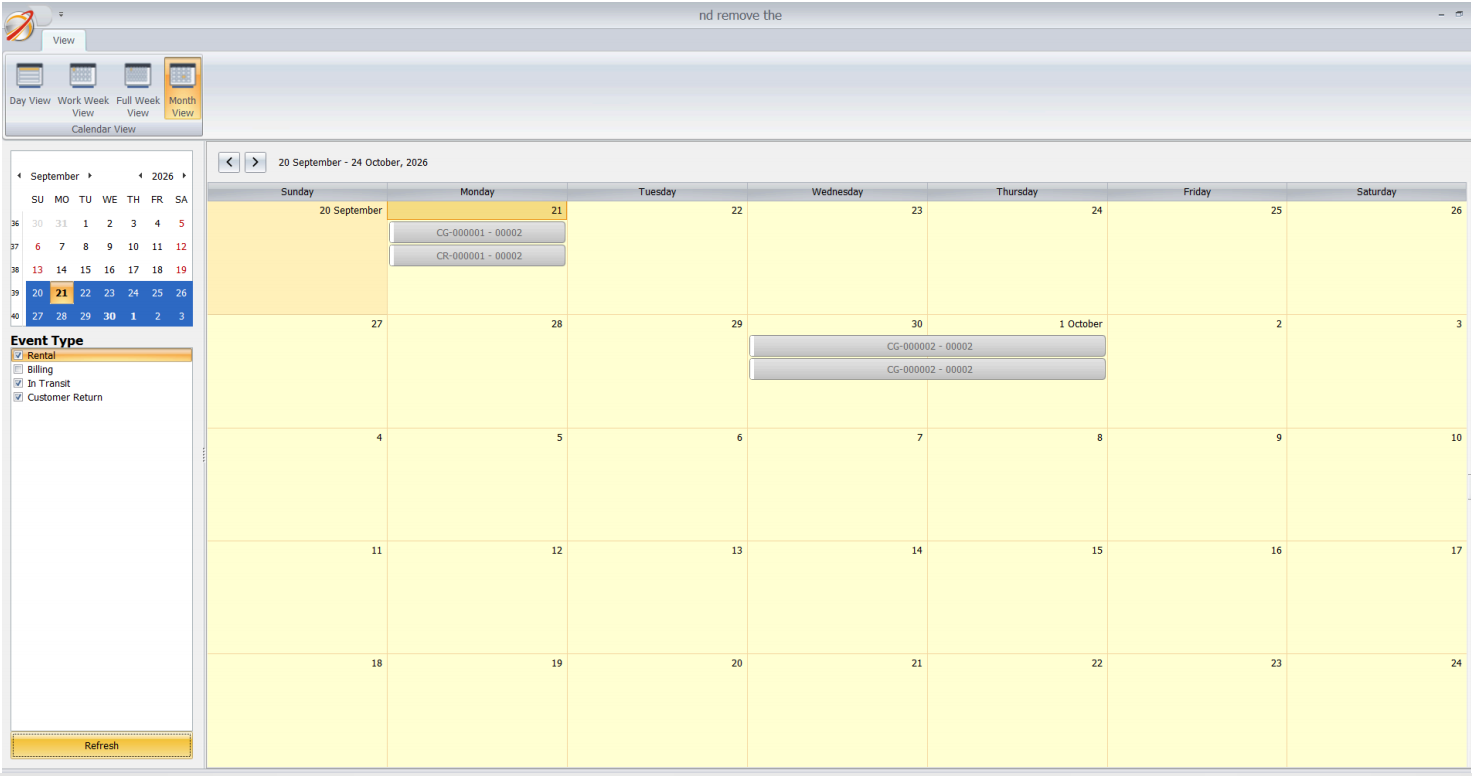
Rental Calendar and Rental Expiry Reminder help users monitor active, transit, and closed rentals and take action before expiry.
- Open Rental Management > Rental Calendar.
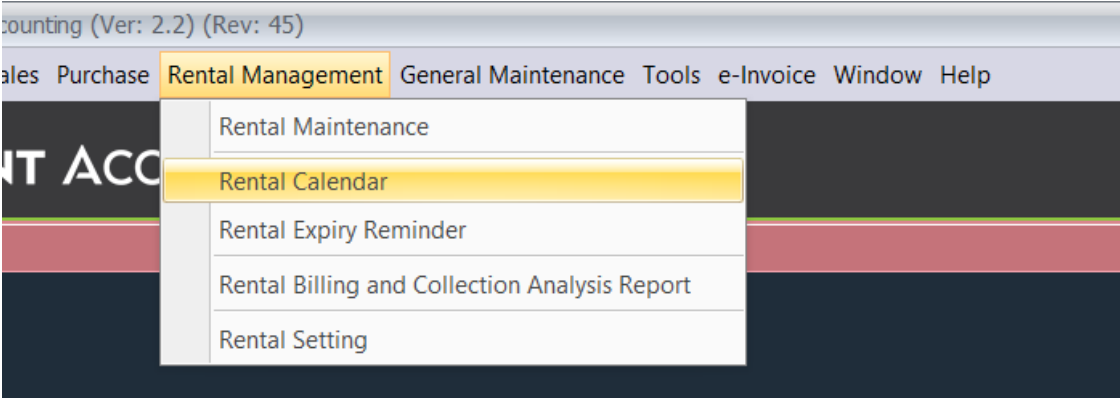
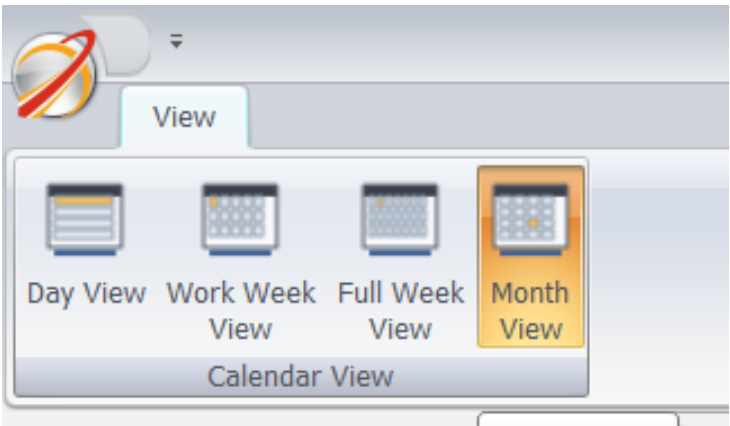
- Choose Day View, Work Week View, Full Week View, or Month View.
- Use the rental-status filter and Refresh to focus on the required rentals.
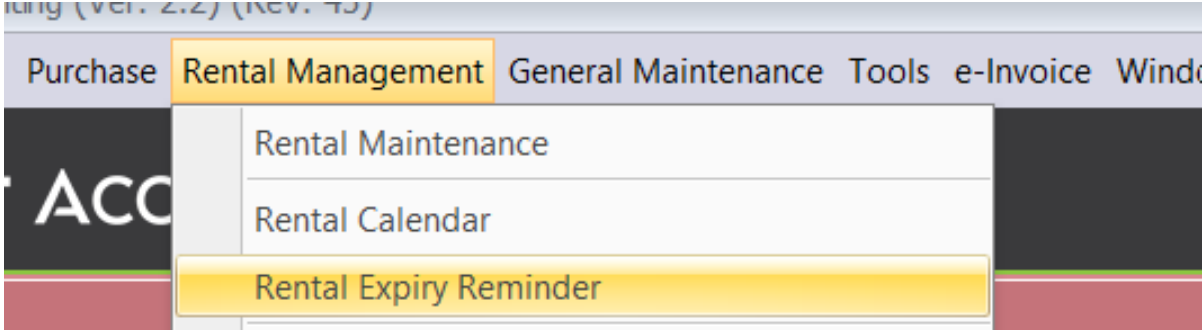
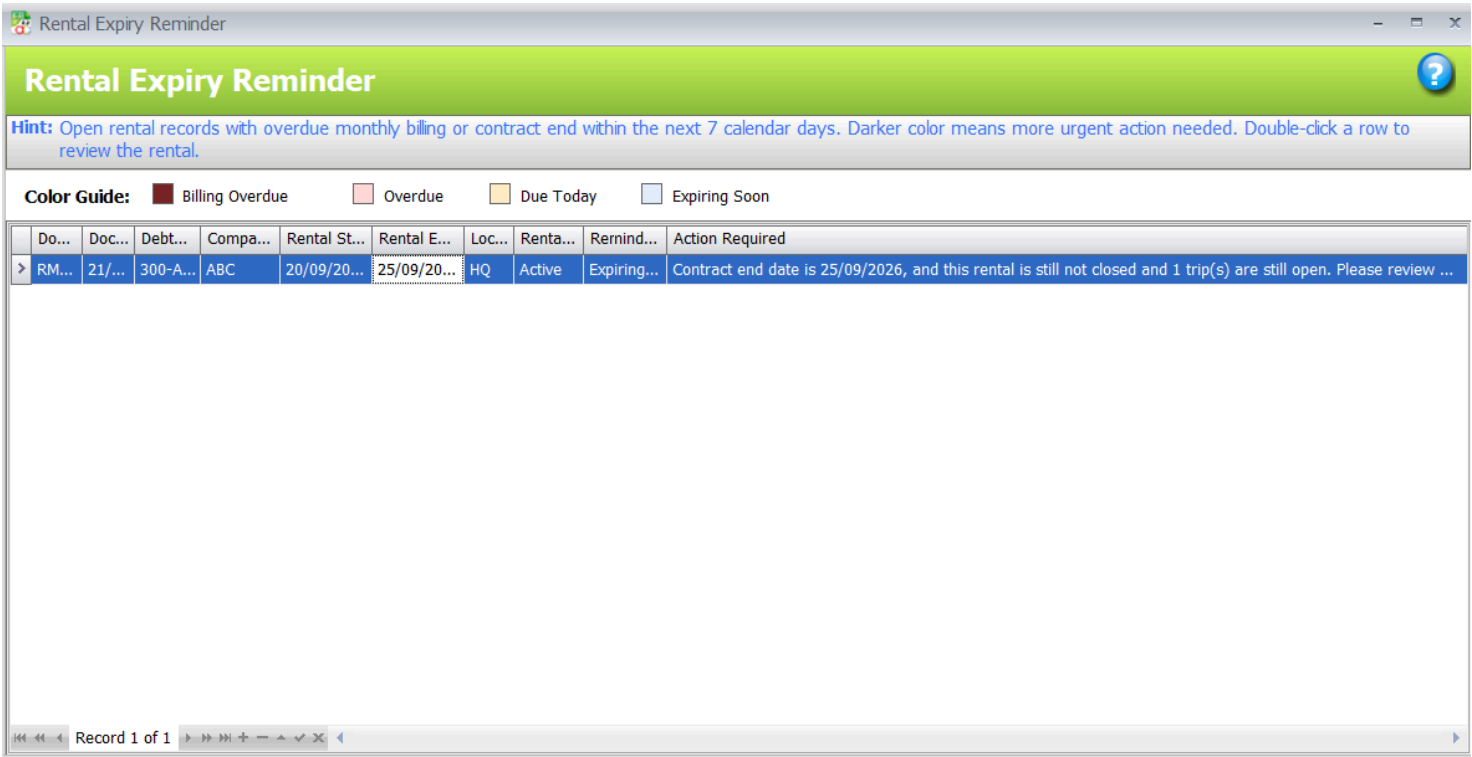
- Open Rental Expiry Reminder to review rentals nearing expiry, including document number, debtor, rental dates, location, status, reminder status, and action required.
- Use the colour guide to identify records that are expiring soon, due today, overdue, or need extension.
H. Print Rental Documents and Analyse Billing
Rental Management provides operational rental documents, listing reports, and a billing and collection analysis report for finance follow-up.
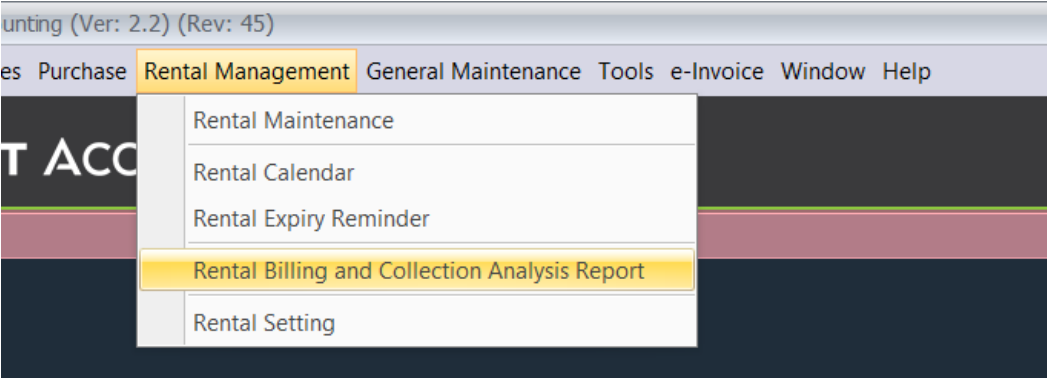
- Go to Rental Management > Rental Billing and Collection Analysis Report.
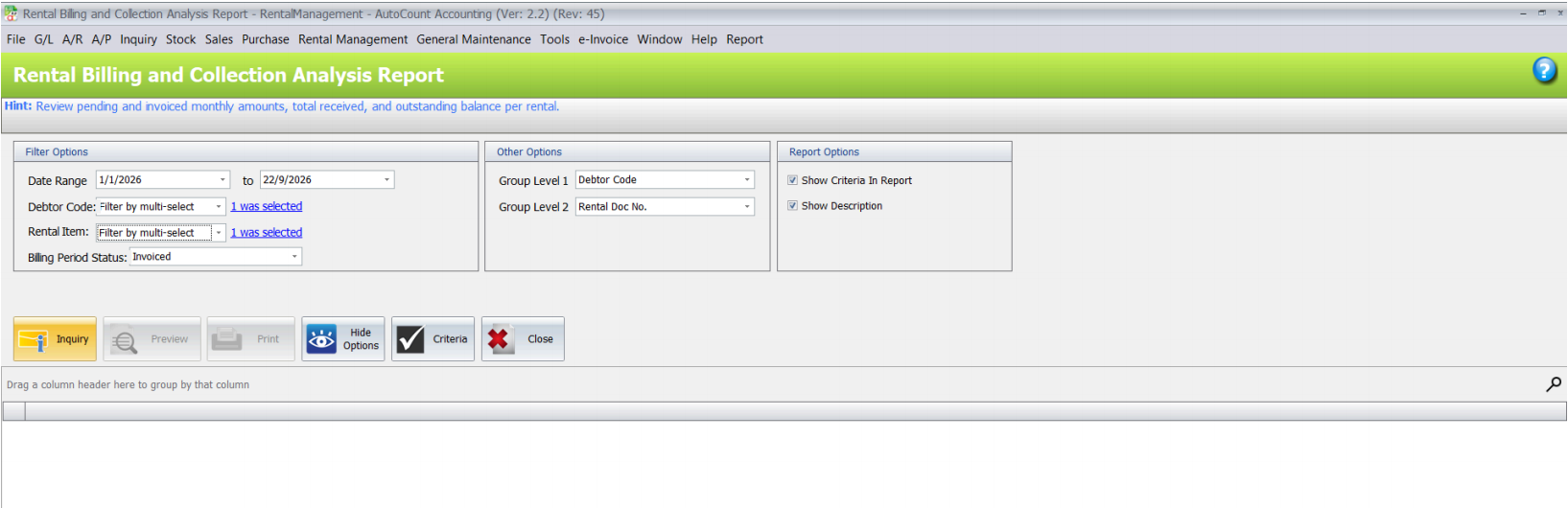
- Set the required criteria such as Billing Period Status, Date Range, Debtor Code, Rental Item, Grouping Options.
- Click Inquiry to generate the billing analysis result.
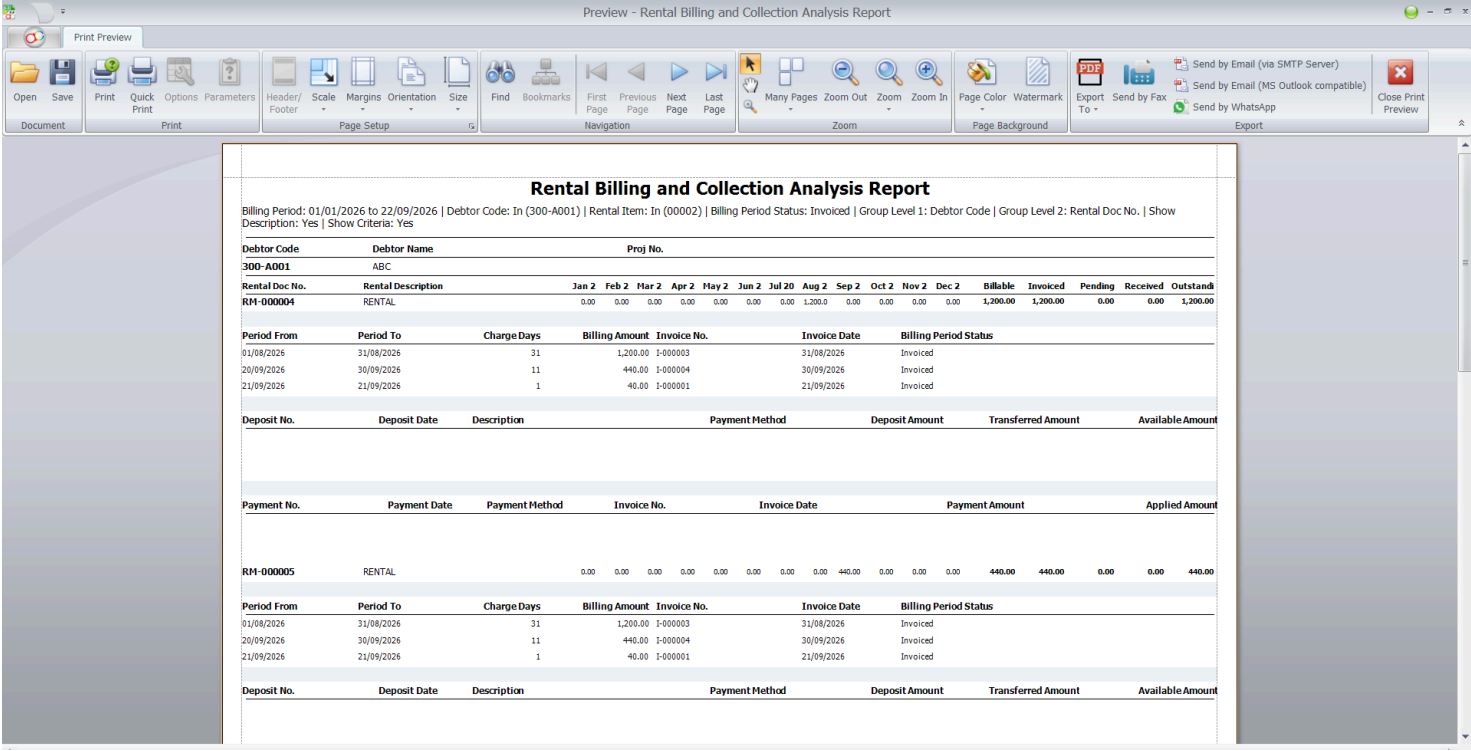
- Use Preview or Print to generate the billing analysis report when required.

Frequently Asked Questions
What does the Rental Management Plugin do?
It manages the complete rental workflow, including rental contracts, dispatch, returns, billing, expiry reminders, and rental reports.
How do I configure Rental Settings?
Open Rental Management > Rental Setting, configure billing methods, proration options, reminder days, calendar colors, and rental pricing, then save the settings.
How do I create a Rental Contract?
Open Rental Maintenance, create a new rental, enter debtor and rental details, add rental items and pricing, record deposit information if required, then save the rental contract.
Can I create a rental from a Sales Order?
Yes. The plugin allows users to transfer eligible Sales Orders into Rental Maintenance while keeping linked document references through Transfer From and View Flow.
How do I process dispatch and returns?
Use Trip Management to manage dispatch, mark items In Transit, start the rental when items are received, and complete the rental by recording returned quantities.
How do I monitor rental expiry?
Use Rental Calendar and Rental Expiry Reminder to track active rentals, upcoming expiries, overdue rentals, and extension requirements.
Simplify Your Rental Operations Today!
Manage your rental business more efficiently with the AutoCount Rental Management Plugin. Create rental contracts, track dispatch and returns, automate monthly billing, monitor rental status through calendars and reminders, and generate billing reports from one centralized solution.