
-
AutoCount Accounting Features
-
- Approval Workflow
- Audit Trail
- Auto Save in Draft Folder
- AutoCount Contra Account
- AutoCount Feature Stock Take
- AutoCount License Setting Guide
- Column Chooser
- Deposit Tracking & Management
- Documents Numbering Format
- Full Transfer and Partial Transfer
- Import Data to AutoCount Accounting Using Excel
- Informative Charts and Analytical Data
- Layout Customization
- Multi Pricing
- Sales and Services Tax
- Schedule Backup
- Search Lookup Edit
- View Documents Flow
- Show Remaining (3) Collapse
-
AutoCount Cloud Accounting
-
AutoCount E-Invoice
- AutoCount E-Invoicing Tutorial
- E-Invoice Guide and Preparation for AutoCount Users
- Employee Handbook Template for E-Invoicing
- How E-Invoice Works in AutoCount Accounting?
- How to Enable and Submit SVDP e-Invoices in AutoCount 2.0
- How to Use AutoCount Accounting for LHDN e-Invoice
- What is E-Invoicing?
-
AutoCount Payroll & HRMS
-
- Coming soon
-
- Coming soon
-
AutoCount Modules
-
- Activity Stream
- Advanced Financial Report
- Advanced Item
- Advanced Multi-UOM
- Advanced Quotation Module
- AutoCount Bonus Point Module User Guide
- AutoCount Scripting Module User Guide
- AutoCount Service Management Plugin User Guide
- AutoCount SST Hidden Functions
- AutoCount SST Submission - Service Tax
- Basic Multi-UOM
- Budget Module
- Consignment
- Filter By Salesman
- FOC Quantity
- Formula
- Item Batch
- Item Package
- Landing Cost
- Multi-Currency
- Multi-Dimensional Analysis
- Multi-Location
- Project Account
- Recurrence
- Remote Credit Control Module
- Stock Assembly
- User Defined Fields (UDF)
- Show Remaining (12) Collapse
-
AutoCount Plugins
-
- AutoCount Car Tint Film Plugin
- AutoCount Credit Memo Plugin User Guide
- AutoCount Easy Recurrence Plugin
- AutoCount Lock Price Plugin
- AutoCount Pick List Plugin User Guide
- AutoCount Production order
- AutoCount Progressive Billing
- Batch Update Unit Price Plugin
- DMS Import Plugin
- Fixed Assets Management
- Goldsmith
- TD Ordering Mobile Apps
- TD Stock Mobile Apps
- Universal Import Plugin
-
- AutoCount Advance Aging Format Plugin
- AutoCount Advance Deposit Plugin
- AutoCount Advanced Credit Term Plugin User Guide
- AutoCount Advanced Stock Assembly Plugin User Guide
- AutoCount Agent Validation Plugin User Guide
- AutoCount AutoBank Reconciliation Plugin User Guide
- AutoCount Barcode Generator Plugin User Guide
- AutoCount Batch Transfer SO DO Plugin
- AutoCount Bill Remark Plugin User Guide
- AutoCount Cage Management Plugin User Guide
- AutoCount Centralized Kitchen Management Plugin
- AutoCount Daily Collection Summary Plugin User Guide
- AutoCount Easy Batch Number Entry Plugin User Guide
- AutoCount Easy Deposit Plugin User Guide
- AutoCount Easy Knock Off Plugin
- AutoCount Easy Payment Plugin User Guide
- AutoCount Easy Photo 2.0 User Guide
- AutoCount Email & WhatsApp Plugin User Guide
- AutoCount Event Management System Plugin User Guide
- AutoCount Fruit Basket Plugin Guide
- AutoCount GridToExcel Plugin
- AutoCount Historical Outstanding DO Listing Plugin
- AutoCount IC Checker Plugin
- AutoCount Integrator Plugin
- AutoCount InterCompany Billing Plugin
- AutoCount Item Visibility Control Plugin User Guide
- AutoCount Migrator Plugin
- AutoCount MRP Order Plugin
- AutoCount Multi Company Knock Off Plugin
- AutoCount Optical Plugin
- AutoCount Pain Tracker Plugin User Guide
- AutoCount Payment Request Plugin
- AutoCount Procurement Planning Plugin User Guide
- AutoCount Project Department Visibility Control Plugin
- AutoCount Recurrence Late Interest Plugin
- AutoCount Recurring Invoice Plugin User Guide
- AutoCount Referral Management Plugin User Guide
- AutoCount Rental Management
- AutoCount RMA Plugin
- AutoCount Sales Commission Plugin
- AutoCount Scale Barcode Plugin User Guide
- AutoCount Service Contract Plugin User Guide
- AutoCount Shipment Plugin User Guide
- AutoCount Smart Analysis Plugin User Guide
- AutoCount Stock Availability Report Plugin
- AutoCount Timber Log Plugin User Guide
- AutoCount To-Do List Plugin User Guide
- AutoCount Tour Plugin User Guide
- AutoCount Vege Basket Plugin User Guide
- AutoCount Vehicle Master Plugin User Guide
- AutoCount Vehicle Plugin
- AutoCount Warranty 2.0 Plugin User Guide
- Batch Transfer SODO Plugin
- Intercompany Billing Plugin User Guide
- Lead Management 2.0 Plugin
- SL AutoCount API
- AutoCount Smart Dashboard Plugin User Guide
- Show Remaining (42) Collapse
-
-
Form Template
-
Report Template
-
- Advance Quotation
- Cash Sale
- Consignment
- Consignment Movement
- Credit Note
- Debit Note
- Delivery Order
- FOC Quantity Analysis By Document Report
- Invoice
- Item Package Sales Report
- Monthly Sales Analysis
- Outstanding Sales Order Listing
- Profit And Loss Of Documents
- Quotation
- Sales Agent Contribution Report
- Sales Order
- Top/Bottom Sales Ranking
- Show Remaining (2) Collapse
-
- Available Stock Status Report
- Expired Item Batch Listing
- Inventory Physical Worksheet
- Stock Adjustment
- Stock Aging Report
- Stock Assembly
- Stock Assembly Order
- Stock Balance By Location
- Stock Balance Report
- Stock Card Report
- Stock Disassembly
- Stock Issue
- Stock Item Profit Margin
- Stock Movement Report
- Stock Receive
- Stock Take
- Stock Transfer
- Stock Write Off
- Show Remaining (3) Collapse
-
B2B ORDERING
-
AutoCount AI Agent
-
AutoCount FAQ & Troubleshooting
- How to Add New User ID in AutoCount Accounting (Step-by-Step Guide)
- How to Add or Edit Company Header in AutoCount
- How to Add the Account Number Column in AutoCount
- How to Adjust Decimal Places in AutoCount
- How to Change Default Document Numbering Format for OR and PV in AutoCount
- How to Disable e-Invoice in AutoCount
- How to Switch to Default Workspace in AutoCount
- How to Turn Off Smart App Control in Windows 11 for AutoCount
-
AutoCount F&B
-
- How to Accept or Reject QR Orders in AutoCount F&B POS
- How to Connect AutoCount POS Backend to QR Ordering Using an API Key
- How to Create a Restaurant in AutoCount QR Ordering Backend
- How to Customize AutoCount QR Ordering Customer View and Operating Hours
- How to Print and Test AutoCount F&B Table QR Codes
- How to Publish Menu Items to AutoCount F&B QR Ordering
- How to Set Up AutoCount F&B QR Ordering: Complete Guide
- How to Set Up Table QR Codes in AutoCount F&B
-
-
AutoCount Unicart Integration
- How Customer, Supplier and Order Field Mapping Works
- How Does a SiteGiant iSKU Map to an AutoCount Item Code?
- How Does the System Check Duplicate iSKU Mapping?
- How Is the Stock Sync Quantity Calculated?
- How Shipping, Discounts, Vouchers and Marketplace Charges Post to AutoCount?
- How Should a New AutoCount Item and SiteGiant iSKU Be Created?
- How SiteGiant Members and Bonus Points Sync with AutoCount POS
- How SiteGiant Orders Sync to AutoCount: Manual or Automatic
- How SiteGiant Purchase Flow Posts to AutoCount GRN
- How to Auto Sync AutoCount Price & Cost to SiteGiant Inventory
- How to Choose the Stock Master in SiteGiant and AutoCount
- How to Connect SiteGiant ERP to AutoCount and Confirm the Connection
- How to Handle Cancelled, Returned or Refunded Online Orders?
- How to Handle Fulfilled by Shopee Stock in AutoCount
- How to Handle SiteGiant Bundle / KIT Items
- How to Map Different UOMs for the Same Item?
- How to Reconcile Marketplace Settlements Using Bulk Knock Off
- How to Set the Posting Rules for Each Sales Channel
- How to Sync Stock from AutoCount to SiteGiant: Manual or Automatic
- Show Remaining (4) Collapse
AutoCount Recurring Invoice Plugin User Guide
Learn how to generate multiple Sales Invoices from one existing invoice template in AutoCount Accounting. This guide covers debtor selection, invoice dates, the Generate Invoice action and checking the saved invoices.
Important: This is a manual invoice-generation tool, not an automatic date-based scheduler.
In this guide
Before you begin
This AutoCount Recurring Invoice Plugin user guide explains how to generate multiple Sales Invoices from an existing invoice template, select active debtors, choose an invoice date and review the saved invoices.
Source: Recurring Invoice Plugin user guide, prepared by SL Software Solutions Sdn Bhd. The steps follow the supplied manual. Screen availability may depend on your installed plugin and assigned permissions.
- Open the correct AutoCount account book with the Recurring Invoice Plugin available.
- Prepare an existing Sales Invoice containing the item details, quantities and prices to reuse.
- Check that the intended debtors are active, and prepare the required Date For Invoice.
- For training, use a test account book. Before generating multiple invoices in a live account book, review the template and debtor selection and keep an appropriate backup.
Save the invoices: After choosing the debtors, click Generate Invoice. The plugin creates and saves one new Sales Invoice for each selected debtor using AutoCount standard invoice numbering.
1. Generate Multiple Sales Invoices
Follow the steps below whenever you need to issue a new set of Sales Invoices to selected debtors.
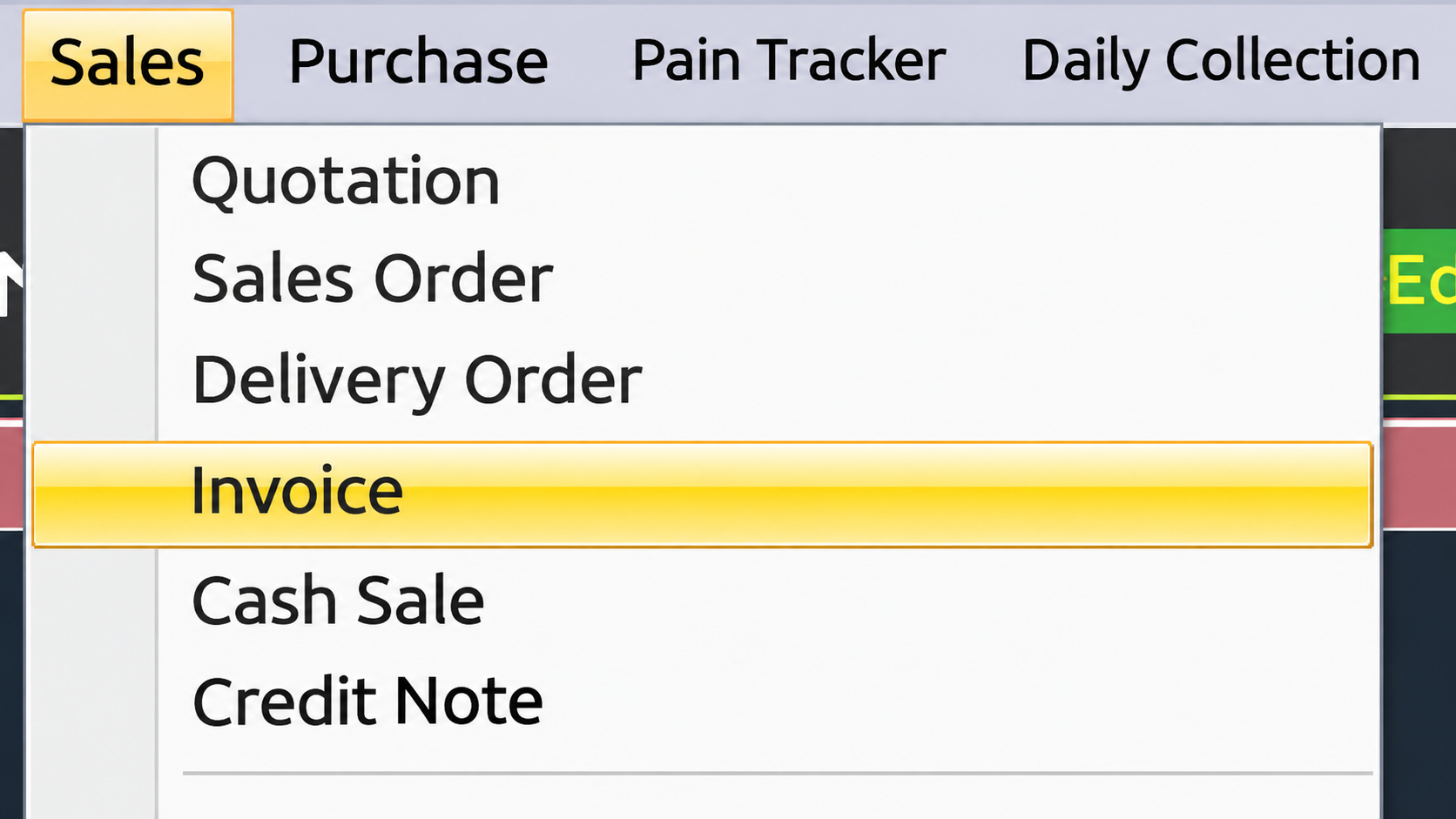
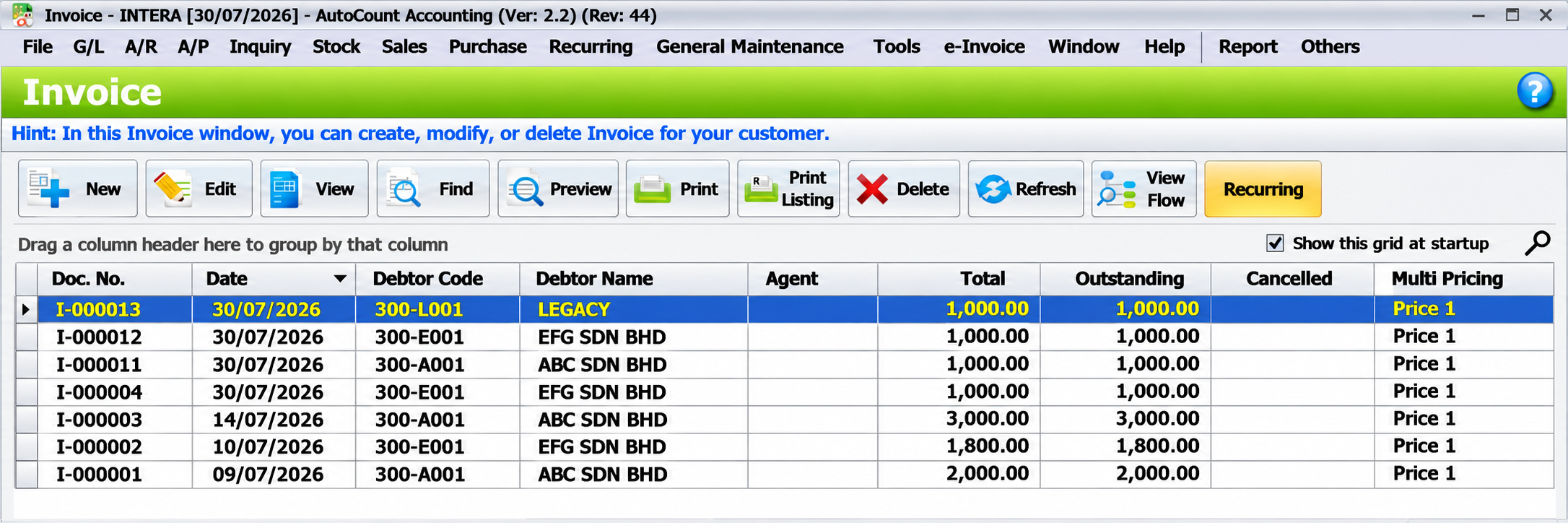
1. Go to the Sales > Invoice.
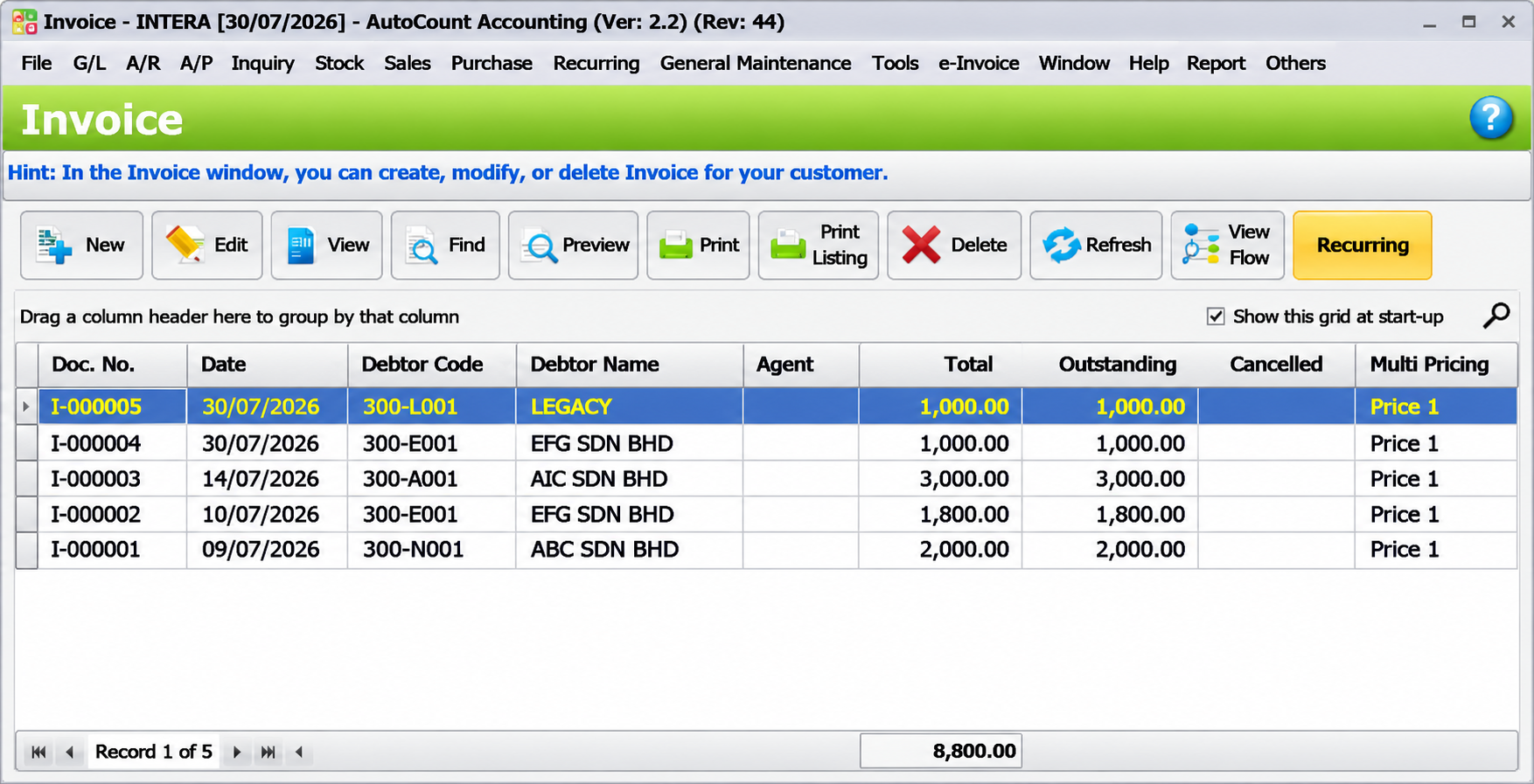
2. Select an existing Sales Invoice to use as the template. Click Recurring.
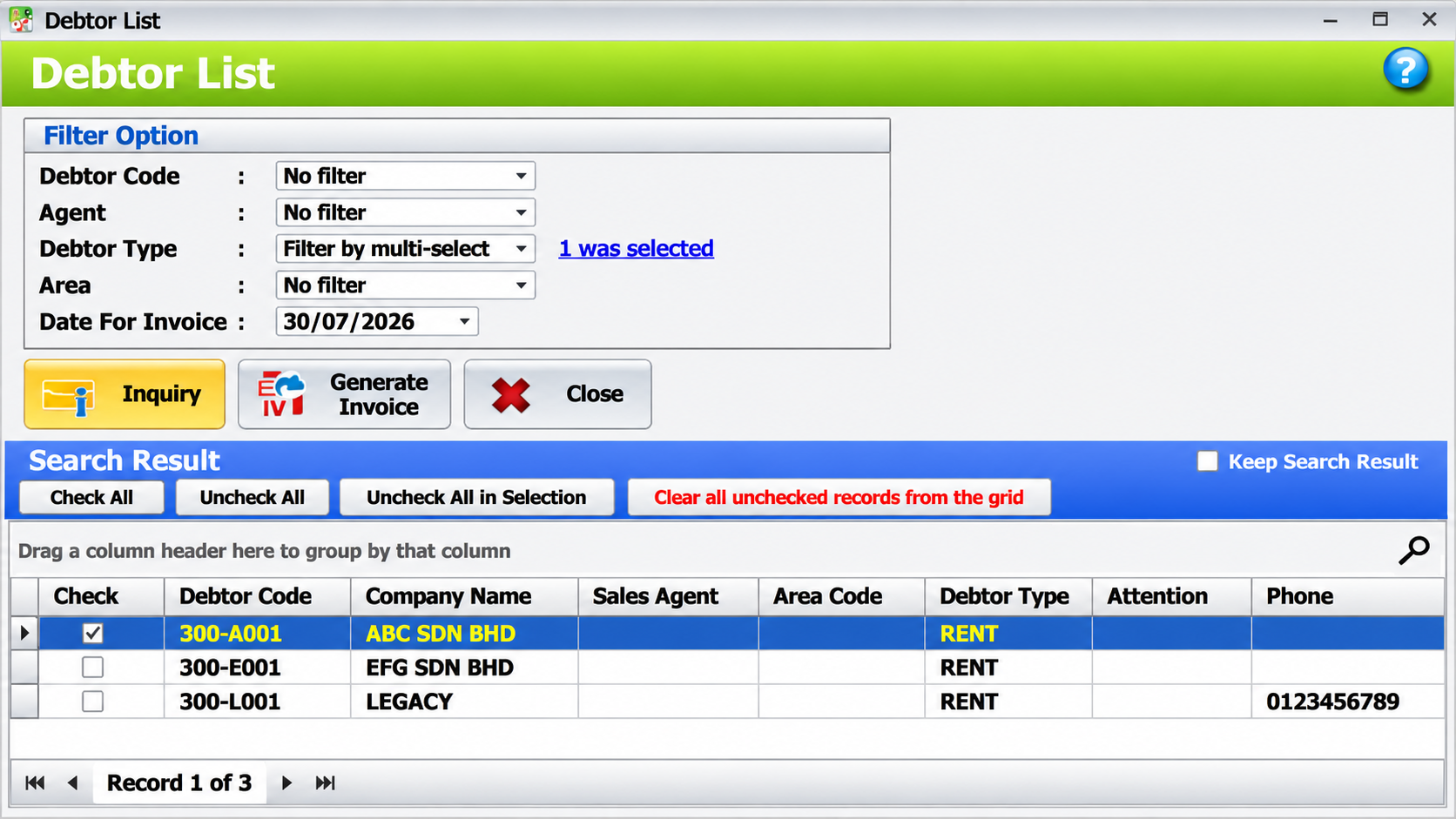
3. Filter the active debtors by Debtor Code, Agent, Debtor Type, or Area, if required. Choose the Date For Invoice. Click Inquiry then select one or more debtors.
4. Click Generate Invoice.
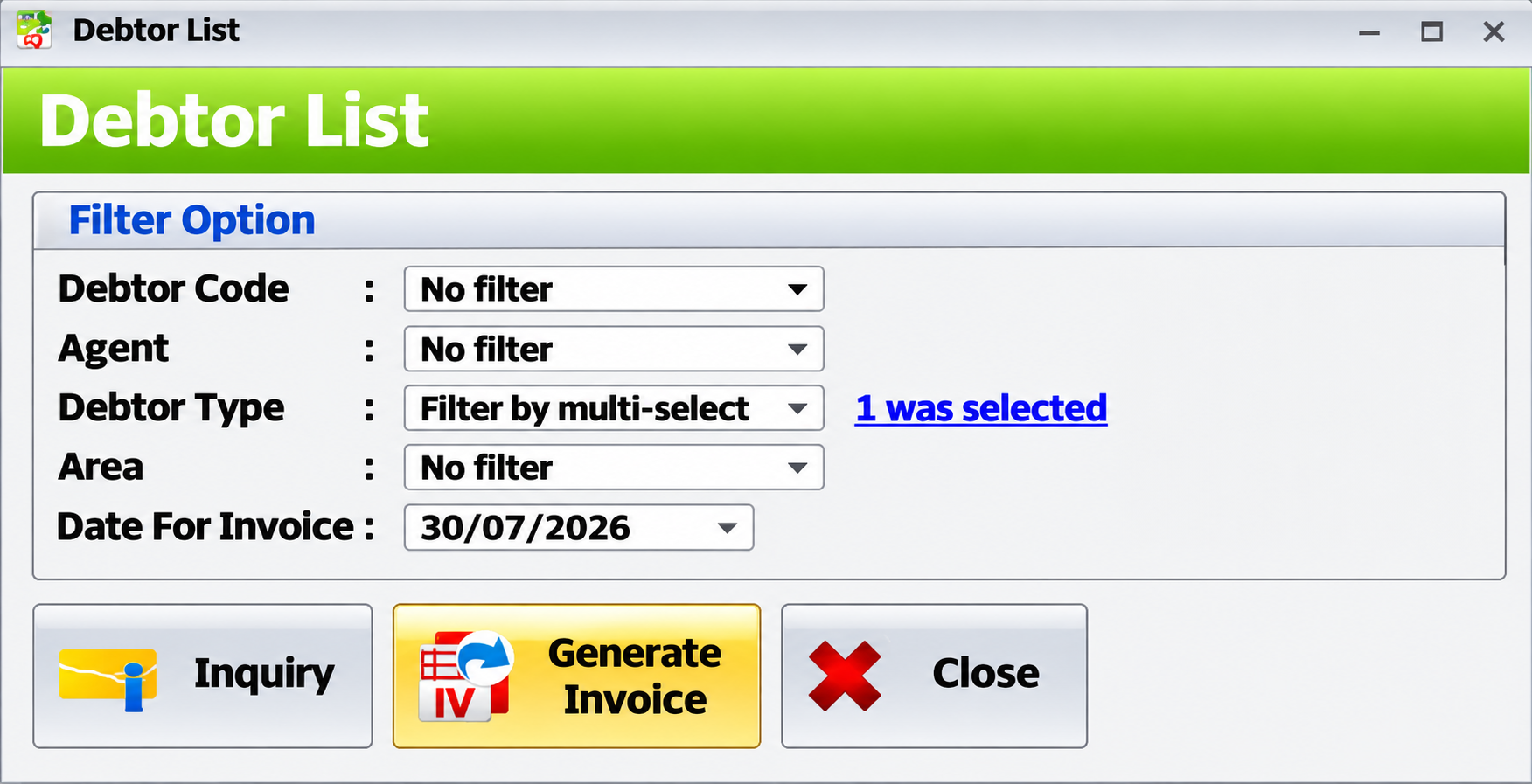
5. The plugin creates and saves one new Sales Invoice for each selected debtor. The new invoices use AutoCount’s standard invoice numbering.
6. Review the generated Sales Invoices.
Information Copied to New Invoices
From the selected template invoice, the plugin copies item details, quantities, UOM, prices, discounts, descriptions, remarks, display term, currency, exchange rate and note.
Each generated invoice uses the selected debtor’s account and sales agent.
Important Notes
Manual operation: The Recurring Invoice Plugin is not an automatic date-based scheduler. Select the template invoice and generate each new batch manually whenever required.
Review before generating: New Sales Invoices are created and saved, so carefully check the template, invoice date and customer selection first.
Troubleshooting: checks before contacting support
These checks follow the documented Recurring Invoice workflow. If an issue remains unresolved, check your installed plugin and account book with your administrator or support team.
- Recurring button is missing: confirm the Recurring Invoice Plugin is available in the correct AutoCount account book, and check access with your administrator.
- A debtor does not appear: confirm the debtor is active. Review the Debtor Code, Agent, Debtor Type and Area filters, then click Inquiry again.
- The debtor list contains unexpected customers: adjust your filters and repeat Inquiry. Check the selected debtors before generating invoices.
- The invoice date is incorrect: check Date For Invoice before clicking Generate Invoice.
- Invoice details are unexpected: inspect the original template Sales Invoice, including items, quantities, prices, discounts and other copied information.
- Generated invoices cannot be found: review Sales > Invoice using the selected date and debtor. Check for existing generated invoices before running the process again to avoid duplicates.
Frequently asked questions
Does the Recurring Invoice Plugin generate invoices automatically every month?
No. This plugin is not a date-based scheduler. Select an existing Sales Invoice, choose the debtors, then manually click Generate Invoice whenever needed.
Can I generate invoices for several debtors at the same time?
Yes. Open the Recurring function from the Invoice listing, filter active debtors if needed, run Inquiry and select one or more debtors before clicking Generate Invoice.
Can I filter the debtors before generating Sales Invoices?
Yes. Available filters include Debtor Code, Agent, Debtor Type and Area. Choose Date For Invoice, click Inquiry and select the required debtors.
Will each new Sales Invoice receive its own document number?
Yes. The plugin creates and saves one Sales Invoice for each selected debtor using AutoCount’s standard invoice numbering.
Will all new invoices use the same debtor as the template?
No. Each new invoice uses the selected debtor’s account and sales agent.
Which invoice details are copied from the existing template?
The plugin copies item details, quantities, UOM, prices, discounts, descriptions, remarks, display term, currency, exchange rate and note. Review the new Sales Invoices after generation.
Recurring Invoice Video Guides
These existing video tutorials are retained for additional visual reference. Where older videos differ, follow the workflow documented above.
Related resources and technical support
Continue exploring AutoCount or get assistance with the steps in this guide.
Explore Recurring Invoice Plugin
Review the features and business workflows supported by AutoCount Recurring Invoice Plugin.
Browse the Knowledge Base
Find practical instructions for other AutoCount functions, modules and plugins.
TECHNICAL SUPPORT
Need help with Recurring Invoice Plugin?
Send the details below so our team can understand the issue and review the relevant workflow.
Have these details ready
- AutoCount and Recurring Invoice Plugin versions
- Sales Invoice or Debtor List screen being used
- Relevant invoice number (if available)
- Exact error message
Before sharing a screenshot: hide customer names, contact details and other personal or confidential information.